Introduction: How to Make Brand Tracking Surveys Relevant in 2026
Brand tracking surveys are recurring research studies designed to measure how a brand is performing over time. Unlike one-off market research projects, which answer a specific question at a particular moment, a tracker creates continuity. It allows marketers to see whether awareness, consideration, usage, brand associations and Mental Availability are strengthening, weakening or remaining stable.
A well-designed tracker helps senior marketers separate temporary noise from meaningful movement and identify where action is required.
The problem is that many traditional trackers have become too long, too slow and too detached from commercial decisions. Brand teams can sit through presentations filled with metrics yet remain unclear about what the results mean or what should happen next.
This is where Mental Availability becomes important. Byron Sharp and Jenni Romaniuk have helped shift attention away from awareness and attitudes alone towards whether a brand is easy to think of in real buying situations. A modern Brand Tracking Survey should therefore assess not only whether people know or like the brand, but whether they can retrieve it when relevant Category Entry Points occur.
What Is a Brand Tracking Survey (and How Is It Evolving)?
A Brand Tracking Survey is a recurring, structured study that monitors a stable set of brand health metrics over time.
The same questions are asked at regular intervals using comparable samples, allowing marketers to identify trends rather than isolated scores. Depending on the category, the tracker may run monthly, quarterly, twice yearly or annually.
Historically, many trackers were large, infrequent studies built around long questionnaires. They often measured dozens of image statements, extensive funnel metrics and multiple segment cuts. This produced a great deal of data, but not always clarity.
Modern Brand Tracking Surveys are evolving in three ways.
First, the emphasis is on a smaller set of measures that explain whether the brand is becoming easier to recall, easier to choose and more commercially effective.
Second, they are becoming faster. Digital fieldwork, automated dashboards and more regular reporting allow teams to see movement sooner and respond while the evidence is still relevant.
Third, and most importantly, they are becoming more decision-led. The tracker is expected to support questions such as:
- Is the brand growing Mental Availability?
- Are campaigns building the intended associations?
- Which Category Entry Points should be defended, strengthened or explored?
- Are Distinctive Brand Assets becoming more recognisable?
- Is brand investment translating into commercial progress?
This shift does not require organisations to abandon all historic metrics. The best approach is to preserve the most useful existing measures while adding Mental Availability and Category Entry Point diagnostics alongside them.
What to Measure: Applying the Principles of ‘Better Brand Health’
Jenni Romaniuk’s Better Brand Health provides an alternative and more robust approach compared to how many trackers have traditionally been designed.
The central principle is that brand health should be assessed in the context of the category and its buyers, rather than from the perspective of the client brand alone. A tracker should therefore help marketers understand how buyers retrieve competing brands, which buying situations matter and where relative strengths and weaknesses exist.
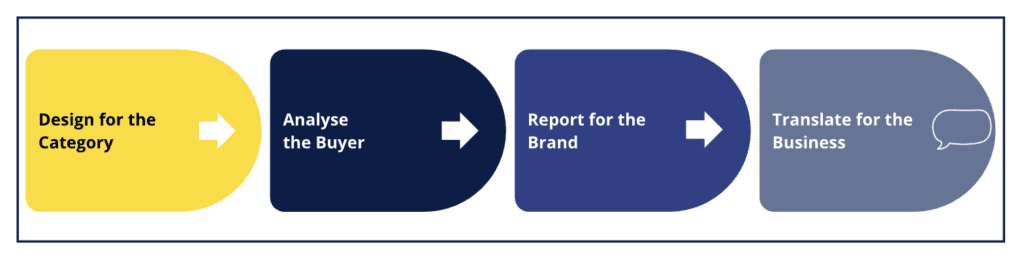
The Brand Tracking Principles summarised in the Brand Health Tracking pillar page are:
- Design for the category.
- Analyse the buyer.
- Report the brand.
At SmilingCFO, we have added a fourth principle;
- Translate the findings for the business.
A practical interpretation of this approach is to devote the greatest attention to Category Entry Points, supported by relevant attributes and a smaller number of attitudinal measures. Romaniuk suggests a balance of approximately 60% CEPs, 30% other attributes and 10% attitudes.
That does not mean every tracker must follow an exact numerical formula. It means the centre of gravity should move towards category buying situations and brand retrieval rather than overloading the survey with abstract attitudes.
Design for the Category
The brand tracker should begin by defining the category correctly and representing the competitive landscape.
This requires clarity on:
- who counts as a category buyer;
- which brands and solutions buyers realistically consider;
- whether adjacent categories should be included;
- which buying situations account for demand;
- how the category may be evolving.
A brand tracker designed too narrowly may miss emerging competitors or new sources of demand. One designed too broadly may dilute the findings and make the results difficult to act upon.
Analyse Buyers and Non-Buyers
A modern Brand Tracking Survey should distinguish between current buyers, lapsed buyers, competitor buyers and non-buyers of the brand.
Existing buyers will usually have richer memory structures because they have more experience with the brand. Non-buyers reveal whether the brand is building future demand beyond its current customer base.
This is particularly important because growth depends on reaching more category buyers, not simply increasing attachment among a small group of loyal customers.
The tracker should therefore assess whether buyers and non-buyers can connect the brand to relevant Category Entry Points and whether those associations are growing over time.
Measure Awareness, But Don’t Stop There
The limitation of tracking awareness is that it does not reveal whether the brand is retrieved when the buying need occurs. A brand may be widely known but absent from consideration in specific situations. Prompted Awareness is a useful metric. It indicates whether the brand is associated with the correct category.
Category Entry Points and Mental Availability
Category Entry Points are the needs, occasions and situations that prompt buyers to enter the category and retrieve brands from memory.
They can be personal, such as “when I need a pick-me-up”, or situational, such as “when I stop at a petrol station for a quick snack”. They connect the buying situation with brands held in memory.
The core Mental Availability metrics are:
- Mental Penetration: the percentage of category buyers who can link the brand to at least one CEP.
- Network Size: the average number of CEP links among people with knowledge of the brand.
- Mental Market Share: the brand’s share of all brand-to-CEP memory links in the category.
- Mental Advantage and Disadvantage: whether the brand performs above or below expectation on specific CEPs.
- Buyer and non-buyer links: whether memory structures are extending beyond the current customer base.
These measures expose risks that conventional tracking may miss. Awareness and favourability can remain stable while a competitor becomes easier to retrieve across more buying situations.
Consideration and Usage
Consideration helps track whether buyers would include the brand among the options they might choose.
Usage and penetration show whether the brand is reaching more category buyers. These are commercially important because declining penetration may signal a deeper issue than a temporary movement in share.
However, consideration should be interpreted alongside Category Entry Point associations. A general score may appear healthy even while the brand is losing relevance in high-value buying situations.
Brand Attributes and Positioning
A focused set of brand attributes should assess whether the intended positioning is becoming established in buyer memory.
Avoid long lists of generic statements such as “trusted”, “innovative” and “good quality” unless they have a clear strategic role.
Prioritise attributes that:
- link directly to the positioning;
- matter in category choice;
- can be influenced through marketing and experience;
- can be compared meaningfully with competitors;
- provide evidence for the brand promise.
Loyalty, Satisfaction and NPS
Repeat purchase, satisfaction and Net Promoter Score can provide useful insight into the customer experience.
These measures are particularly relevant in service and subscription categories. They can indicate whether buyers are likely to continue using the brand or recommend it.
Their limitation is that they mostly describe the experience of people already connected with the brand. They do not reveal whether enough new buyers are thinking of it.
A tracker should therefore only use satisfaction and loyalty as supporting measures rather than allowing them to dominate the scorecard.
From Measurement to Action: The SmilingCFO Mental Availability Assessment
Adding CEPs to a tracker is valuable, but brands first need to identify which CEPs should be measured.
This is where a SmilingCFO Mental Availability Assessment provides the foundation.
The process identifies the Category Entry Points most likely to be used by buyers in the moments that matter, then assesses the brand’s opportunities relative to competitors.
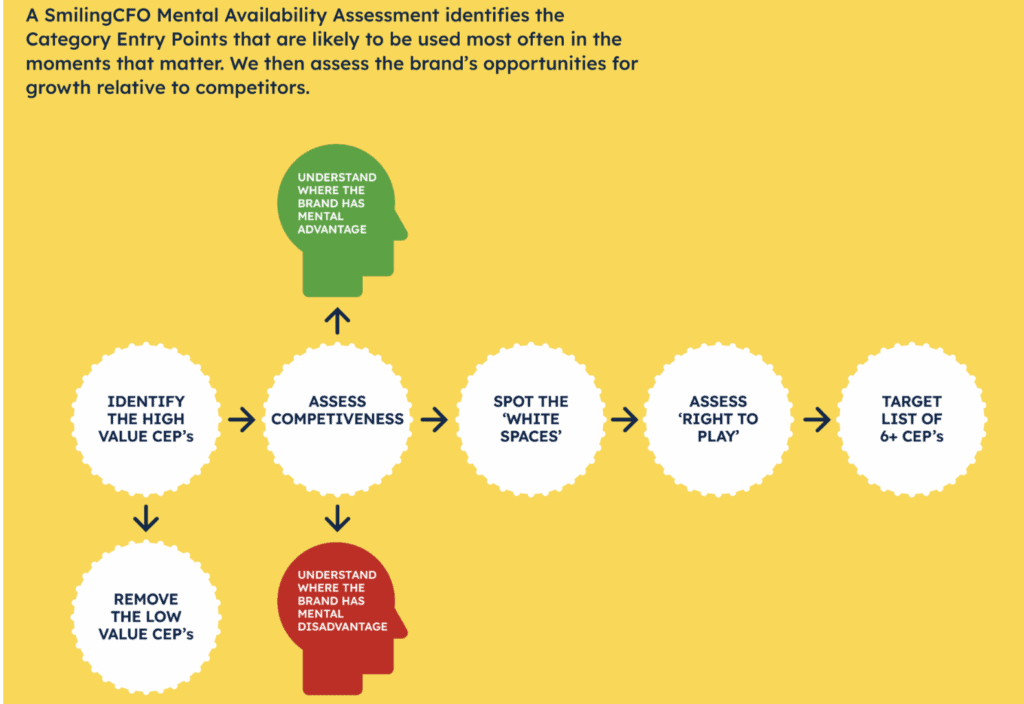
1. Identify the High-Value Category Entry Points
The first stage is to identify the CEPs most frequently used by category buyers.
This prevents the tracker from including a long, unprioritised list of possible buying situations. The focus is placed on the contexts with the greatest potential commercial value.
Low-value CEPs can then be removed from the tracker.
2. Assess Competitiveness
Some valuable CEPs may already be highly competitive, with several large brands holding strong associations. Others may contain fewer competitors and offer more achievable room for growth.
SmilingCFO assesses:
- where the brand has Mental Advantage;
- where it has Mental Disadvantage;
- which competitors are strongest;
- whether the brand is underperforming relative to its size.
3. Spot the White Spaces
White spaces are buying situations where no brand holds a strong Mental Advantage.
These may offer opportunities for a brand to build an association, provided the situation is relevant, credible and commercially worthwhile.
The objective is not to chase every opportunity. It is to identify where buyer demand and brand permission overlap.
4. Assess the Brand’s Right to Play
A brand needs credibility in the buying situation it wants to target.
The assessment considers whether the current brand image, product, experience and assets support the proposed association.
A theoretically attractive CEP may be a poor investment if the brand lacks the ability or permission to deliver against it.
5. Create a Focused CEP Target List
The process produces a focused target list, typically containing six or more priority CEPs.
These can then be integrated into the Brand Tracking Survey so progress is measured consistently over time.
The tracker can show:
- which existing strengths should be defended;
- which associations need strengthening;
- which white spaces offer credible room for growth;
- which CEPs should receive less investment;
- whether campaigns are building the intended memory structures.
This gives the tracker a direct strategic purpose.
Instead of asking only whether awareness or consideration moved, the organisation can see whether marketing is increasing the brand’s probability of being recalled in the situations that drive demand.
Design a Brand Tracking Survey That Senior Marketers Will Actually Use
The best Brand Tracking Survey is not the longest or most statistically elaborate. It is the one that helps senior marketers make better decisions.
Start With Clear Objectives
Before writing questions, define the decisions the tracker must support.
For example:
- Are we building Mental Availability?
- Are campaigns strengthening priority CEPs?
- Is the positioning becoming more strongly associated with the brand?
- Are competitors gaining advantage?
- Are Distinctive Brand Assets being correctly attributed?
- Are we growing memory among non-buyers?
Every question should contribute to one of these objectives.
Keep the Survey Concise
A concise questionnaire may include:
- category screening;
- prompted awareness;
- consideration and usage;
- priority CEP associations;
- a small number of positioning attributes;
- limited Distinctive Brand Asset measures;
- satisfaction or NPS where relevant.
Not everything needs to be measured in every wave. Distinctive Brand Assets, for example, may only require annual reassessment.
Preserve Comparability
Question wording, sample definitions and fieldwork methods should remain stable.
Frequent changes make trends difficult to interpret. Where new Mental Availability measures are added, they can be introduced alongside existing metrics to preserve continuity.
Frequency, Governance and Turning Tracking Data into Action
Quarterly tracking is appropriate for fast-moving categories and active communications programmes. Semi-annual tracking may be sufficient in more stable markets.
Some organisations may benefit from two speeds:
- a broad category tracker once or twice a year to assess long-term Mental Availability;
- lighter campaign studies during the year to assess whether specific activity is building intended associations.
This reflects the ‘two-speed’ plan advocated by Mark Ritson, which is his interpretation of ‘The Long and The Short’ by Binet & Field.
Turn Every Wave Into a Learning Loop
Each review should answer five questions:
- What has changed?
- Is the movement statistically and commercially credible?
- What is the most plausible explanation?
- What should we do differently?
- Who owns the action, and when will it be reviewed?
The SmilingCFO process gives these discussions a sharper focus.
If the brand tracker shows that a priority CEP is strengthening, the brand may decide to scale the activity. If a high-value association is weakening, creative and media investment may need to be adjusted. If a white space remains unclaimed, the organisation can decide whether to test it.
The tracker therefore becomes a continuing cycle:
Assess → Prioritise → Activate → Track → Learn → Refine

Connect the Tracker With Commercial Evidence
Brand Tracking Survey results should be reviewed alongside:
- sales and market share;
- penetration;
- distribution;
- pricing and promotions;
- media investment;
- campaign response;
- customer experience;
- competitor activity.
This helps distinguish between memory problems and issues relating to availability, price or execution.
Conclusion
Brand Tracking Surveys remain one of the most useful tools available to senior marketers, provided they are designed around the category, its buyers and the decisions the organisation needs to make.
The principles in Better Brand Health provide a clear direction. Design for the category. Analyse buyers and non-buyers. Measure the brand in the context of competitors.
And remember to ensure the findings can be translated into business action.
Brand Tracking needs to be seen as an evidence-led management system, that is to say it guides creative development, media investment, brand strategy and sustainable growth.
Further Reading:
Brand Health: How to Enhance Your Brand Health Tracking Without Losing Continuity
Brand Health Tracking:Building Evidence For Mental Availability and Brand Growth