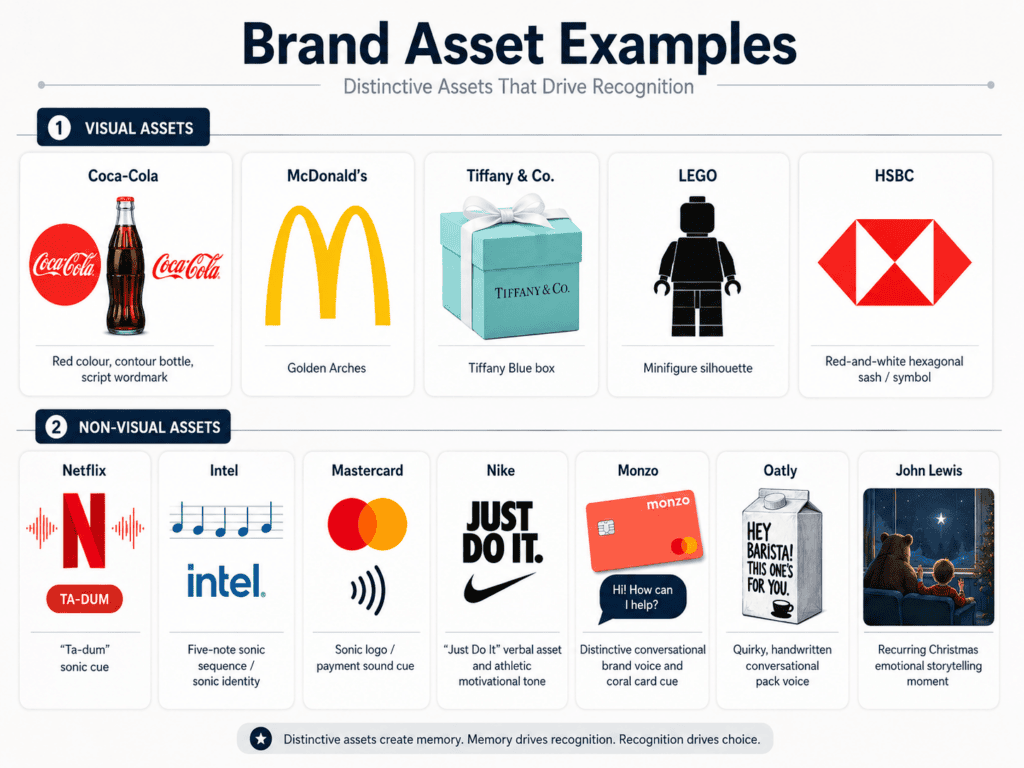
Brand consistency is a memory-building discipline.
Consistent application of Distinctive Brand Assets (DBAs) directly improves the chances of correct brand attribution. When those assets are repeatedly presented alongside relevant buying situations, they help strengthen the memory retrieval pathways that underpin Mental Availability.
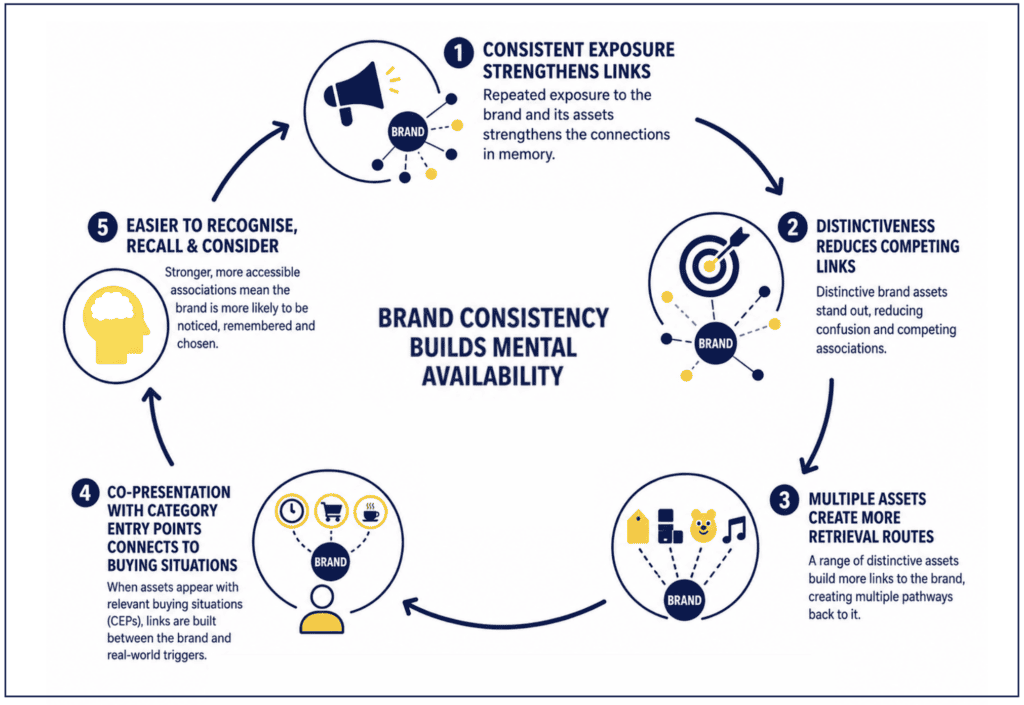
As Professor Jenni Romaniuk explains in her brilliant book Building Distinctive Brand Assets, DBAs are the non-name elements of the brand that make up the brand’s identity and trigger the brand into the memory of category buyers. Examples of assets include, colour, logo, character, pack shape, sonic device or a tagline.
The science behind the importance of brand consistency can be rooted back to Associative Network Theory, which describes memory as a network of nodes connected by associative links. The brand’s name might form one node and the DBA’s, advertising, product experiences and relevant buying situations form others. Consistent exposure strengthens the network of associations back to the brand.
In a previous article, ‘Distinctive Brand Assets: A Practical Guide for CMOs’ I outlined the following recommendations;
i) Identify the 4 or 5 assets with the greatest potential. Measure them properly for Fame and Uniqueness.
ii) Build a 2–3 year playbook for how they will be used. Apply them relentlessly. Resist unnecessary change.
iii) Track Mental Availability as the output, not just asset recognition as the input.
Speaking at Cannes Lions 2026, Byron Sharp’s typically forthright view was; “Marketers know that consistency is important, they just lack the discipline to implement it.” This may or may not be true for some, but in this article I want to focus on the importance of consistency, incorporating industry evidence, academic research and my own experience.
Why Consistent Brand Assets Drive Recognition and Mental Availability
The Magic of Compound Creativity, produced by System1 and the IPA examined more than 4,000 advertisements from 56 brands, spanning 44 categories, five years and approximately £3.3 billion of television investment. It found that the brands judged most consistent achieved an average System1 Star Rating of 3.3, compared with 2.6 among the least consistent brands. The most consistent brands also generated 27% more positive brand effects and 28% more positive business effects.
The report defined consistency more broadly than applying the same set of brand assets. They grouped 13 characteristics into three headings;
- Creative foundations: a stable positioning, an enduring creative idea and a long-term agency relationship.
- A culture of consistency: allowing work to wear in, connecting executions across channels and reusing established assets.
- Consistent execution: recurring assets, e.g. slogans, characters, celebrities and music.
Consistency does not mean repeating an undistinctive execution indefinitely. Established brand assets can remain stable while stories, settings, characters and Category Entry Points messaging provide variation.
Positive Brand Consistency Examples: Assets Used Well Over Time
The strongest brand consistency examples preserve a small set of recognisable cues while allowing the story, setting and cultural expression to evolve. Their consistency lies in the recognition system rather than in producing identical advertising.
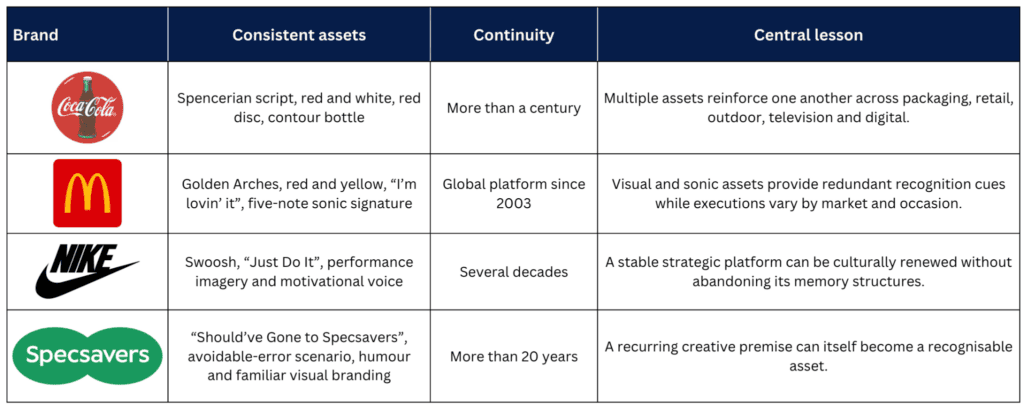
Specsavers: A Creative Idea That Became an Asset
Specsavers has used “Should’ve Gone to Specsavers” and the recurring consequence of an avoidable visual mistake for more than two decades.
An IPA effectiveness case covering approximately 30 years of advertising attributes £1.1 billion of incremental profit to the broader combination of sustained investment, broad reach, humour, familiar assets and the enduring creative platform. The total should not be credited to the line alone, but it demonstrates how consistency can compound across strategy, media and execution.
Learning: a recurring situation or narrative device can become as recognisable as a logo when it is distinctive, repeatedly branded and protected over time.
The Cost of Weak or Poor Brand Consistency
In 2021, Bahlsen, a leading German biscuit brand, decided to redesign their packaging due to long-term declines. Despite the new design winning the prestigious D&AD award, penetration, unit sales and market share continued to decline. As Lucas Wentzel, LinkedIn reminds us;
“…even when a redesign is beautifully executed, it can still weaken recognition or shelf memory if too much brand equity is removed”
Fast forward to 2025 and another change, explained by Alexander Kühnen, CEO of Bahlsen:
“We conducted extensive research into the needs of our consumers across key markets such as Germany, Italy and the UK. The new design and refreshed positioning directly respond to their desire for indulgence, clearer product structure, and the reintroduction of Bahlsen Blue as a distinctive brand marker.”
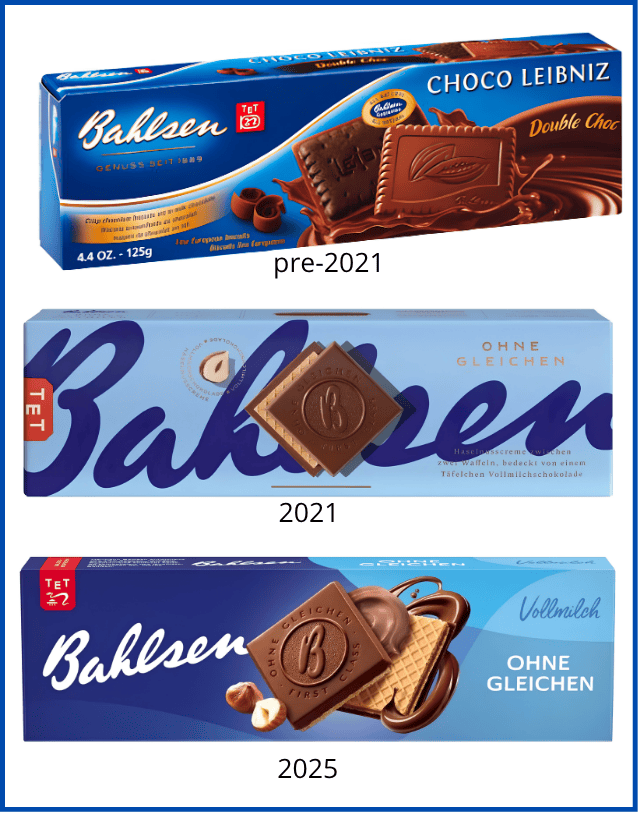
Learning: This case highlights the difference between design appreciation and brand recognition. A pack can be modern, attractive and award-winning while still making the brand harder to identify.
How can research help avoid redesign mistakes?
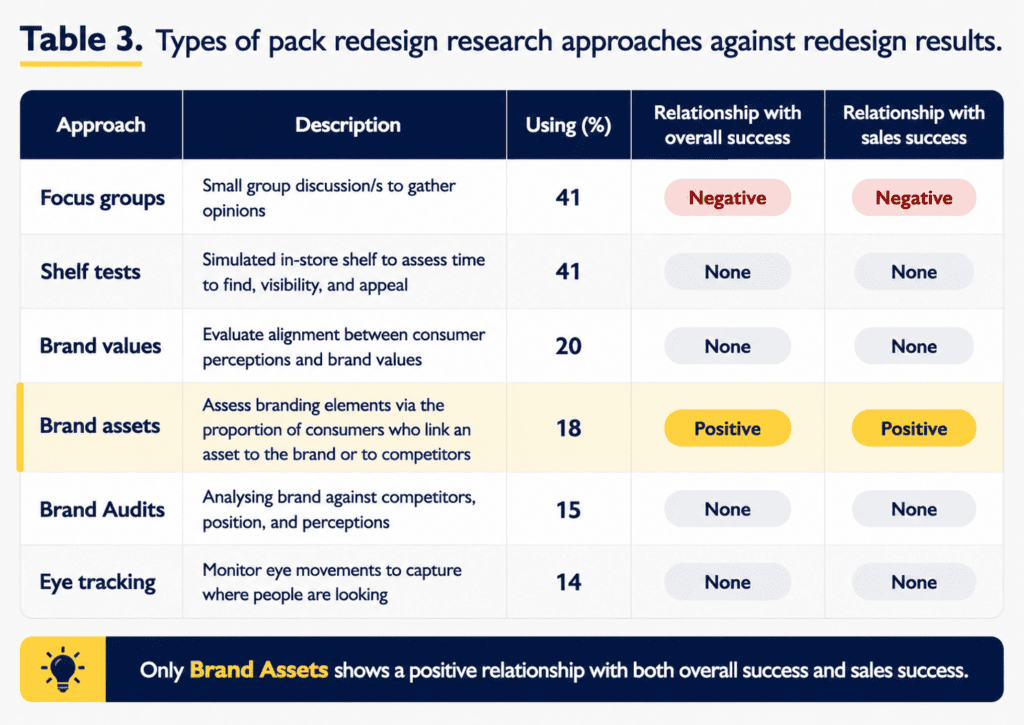
It is interesting how much emphasis Alexander Kühnen placed on research, but did they carry out the right type of research?
Writing in International Journal of Market Research 2024 William Caruso, from the Ehrenberg Institute, reports that only brand asset research is more likely
to lead to a successful pack redesign.
Distinctive Brand Assets can be measured by testing the extent to which an asset is associated with a brand (Fame) and whether the asset is only linked to your brand (Uniqueness). The results can be plotted on a 4-box grid, each quadrant guiding you on how the asset should be used.
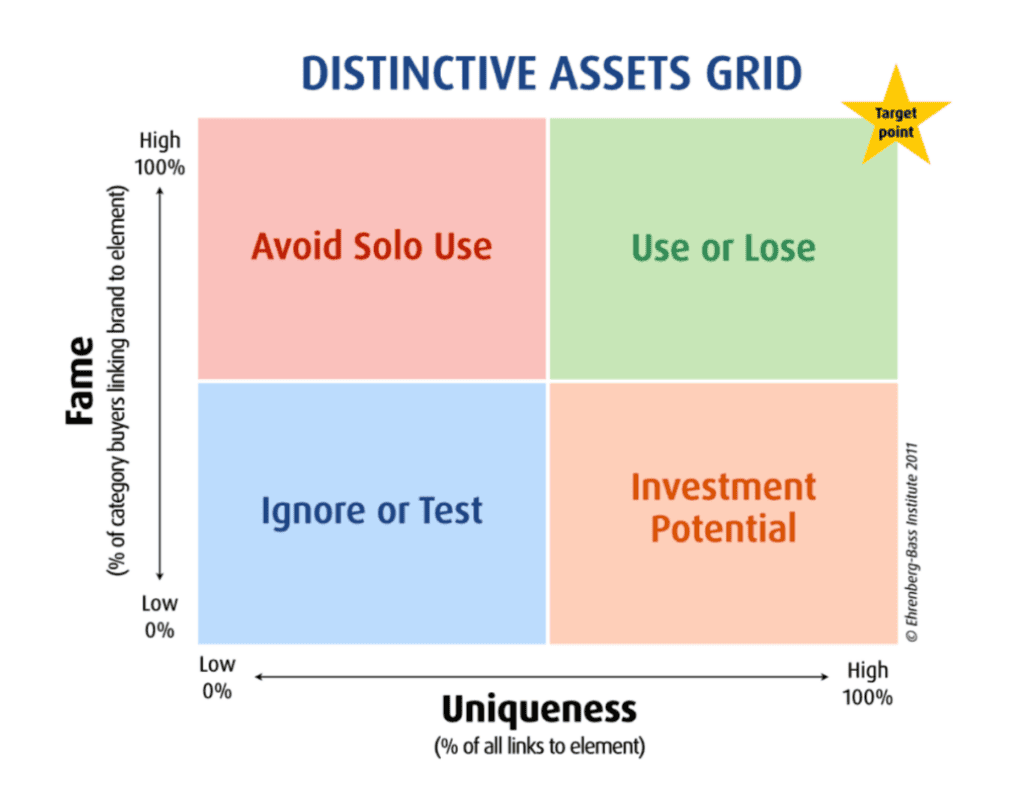
Credit: Jenni Romaniuk
Redesign research should be able to answer:
- which current cues buyers use to locate and identify the brand;
- how much recognition is lost when a cue changes;
- whether the new design preserves the brand’s strongest memory structures;
- Which elements must remain fixed, and which have permission to flex?
Ruby Brus et al (Journal of Brand Management 2025) warn against justifying a brand refresh because the brand has somehow become stale or tired. Doing so “ignores the risk that discarding or altering brand elements can inhibit consumers’ established ability to identify the brand in advertising campaigns or purchase situations.”
Which Brand Assets Matter Most for Building a Consistent Brand?
Results of testing 1281 in-market elements from 13 consumer packaged goods categories in 19 countries show that character, logo and logotypes have the greatest potential for unique brand ownership. Colour, however, is more challenging to develop as a unique brand identifier due to high levels of competitive sharing. (Ella Ward et al, Journal of Brand Management, 2020).
The priority should be to utilise the assets that are famous, unique and practical to deploy across the brand’s most important touchpoints.
What Must Remain Consistent and What Can Flex?
The fixed recognition layer
- The three to five priority DBAs validated through Fame and Uniqueness research.
- Core logo and packaging geometry.
- Defining colour combinations and proportions.
- Sonic signature or melodic structure.
- Recurring characters and their defining characteristics.
The flexible execution layer
- Central creative platform or narrative premise.
- Storyline, casting and setting.
- Local language and cultural references.
- Channel format and duration.
- The Category Entry Point being dramatised.
How Senior Marketers Can Build and Maintain Brand Consistency at Scale
The challenge for senior marketers is making that consistency survive the realities of modern brand management: multiple agencies, channels, markets, retailers, packaging formats, media partners and internal stakeholders.
Brand consistency at scale therefore requires;
- a clear asset hierarchy;
- rules governing which cues must always be present;
- templates for recurring commercial situations;
- formal approval when a core asset is changed or removed;
- a measurement system that connects asset use to Mental Availability.
Protecting the 3-5 most critical Distinctive Brand Assets
As a CMO I knew it was important to be pragmatic to secure new commercial opportunities, but at the same time it was my role to protect the brands under my stewardship. By working closely with key stakeholders and being empathetic to their challenges I was able to make the commercial value of DBAs clear enough that Sales, Shopper, Packaging, Operations and Finance understood what we needed to protect and where we could be flexible.
The same applied when partnering with our Creative agencies. It was important to make a clear distinction between 3-5 assets that should remain stable whilst giving the freedom to evolve the story, setting, execution, channel format and cultural expression used to connect the brand’s distinctive assets to the priority Category Entry Points.
Build a 2-3 year DBA playbook
In a previous article I recommended the introduction of a playbook to aid the consistent implementation of the assets identified as most important.
The playbook should specify which asset will appear in advertising, packaging, shopper, retail media, social, e-commerce, sales decks, sponsorships and product experience.
It should link assets to priority Category Entry Points, so the brand is not only recognisable but also associated with valuable buying situations. Ultimately it should demonstrate how the brand will build the same memory structures over several years, across multiple campaigns and touchpoints.
Create a governance structure to minimise the moments of risk
Redesigns, pack refreshes, retailer collaborations, sponsorships, promotions, local market adaptations and new agency appointments are high-risk moments.
Any proposal to change a priority asset should require a short evidence pack. That pack should include current Fame and Uniqueness scores, the role of the asset in recognition, the reason for change, the recognition risk, and the transition plan.
My guidance here is that if you have any doubts, don’t approve the change. This is a time when it is ok to be risk averse. Remember, the more famous an asset becomes the more dangerous change becomes.
Budget for unglamorous touchpoints
Advertising and Packaging are often the most talked about touchpoints, but there are many other touchpoints that build memory that are de-prioritised when budgets come under pressure. E-commerce thumbnails, delivery vehicles, sales presenters, glassware, menus, uniforms and point-of-sale materials should be included in the consistency plan with investment available to update these assets over the playbook period.
Track asset deployment as well as recall
We know that Mental Availability is built by associating the brand with multiple category entry points, which increases the likelihood of brand recall in different buying situations.
SmilingCFO has a process to measure Mental Availability. We are also able to measure Fame and Uniqueness using the Ehrenberg Bass methodology.
A brand should also measure DBA consistency through a simple deployment audit.
First, identify the three to five priority assets the brand is relying on to build recognition.
Then map the highest-reach and highest-value touchpoints where buyers encounter the brand, including advertising, packaging, retail, e-commerce, social, sales materials, promotions and product experience.
Each touchpoint should be scored for whether the priority assets are present, prominent, correctly applied and linked to the relevant category entry point(s).
This creates two useful measures: a reach-weighted deployment score, showing the proportion of buyer exposure where the assets appear correctly, and a value-weighted deployment score, showing whether the assets are present in the most commercially important environments.
Asset coverage score = weighted exposure where the asset is correctly used ÷ total weighted exposure
The results should then be connected to buyer research. If the assets are being used consistently, Fame, Uniqueness, brand attribution and relevant CEP associations should improve over time. This turns brand consistency from a subjective design judgement into a measurable system for building Mental Availability.
Conclusion
Brand consistency is a memory-building discipline. This shouldn’t lead to rules that restrict creativity but it should encourage consistent exposure that engage the buyer and strengthen attribution and association with priority category entry points.
To achieve this, a brand must exploit the distinctive assets that buyers uniquely link to the brand. This article highlights positive examples like Specsavers and the value of protecting and utilising different assets over time. In the case of Bahlsen we also show how quickly recognition can be weakened when familiar cues are removed.
The Magic of Compound Creativity reminds us of the commercial benefits of long-term consistency. It is therefore important to have a practical governance framework in place to navigate through moments of high risk such as a request for an on-pack promotion or a change in agency.
Brand consistency leads to stronger Mental Availability. The brand becomes easier to recognise, easier to recall in relevant Category Entry Points and more likely to be considered when buyers enter the category.