Why Brand Health Tracking Matters more than ever.
I suspect that there are many CMO’s questioning how relevant their current brand health tracking is. I have certainly sat in meetings where the results are being presented and Brand Managers look baffled, unsure what the metrics mean and what insights can be translated into an action plan.
This article focuses on how to track brand performance in a meaningful way and how to use the results. The proposed approach is empathetic to the pace of change, potential volatility of the category and the need for short term progress. It roots evidence in marketing science, concentrating on Mental Availability metrics that can be correlated to business performance objectives.
Brand Health Tracking: Why Mental Availability Metrics Should be Included.
At Cannes Lions 2026, two of the most influential voices in the world of marketing, aligned behind the fact that building Mental Availability should be the number 1 brand objective. The fact Mark Ritson, founder of the highly successful Mini MBA and Byron Sharp, Director of The Ehrenberg Bass Institute / author of ‘How Brands Grow’, is significant. If your current brand health tracking doesn’t include Mental Availability then you are paddling against the tide.

I understand the importance of continuity and the frustration for stakeholders if historic trends are lost. I am not advocating you abandon your existing tracker, but it is necessary to update methodologies to reflect how memories are formed and brands recalled in buying situations. This will require co-operative partners willing to help enhance your brand health tracking by blending methodologies.
A key way to integrate brand health tracking and strategy is by ensuring that metrics align with strategic goals.
A brand seeking to expand market share should prioritise metrics like Mental Market Share, which can be influenced by diagnostic metrics such as Mental Penetration and Network Size.
This alignment ensures that the marketing metrics being measured correlate with the business KPIs, resulting in greater engagement and clarity for employees and stakeholders inside and outside the organisation.
Designing a Brand Health Tracking Framework that Leaders Actually Use
A lean set of brand health tracking metrics that link clearly to the organisation’s growth strategy is the desired state.
The output should be a consistent framework that can track effectiveness over time, explaining why campaigns/activations perform as they do and create comparability across brands, buyers and markets.
Adoption of the Brand Health Tracking Principles, created by Jenni Romaniuk in her book ‘Better Brand Health’ helps reprioritise many Tracker’s overemphasis on the brand to a wider focus on the category and the buyers of the category. She reminds us that if a competitor would not find the report useful, then the correct balance hasn’t been achieved.
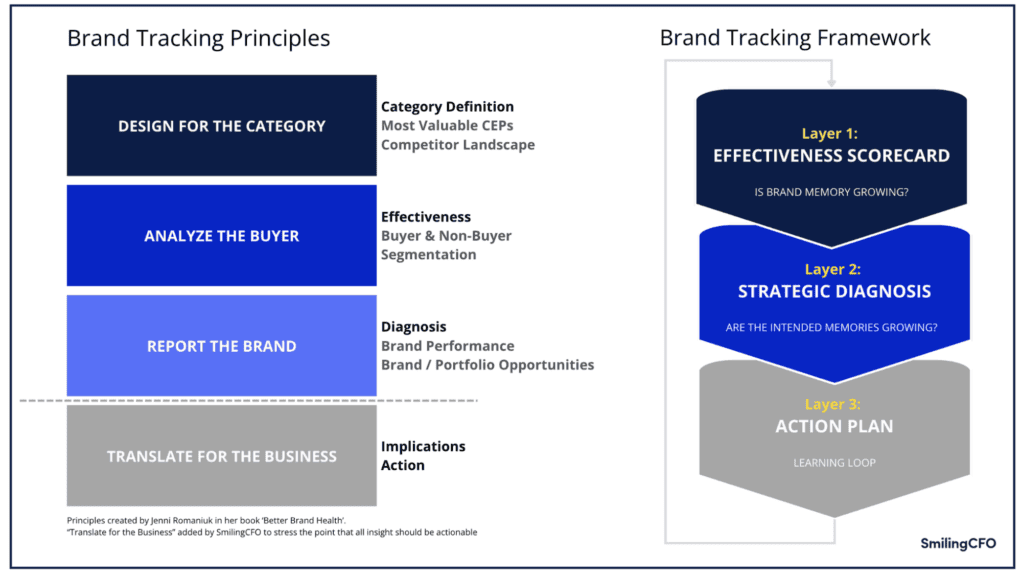
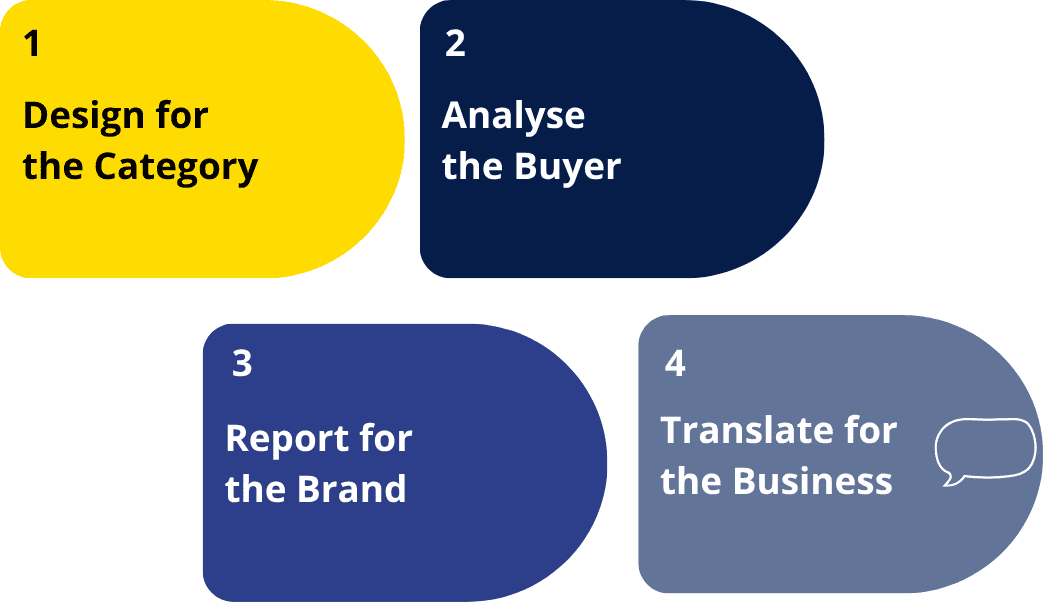
The Brand Health Tracking Framework stays true to the Brand Health Tracking Principle and is designed to keep memory growth at the forefront of the minds of all stakeholders, ensuring the insights are action orientated.
The first layer measures whether Campaigns/Activations are increasing the brand’s Mental Availability over time.
There is a correlation between Mental Market Share and Sales Market Share.
Network Size is treated as a critical measure of memory growth, showing whether buyers and non-buyers are linking the brand to a broader range of Category Entry Points as a result of exposure to Campaigns/Activations.
The second layer diagnoses whether the right memory structures are being built.
It compares the brand’s intended Messaging / Positioning with the CEP associations actually being formed, using Mental Advantage and Mental Disadvantage deviation analysis.
The third layer converts the evidence into a learning loop for future creative and media decisions, showing which CEPs should be reinforced, which could be scaled and which might need to be rebriefed.
Brand Health Tracking: the short-term and long-term effects
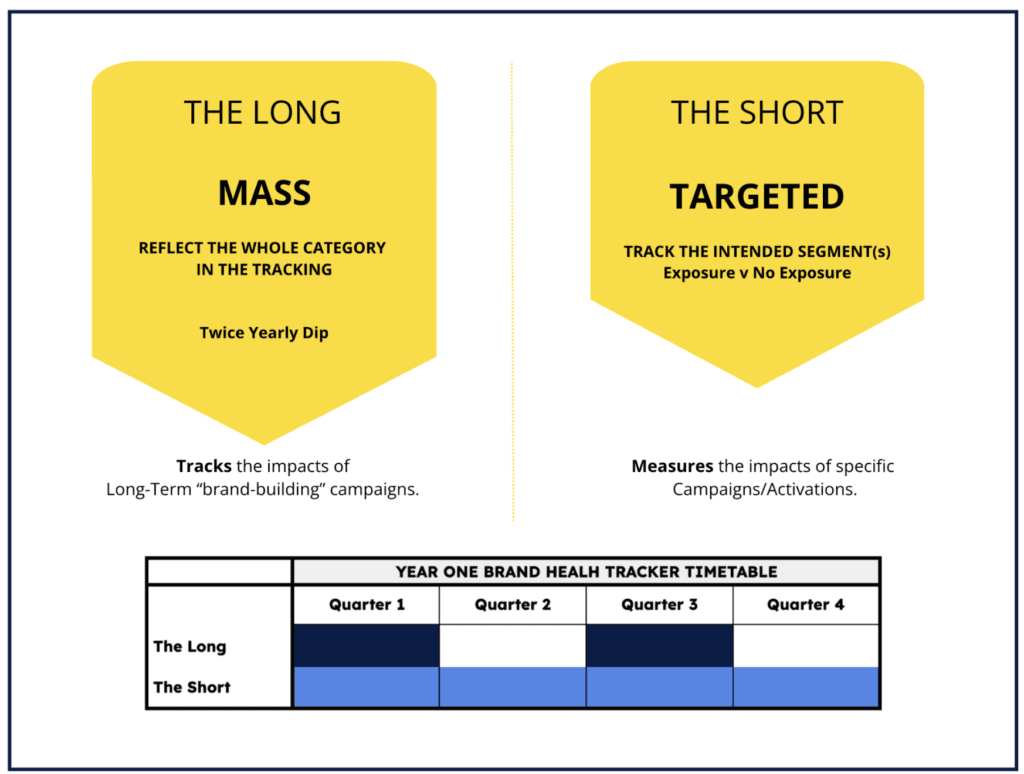
The work of Binet & Field, aptly named “The Long & The Short” and Mark Ritson’s ‘Two-Speed Plan’ provide the most appropriate guidance when considering frequency in the context of the ‘Brand Tracking Principles’ and ‘Brand Tracking Framework’.
It is critical to track both long-term and short-term effects, by tracking the responses of a wide representation of those who buy the category. Don’t define target segments to such an extent you inadvertently bias the results, but it is ok to measure specific campaigns with set audiences, but the metrics should reflect how Mental Availability grows, not short-term metrics like ROI.
Tracking Category Entry Points to Build Mental Availability
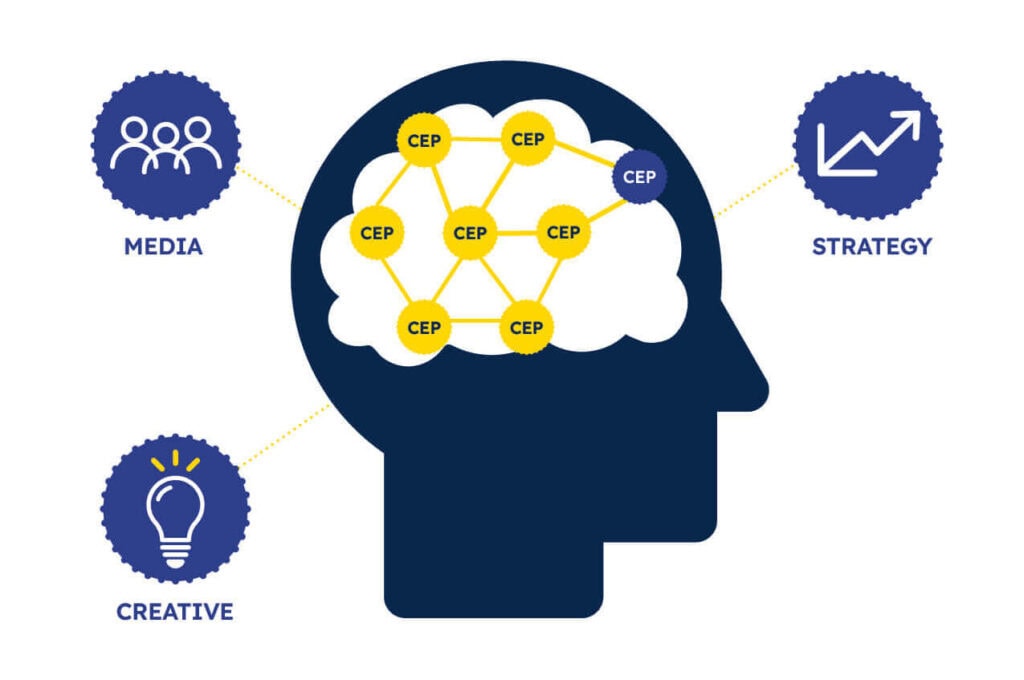
Category Entry Points (CEPs) are the building blocks of Mental Availability; the mental cues and buying triggers that help buyers recall your brand when making decisions. These triggers can be personal, such as feeling tired and wanting a pick-me-up, or situational, such as stopping at a petrol station for a quick snack.
They link the buying situation to the brands that buyers have stored in their memory.
SmilingCFO data consistently shows that Category buyers who can make at least one link to a brand are significantly more likely to buy the brand than those who cannot.
Therefore understanding the CEPs for your category is a crucial step toward building Mental Availability and incorporating them into brand health tracking is straightforward.
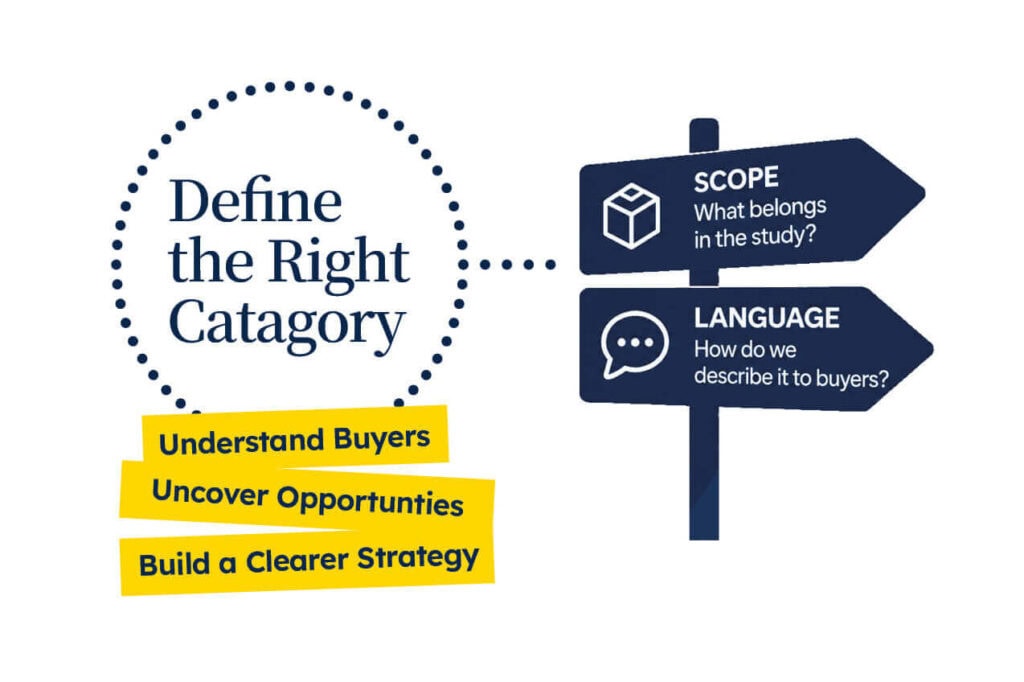
First, as part of your market orientation process, run a Mental Availability Assessment. This will reveal the most relevant CEPs for your category, highlight where your brand is strong and where your competitors are stronger, as well as uncover potential growth spaces.
Second, assess which high value CEPs have the best fit for your brand and add them to your brand health tracker.
Third, measure your brand’s progress against these CEPs in terms of mental advantage growth and the number of buyers and non-buyers who associate the brand with the CEP.
The results will help inform the creative and media briefs.
Improvements in individual CEP associations will increase key mental availability metrics such as network size and mental market share thereby increasing the chance the brand comes to mind in these related buying situations.
SmilingCFO Tip: Cluster the CEPs into territories to make it easier to identify patterns and themes.
Below is an example of potential territories in the rice category.
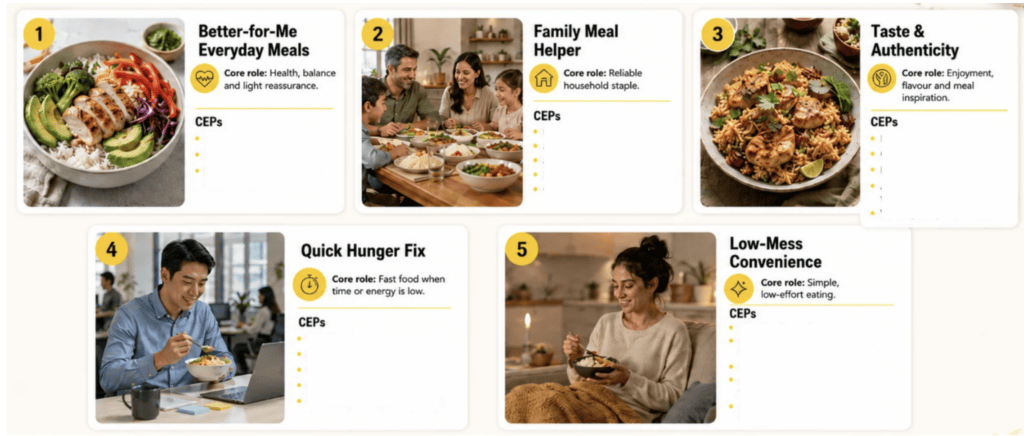
The appropriate CEPs are then populated under each territory and analysed to see which brands perform strongly in which territories.
In the example below we see that brands have mental advantage in 2 of the 3 CEPs, but “managing my diet” is a white space, offering potential growth opportunities.
Let’s take Goya Foods; the brand is strongly associated with “making a healthy choice” and by widening its creative messaging to incorporate good ingredients and dietary benefits it can increase the number of category buyers able to link it to the other two CEPs and build superiority in this territory. Our research showed that “Better-for-Me Everyday Meals” contained the highest value CEP, so increasing mental share of this territory is likely to correlate with an increase in sales share.
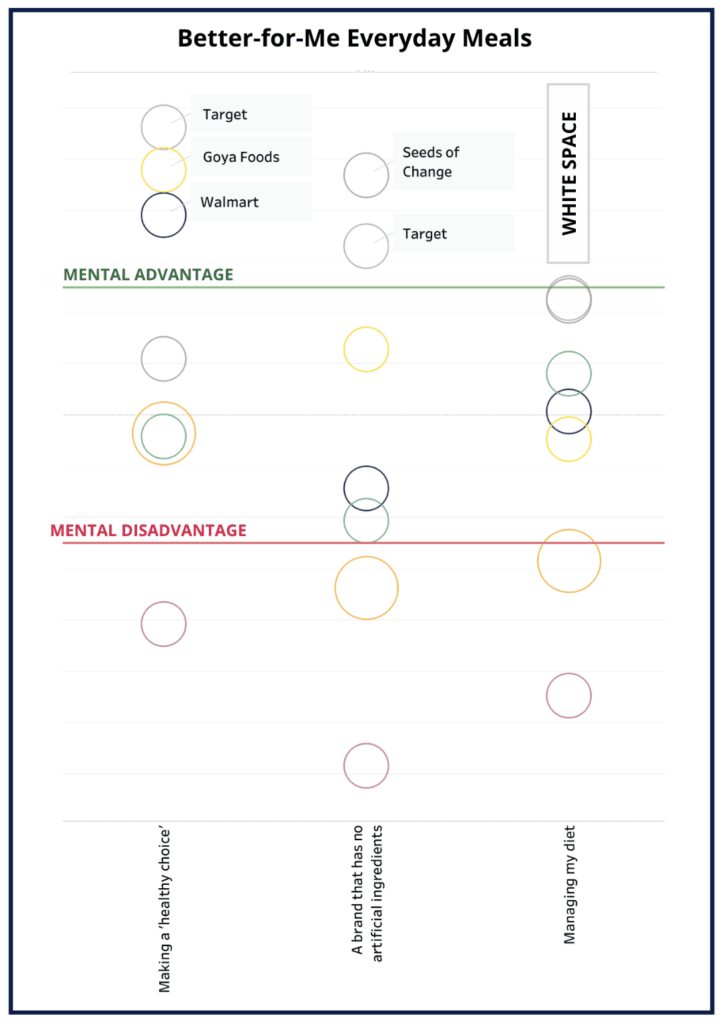
By tracking brands to CEPs in this way, CMO’s can use the data to refine marketing strategies, prioritise media investment and report progress in a way that is meaningful to C-Suite colleagues.
Brand Health Tracking Case Study: SAS Moves from General Awareness to Situational Awareness
In a 2022 conversation with The B2B Institute (in collaboration with LinkedIn), Jennifer Chase, CMO, SAS explained how they have moved beyond conventional awareness tracking towards measuring whether the brand came to mind in valuable buying situations. SAS identified important Category Entry Points in the business intelligence market and carried the same buying situation messages through brand and demand-generation activity. It also tested its distinctive assets and found that the Viya name and its pink cube offered particular memory building potential. These assets were subsequently used more prominently and consistently. A later LinkedIn case study reported that the SAS Viya activity reached nine million new buyers in six months, tripled lead-form completion rates, increased engagement by 31% and reduced cost per lead by 28%.
Brand Health Tracking Should Measure Distinctive Brand Assets
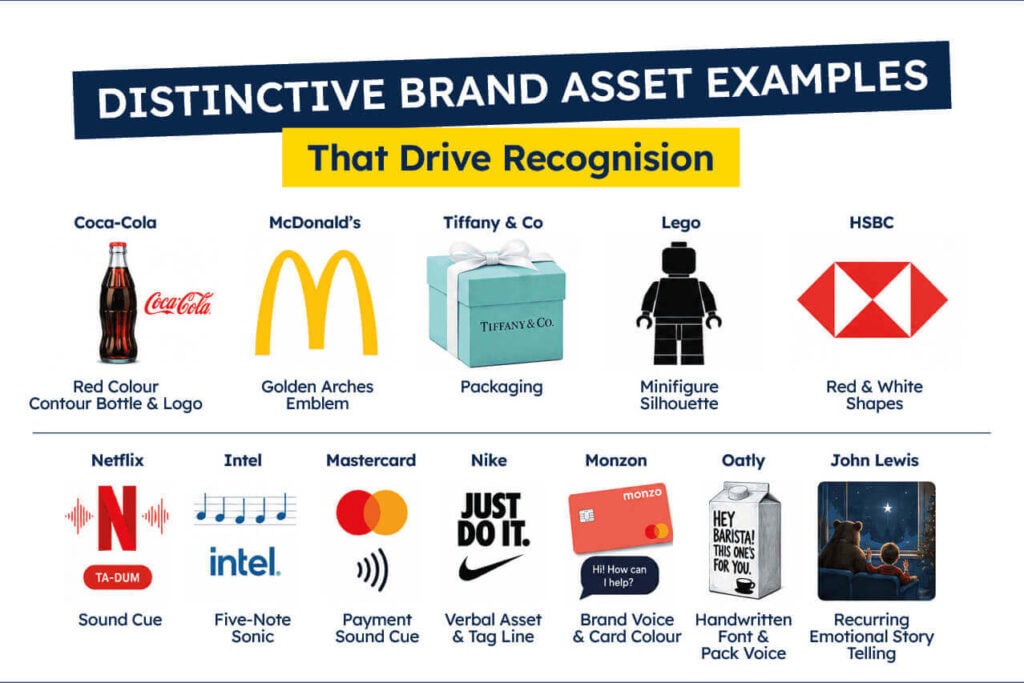
Having identified which CEPs a brand should focus on to build memories, Distinctive Brand Asset (DBAs) help ensure that those memories are correctly attributed to the brand. DBAs, also known as Brand Codes, are any cue that helps buyers recognise a brand without relying on the brand name. Logos, characters, colours, music and even smells can be classified as an asset.
Professor Jenni Romaniuk recommends assessing the strength of these assets through two measures:
- Fame: how many category buyers link the asset to the brand.
- Uniqueness: how exclusively the asset is linked to that brand rather than to competitors.
| Asset performance | Recommended action |
| High Fame and High Uniqueness | Protect it and use it consistently across communications. |
| Low Fame and High Uniqueness | Invest in it because it has the potential to become a strong asset. |
| High Fame and Low Uniqueness | Avoid relying on it alone because it may also evoke competitors. |
| Low Fame and Low Uniqueness | Reconsider, substantially develop or retire it. |
Credit Jenni Romaniuk ‘ Building Distinctive Brand Assets’.
DBA measurement doesn’t need to be included in every tracking wave, retesting annually is sufficient.
Brand Health Tracking Governance: Turning Evidence into Action
Brand Health Tracking should operate as a management system, ideally integrated into a ‘Sales and Operation Process’. Brand Health should help Supply Chains predict demand with their sales colleagues.
It is of no value if you are simply tracking brand image statements. Understanding how likely the brand will be recalled in multiple buying situations is what will build confidence and inform wider business decisions.
Ideally the tracker should be “a tool for increased profitability (Eckerson 2005) and “a source of organisational learning” (Clark et al 2006).
For it to have this level of status and importance, it helps if the CEO or Managing Director is a joint sponsor of the tracker alongside the CMO and is adopted by Finance and the Senior team rather than remain with Marketing/Insight.
Match brand health tracking cadence to the organisation’s decision making process
Align research and measurement with the ‘Long’ & the ‘Short’ communication strategies AND the commercial cadence, (e.g. Sales & Operation Planning Meeting).
Turn every review into a learning loop.

Airbnb provides a useful example of why brand and performance marketing should not be evaluated over the same period.
In its Q2 2024 earnings call, Airbnb CFO Ellie Mertz explained that performance marketing is assessed over weeks and months because the return is relatively immediate and attributable. Brand campaigns require a different approach. They need to remain in-market consistently and Airbnb assesses their payback over approximately six months to a year.
Each Brand Health meeting should answer five questions:
- What has changed?
- Is the change statistically and commercially credible?
- What is the most plausible explanation?
- What will we do differently?
- Who owns the action and when will it be reviewed?
SmilingCFO Tip: Don’t be knocked off course by one noisy wave of results. Agree decision thresholds at the outset and look for material movement before making strategic changes.
Conclusion
Effective Brand Health Tracking should assess progress in the context of the organisation’s growth strategy. Because of the proven correlation with business metrics like Sales Market Share, Mental Availability metrics such as Mental Market Share and Network Size should form a key part of the scorecard, supported by Category Entry Point analysis to show which buying situations are strengthening or weakening. Distinctive Brand Asset tracking should confirm whether those memories are being correctly attributed to the brand.
Measurement should operate at two speeds. Track the category, monitoring long-term memory growth across buyers and non-buyers, whilst also assessing whether campaigns/activities are building the intended associations. Both should feed into a consistent governance process involving Marketing, Insight, Finance and senior leadership.
Each review should identify material changes, accompanied by commentary rooted in deeper analysis, to propose clear actions, owners and review dates. Add a disciplined learning loop and Brand Health Tracking becomes a practical guide for creative development, media investment and sustainable brand growth.
Further Reading
The Drum: Ritson & Sharp agree on 5 things at Cannes
Brand Health: How to Enhance Your Brand Health Tracking Without Losing Continuity
Market Orientation: The First Step In Building an Evidence-Led Brand Strategy