How brand and insight teams can define their category and establish a clear basis for mental availability measurement.
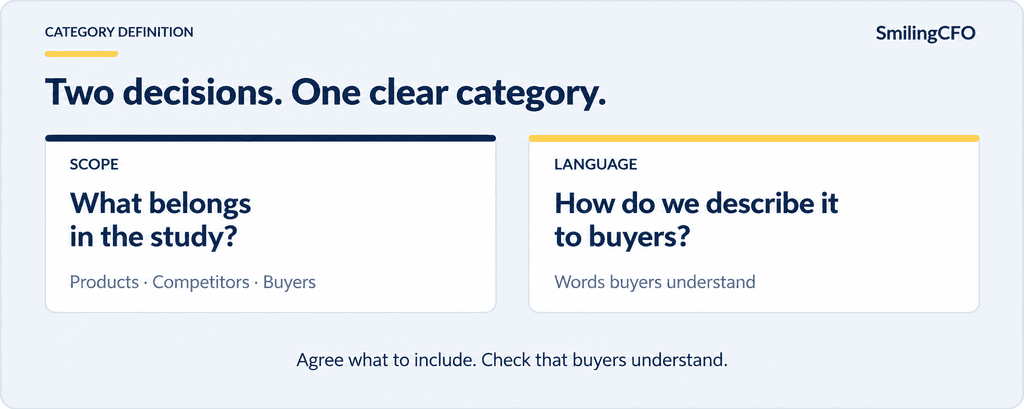
Category definition starts by separating two connected decisions;
i) Scope: what belongs in the study?
Agree which products, competitors and buyers the research should cover.
ii) Language: how do we describe that scope to buyers?
Choose words and examples that make the intended inclusions and exclusions clear.
To illustrate the point; deciding whether chilled potato products compete with frozen ones is a scope question. Finding an understandable description covering both is a language question.
Separating these decisions makes the task more manageable.
1. Explore how buyers see the market
Category definition starts with existing research, competitor knowledge and evidence about buying behaviour. Write down a proposed scope and identify the questions that could materially change the study.
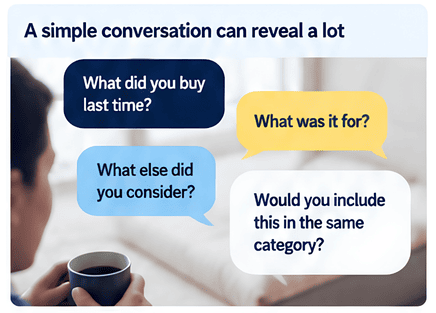
Where gaps exist, explore recent buying situations with relevant buyers, including people who do not buy your brand. Ask: “What did you buy?”, “What was it for?” and “What else did you consider?”
This customer-oriented approach has a long research history. Day, Shocker and Srivastava’s 1979 paper, Customer-Oriented Approaches to Identifying Product-Markets, examined methods for identifying market boundaries through customer behaviour and judgements. (Sage Journals)
For a prepared-potato brand, the useful question might be whether buyers consider chilled and frozen products alternatives for the same meal situations.
2. Resolve any important doubts
Where the existing evidence supports the proposed category definition and buyers understand the description, proceed with the assessment. Where substantial uncertainty remains, we may recommend a focused pilot potentially involving around 400 appropriately recruited buyers.
Recruit across the plausible category definitions. For example, a study investigating whether chilled products belong alongside frozen ones should allow evidence from buyers of both.
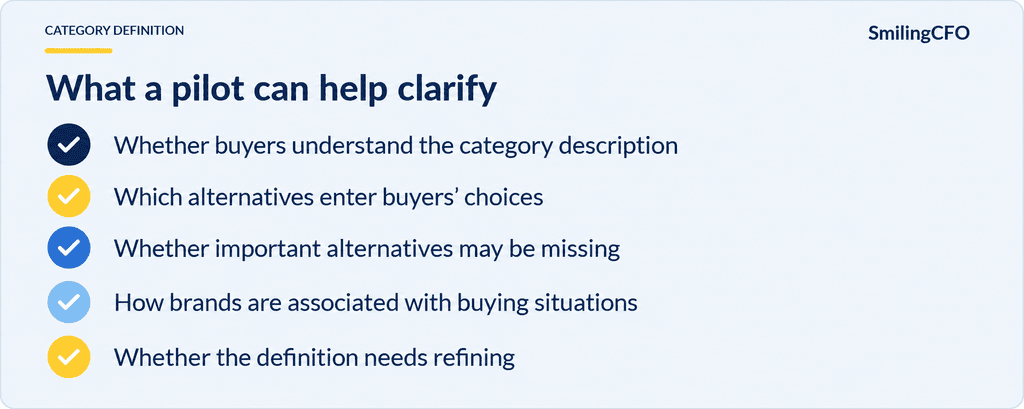
The pilot can help clarify how people interpret the description, which alternatives they consider and how brands are associated with relevant buying situations.
Mental availability patterns provide a useful diagnostic check. Jenni Romaniuk’s research shows that larger brands generally attract more associations, while some buying situations attract more associations across brands. It also recognises genuine brand-specific strengths and weaknesses.
Our recommendation is to investigate unexpected results, but not automatically treat them as evidence of an incorrect category definition.
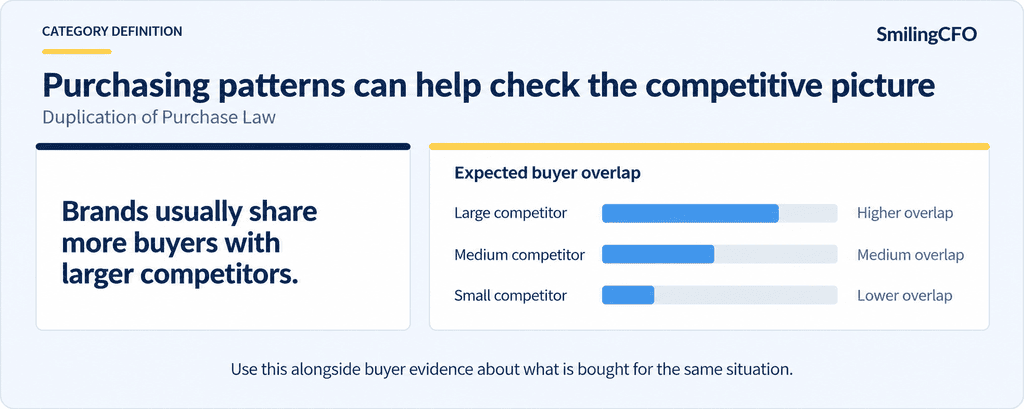
Purchasing patterns can provide another check. The Duplication of Purchase Law (Ehrenberg-Bass Institute) describes how brands generally share a greater proportion of their buyers with widely bought competitors and a smaller proportion with less widely bought competitors. Comparing actual sharing with the expected pattern can help indicate whether the correct brands have been included in the pilot. A change in brands will further refine the category definition.
3. Confirm the category definition, measure and use the results
Agree the included products, competitors, recruitment criteria and wording.
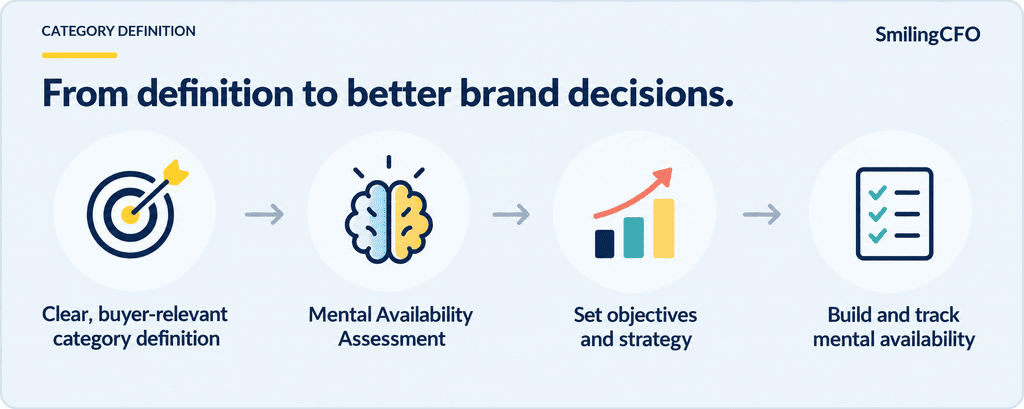
A Mental Availability Assessment examines the links between brands and Category Entry Points (CEPs): cues that bring brands to mind in buying situations, such as needing a quick midweek dinner.
The assessment establishes Mental Penetration: the proportion of category buyers linking your brand to at least one CEP; Network Size: the average number of links among those people; and Mental Market Share: your brand’s share of all the brand to CEP associations measured.
Use this evidence to decide which associations to maintain and which to build. Prioritise situations that matter to buyers, where your product can deliver and where the competitive evidence supports an opportunity.
Consider a hypothetical prepared-potato brand. The assessment identifies quick midweek dinners as a promising priority, but relatively few category buyers associate the brand with that situation. Instead of briefing the agency simply to “increase awareness”, set a specific objective:
Increase the proportion of category buyers associating our brand with a quick midweek dinner so that we move from a positive deviation of 3pts to 5pts within 12 months, thereby achieving Mental Advantage with this CEP.
The strategic choice is to make quick midweek dinners a priority buying situation. The creative brief should demonstrate the brand’s role in those meals, supported by a media plan reaching category buyers.
A clear starting point for better brand decisions
Category definition becomes manageable when you separate scope from language, use buyer evidence and investigate the uncertainties that could change the study.
Purchasing patterns help you understand the competitive picture.
Mental availability evidence helps you decide which buying situations deserve investment and what success should look like.
Talk to SmilingCFO about defining your category and turning a Mental Availability Assessment into measurable objectives and a focused brand strategy.
Further Reading:
Mental Availability: A Strategic Guide for Brand Leaders
Brand Health: How to Enhance Your Brand Health Tracking Without Losing Continuity