Introduction: What is Brand Positioning?
Brand positioning is the deliberate process of defining, in just a few research-backed words or sentences, how you want buyers to perceive your brand relative to the competition. It should fit on a single sheet of paper. Here, the brand team will define the associations it wants the buyers of the category to be able to play back if stopped in the street and asked. Record this encounter and you have your brand image.
Brand Positioning is the intention and Brand Image is the reality.
The gap between these two positions: that’s the marketing plan.
Brand positioning should be thought of as a simple chain of events:
Clear Brand Positioning → Consistent Memory Structures → Greater Mental Availability → Higher Likelihood of Being Chosen = Brand Growth
Strong brand positioning creates a commercial advantage that your CFO will certainly enjoy. Brands with clear, credible positions are able to justify premium pricing (if that is your objective) because buyers of the category perceive greater value.
For senior marketers, the challenge is to create a compelling brand positioning statement which can live and breathe across all buyer touchpoints: from advertising and packaging through to how you communicate your price rises, and everything in between.
In today’s mature and highly competitive markets, brand positioning should no longer be viewed as the brand team’s piece of work; it’s an ongoing discipline that shapes how brands build mental availability.
Coming to mind in buying situations is the number one objective for marketing efforts.
From Brand Positioning Statement to Market Reality
A strong positioning should remain relatively stable for many years.
Thinking of the following three layers together helps avoid a common mistake.
Value Proposition: Explains why a customer should choose your product or service and, as the name suggests, focuses on the value that comes from it.
Brand Positioning Statement: Sits behind the scenes – the internal document that defines how the organisation wants the brand to be perceived.
Tagline: The external expression of the brand – the memorable phrase communicating aspects of the positioning.
A tagline may change with a campaign (not always – Tesco’s Every Little Helps and McDonald’s I’m Lovin’ It feel decades old), and a value proposition may evolve as products improve,
A Practical Brand Positioning Statement Formula
There is a helpful structure featured in the Mini MBA programme outlining how to build an effective brand positioning.
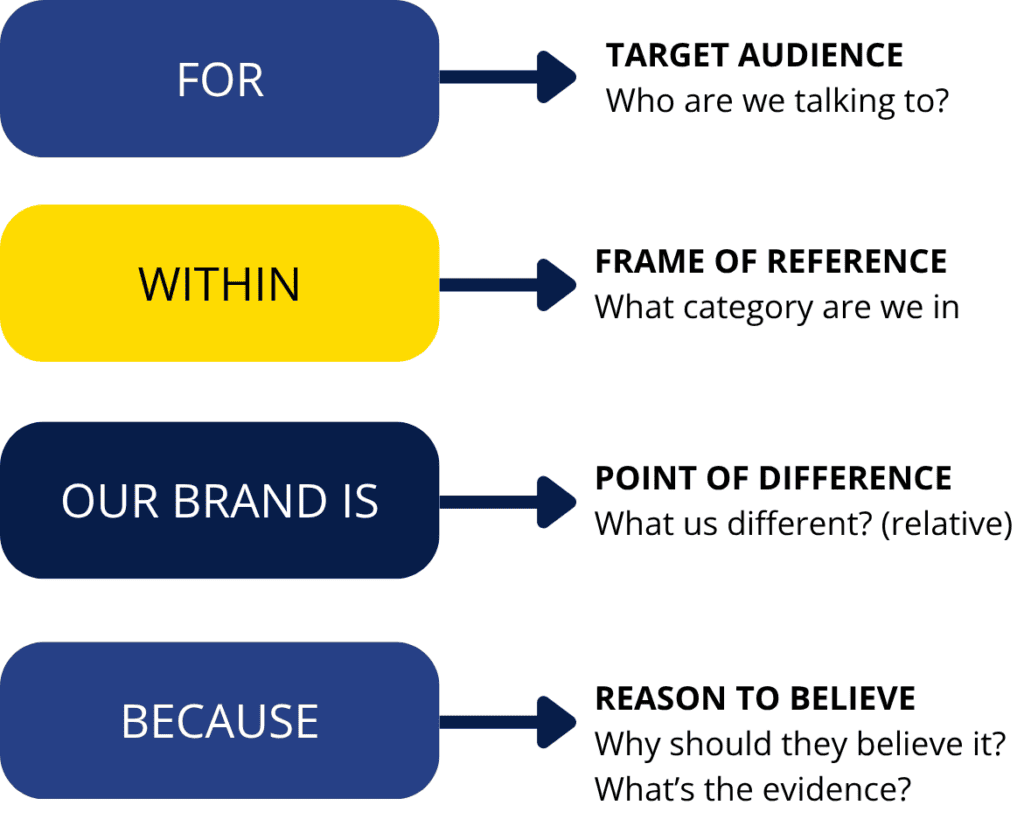
These four strategic questions that will put you on the right path.
For: Target Audience
Who are you trying to influence?
SmilingCFO research supports the school of thought that there is little difference between those that buy one brand in a given category and those that choose a competing brand within the same category.
The skill is not to exaggerate differences between relatively similar brands, but to find the intricacies of what makes up the audience at a category level and start there.
Those that buy pet food probably have a pet, so that’s an audience signal to start with.
Within: Frame of Reference
What category are you competing in? Buyers need to understand what type of solution you offer before they can appreciate how you’re different.
Our Brand Is: Point of Difference
What do you want people to remember about you? Stop the person in the street: what do they say about you? Condense these findings into one or two distinctive associations.
Because: Reason to Believe
What evidence proves the claim? Build a benefit ladder and work this through with your team. You should be able to look at such things as proprietary technology, product performance, heritage (including why the founders started the business or brand), customer experience and social proof.
A couple of examples:
For busy professionals seeking premium coffee at home, Coffee Brand A is the coffee system that delivers barista-quality coffee with exceptional convenience, because its proprietary capsule system consistently produces café-quality results.
Or in B2B:
For mid-market sales teams looking to improve pipeline visibility, CRM Brand B is the CRM that simplifies revenue growth through an intuitive, connected platform, because it combines automation, customer data and AI-powered insights in a single system.
Notice that these examples are not attempting to say everything. Remember: strategy is about choices.
Brand Positioning is a hypothesis until buyers prove otherwise. Your job is to listen, refine and only then roll it out consistently across every communication touchpoint. That’s how a positioning statement becomes market reality.
Start with a handful of qualitative interviews with people who buy the category. Does the brand positioning make sense? Is it believable? Can the buyers play it back to you in their own words?
Once you’ve refined the language, run a quick quantitative survey with a larger sample of category buyers. Measure how clearly they understand the positioning, whether they find it credible and whether it gives them a reason to choose your brand over the competition. Think of this as a final sense check before committing years of marketing investment behind it.
Choosing a Brand Positioning Strategy That Actually Moves the Needle
If targeting answers the question, “Who are we going after?”, a brand positioning strategy answers the follow-up question: “What do we want them to think when they think about us?”
The reality is this: a buyer of your category needs only know a couple of things about your brand:
- That you exist.
- A couple of things they can recall when they think about it.
That is not 19 slides. It’s half a page of A4. It’s only half a page because, on the other side, are the four or five Distinctive Brand Assets.
That’s your brand. That’s how the needle moves.
The challenge, of course, is knowing what these “couple” of things should be. Most successful brands end up making one clear strategic choice about what they want to become famous for.
Think about Volvo and safety.
Some will choose value positioning, becoming the sensible choice in a category by offering buyers the strongest balance between price and quality.
Think Aldi.
Others will adopt quality positioning, justifying a premium price through superior performance, craftsmanship or reliability.
Think Bang & Olufsen.
Some brands will pursue an innovation-led positioning, aiming to become synonymous with progress, technology and category leadership.
Think Samsung.
Others will think about pursuing a customer-centric positioning, differentiating through service, support and ease of doing business rather than product features alone.
Think Zappos.
Others will adopt a lifestyle positioning, connecting the brand to identity, aspiration and values rather than functionality.
Think Nike.
There is no universally correct answer here. The right brand positioning depends on the category, the competitive landscape and the buyers you are targeting. One thing that does matter, however, is the consistency with which it is applied.
Designing a Brand Positioning Framework: From the Three Cs to Distinctive Brand Assets
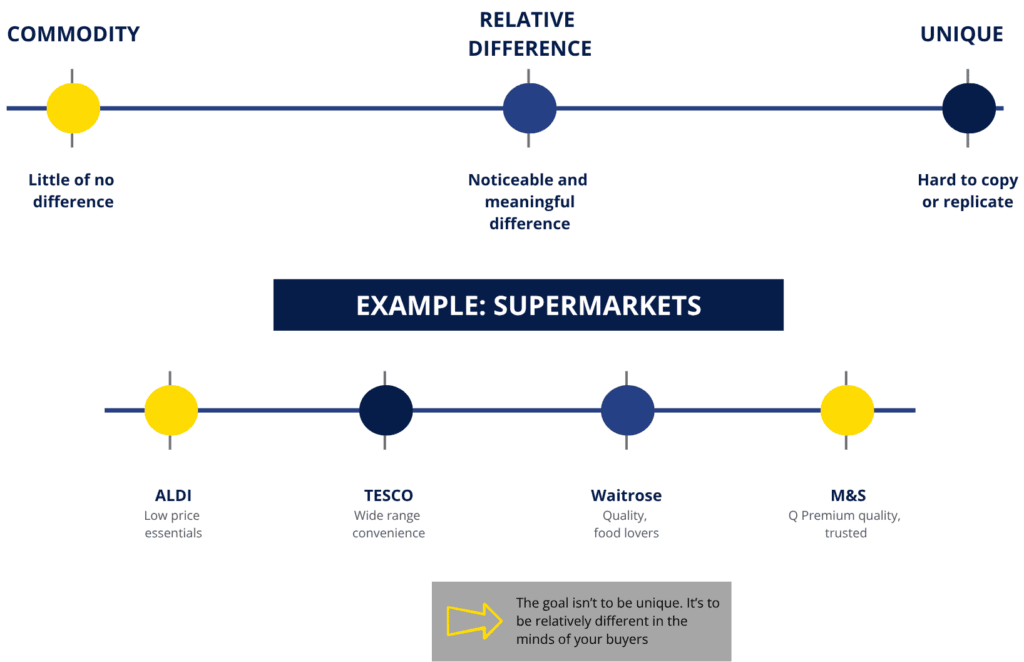
Historically, brand teams have used perceptual maps in an attempt to dramatise the differences from one brand to the next. Of late, this has been acknowledged to be limited, as Mental Availability results (from our own surveys) show just how low relative differentiation is or, as Byron Sharp put it, “how shockingly low it is and how little it matters.”
This is not to abandon differentiation, but to think of it not as something “unique”, but something “relative”.
You want to achieve relative differentiation for your brand versus the alternatives that the people who buy your category could consider. And if you are in doubt, think of a brand in your category that your colleagues think is different, then come up with five reasons why you couldn’t copy it.
Now we have hopefully landed on the job to be done, which is to create relative differentiation. The next step is to use a framework that can help you develop it.
Here we will use the Three Cs.
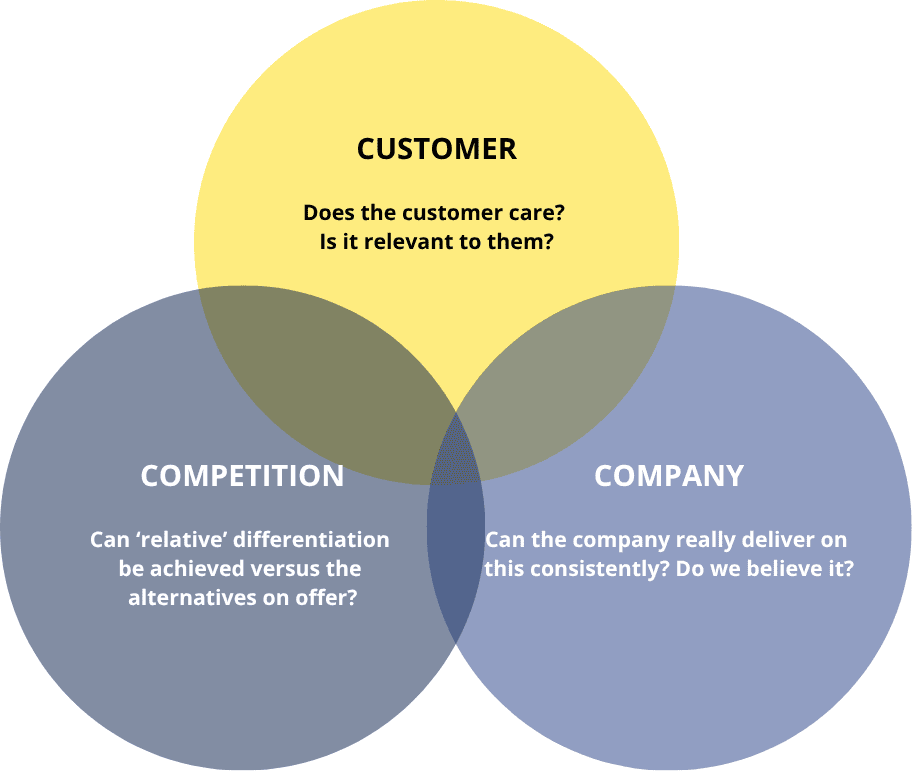
Consumer: Does Anyone Actually Care?
- Does this proposition solve a real problem or fulfil an important need?
- Is there evidence from research, behaviour or market data that customers genuinely value this?
- Does the language reflect how buyers think about the category rather than how marketers talk about it?
- Is the brand positioning simple enough to be understood quickly and remembered easily?
- Would customers notice if this proposition disappeared tomorrow?
The test:
Can you confidently say that customers want this from your brand, and can you prove it with evidence rather than assumptions?
Competition: Can You Genuinely Win Here?
- What position do competitors already occupy in consumers’ minds?
- Are you trying to be different, or are you simply claiming to be better?
- Is this territory distinctive enough to create separation in the category?
- Could a larger or more established competitor make the same claim with greater credibility?
- Are you exploiting a genuine opportunity, or simply seeing one because you want it to exist?
The test:
If a customer compared you against your competitors tomorrow, would this proposition provide a clear reason to choose you?
Company: Can You Consistently Deliver It?
- Does the business genuinely possess the capability to support the promise?
- Can the product, operations and customer experience consistently deliver against the proposition?
- Is the organisation prepared to invest behind this positioning over the long term?
- Would employees recognise this brand positioning as true of the business today?
- Can you prove the claim in reality rather than simply communicate it in advertising?
The test:
Can your business deliver this promise every day, not just in a strategy document or campaign presentation?
The Three Cs of Brand Positioning
Strong positioning exists at the intersection of three conditions:
- Consumer Relevance – customers value it.
- Competitive Distinction – competitors do not already own it.
- Company Capability – the organisation can consistently deliver it.
When all three overlap, brands create positions that are meaningful, distinctive and credible. Caution: When one is missing, brand positioning usually fails.
The goal is not to find an empty space in the market. The goal is to find a position that customers value, competitors struggle to own or copy, and your organisation can deliver better than anyone else.
If this sits over on the left-hand side of the one page of A4, then on the right you will want your distinctiveness to do the work.
Introducing Distinctive Brand Assets
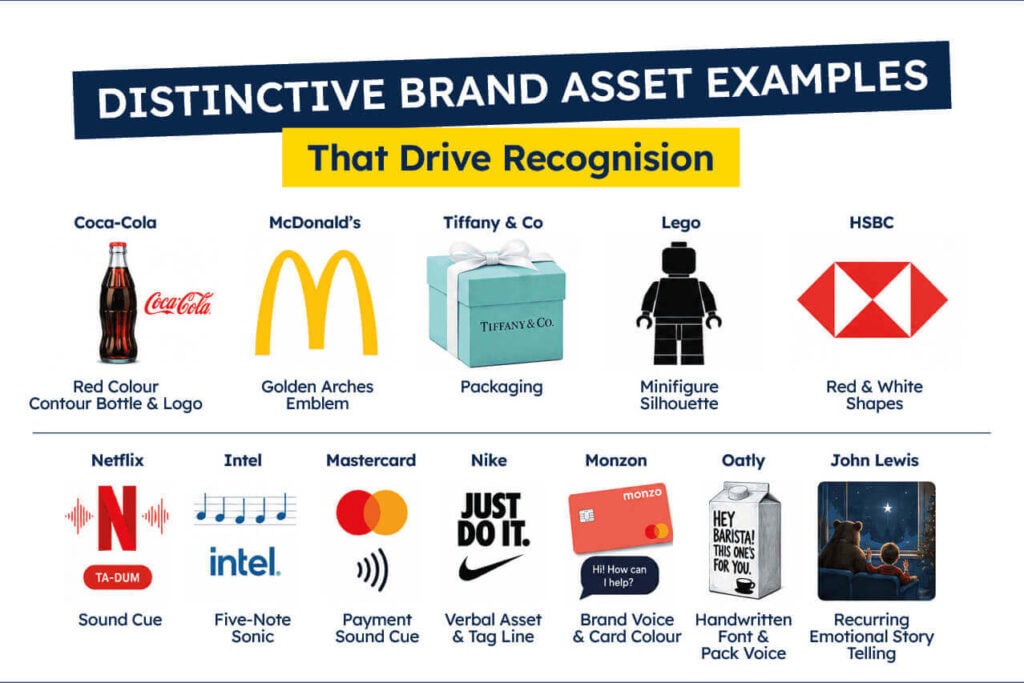
What is a Distinctive Brand Asset (DBA)?
Let’s play a game. I’ll describe the DBA, and if you buy that particular category, the brand is likely to pop into your head:
- The golden arches.
- The bitten apple.
- The red sole of a ladies’ high-heel shoe.
- The blue jewellery box.
- The red of a soft drink.
- The bunny.
- The crack of an ice cream.
- The swoosh.
- The purple wrapper.
- A dog that nods.
- The orange spine on a book.
- The cute puppy.
You might not get all of them. You are probably not participating in all these categories. But if you are the brand team at Louboutin, then you know that red on the sole is the hill you are prepared to die on if the organisation suggests changing it.
If you are the team at Churchill Insurance, then the nodding dog is something you protect and fight for.
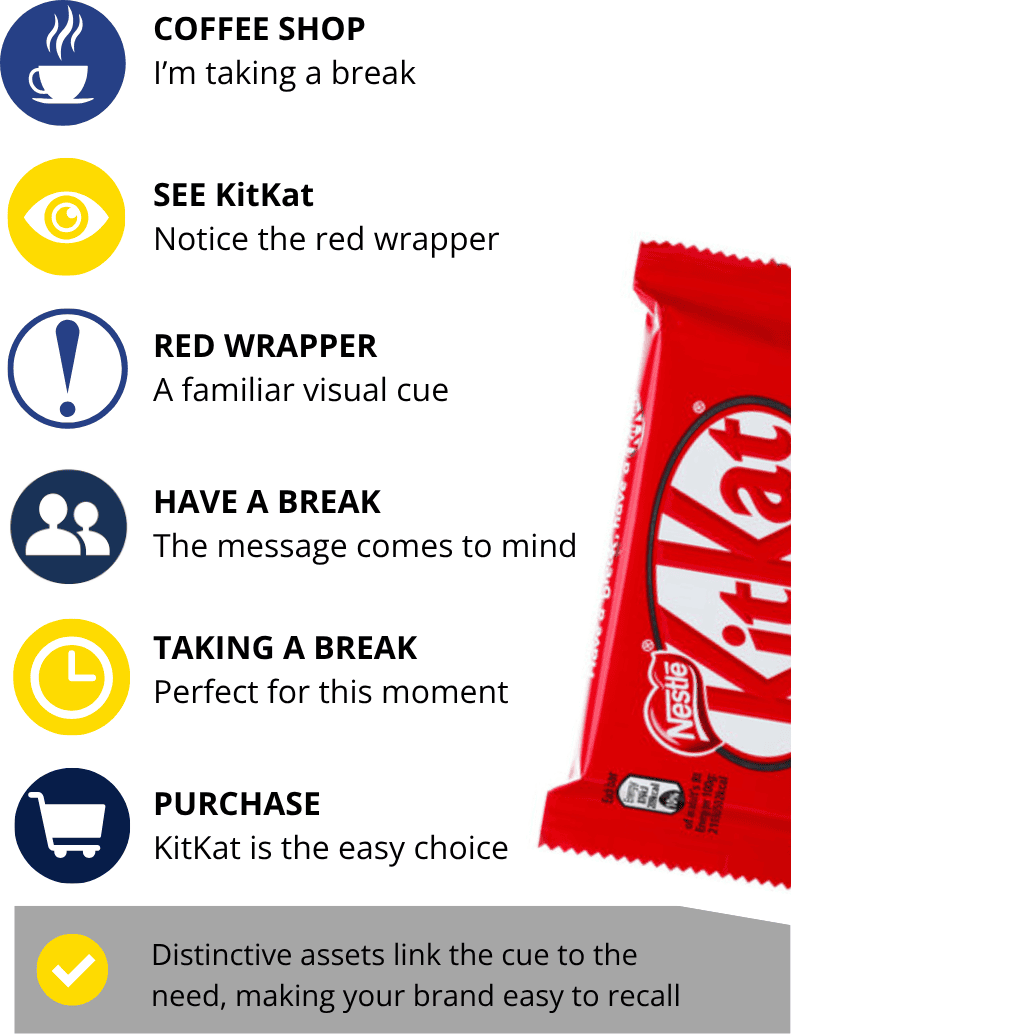
All of these assets do not create the brand positioning, they make the positioning easier to find in memory, and this is why distinctiveness really does matter.
How Do You Decide on Your Distinctive Brand Assets and How Should You Measure Them?
Identify Potential Distinctive Assets
Start broad.
Look across all possible asset types:
- Colours
- Logos
- Symbols
- Characters
- Packaging shape
- Product shape
- Sounds
- Music
- Taglines
- Typography
- Spokespeople
- Animations
- Motion devices
- Brand rituals
- Sensory cues
Examples:
| Asset Type | Example |
| Colour | Cadbury Purple |
| Character | Michelin Man |
| Shape | Coca-Cola Bottle |
| Sound | Intel Bong |
| Symbol | Nike Swoosh |
| Ritual | Oreo Twist-Lick-Dunk |
The first mistake brands make is assuming the logo is enough. It is not. Don’t fall for this.
Measuring and Optimising Brand Positioning Over Time
A mistake that we have seen marketers make is to treat positioning as a finishing line. Something where a group of brand people sit in a room for a few days, workshop the positioning, draft the PowerPoint, get it signed off and then get on with the “other stuff”.
The reality is that, like any commercial asset, brand positioning should be measured and tracked over time. Think of it as a measurement stack, with each layer answering different questions about whether the positioning is landing with your category buyers and, ultimately, driving business performance.
Brand Tracking: Are Category Buyers Thinking What You Intended?
Remember that the positioning of your brand is what you are intending. The image of the brand is what the category buyers are able to play back.
This is where traditional brand tracking comes into play. Measures such as awareness, consideration, preference and brand associations help determine whether the intended positioning is becoming the brand image held by the buyers of the category.
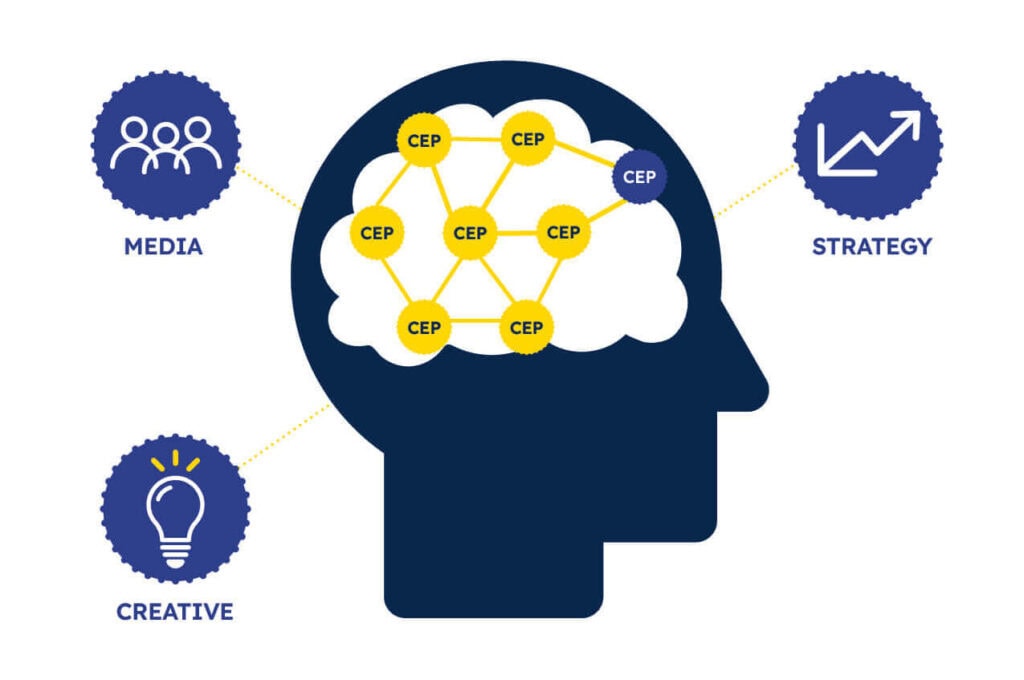
Category Entry Points: Are You Coming to Mind When It Matters?
Remember, awareness alone is not enough here. The real test is whether buyers of the category think of you when they enter the category.
If you are a coffee brand, do buyers think of you for the early morning commute?
If you are a holiday company, do you come to mind when families are planning their two-week summer holiday?
A chocolate brand? Are you the brand that comes to mind when someone has a break?
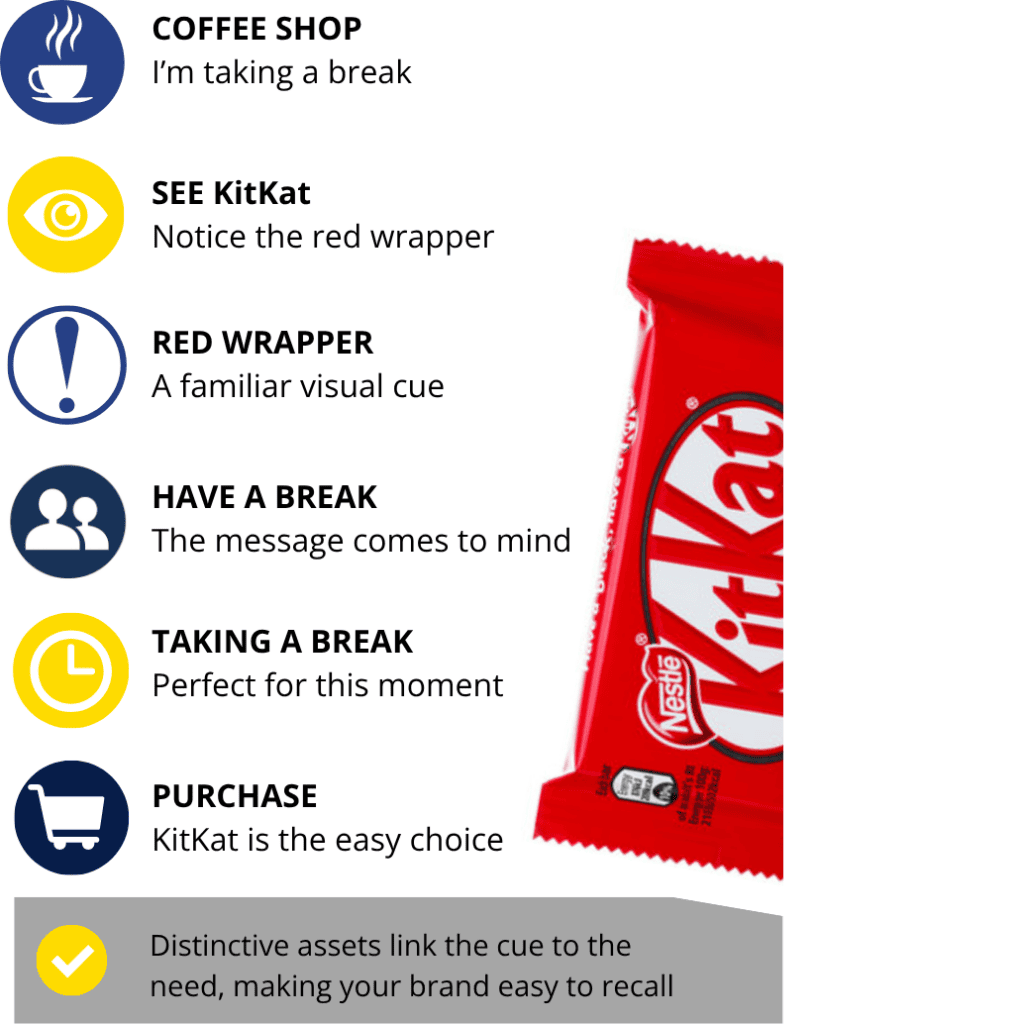
It’s one thing to track this once, but tracking it over time tells you whether the efforts of your marketing plan are driving your scores in the right direction and against the Category Entry Points you have identified.
The goal is to track whether your brand is increasingly being linked to the buying situations that matter most. If this is happening, then your positioning is beginning to translate into Mental Availability.
Commercial Outcomes: Is the Market Rewarding You?
Brand Positioning is not judged by the marketing team. It’s the market that judges it.
Strong positioning should lead to commercial impacts that your boardroom understands:
- Is the penetration of your brand increasing?
- Is pricing power becoming a reality?
- Is market share growing?
- Is revenue growth sustainable?
Marketing metrics tell you whether buyers are changing their perceptions, and commercial metrics tell you whether those changing perceptions are translating into profitable growth.
Both matter.
Alongside these longer-term measures, it’s also worth keeping an eye on the leading indicators. Commercial growth often takes time, so look for early signs that your positioning is beginning to gain traction. Campaign response, branded search behaviour, website traffic and share of search can all provide useful clues that more buyers are beginning to think about your brand. They are not proof that the strategy is working, but they are often the first indicators that your marketing is moving in the right direction.
Carry out a Mental Availability Assessment: Know which of the CEPs matter to the buyers of the category and measure how your brand scores against them.
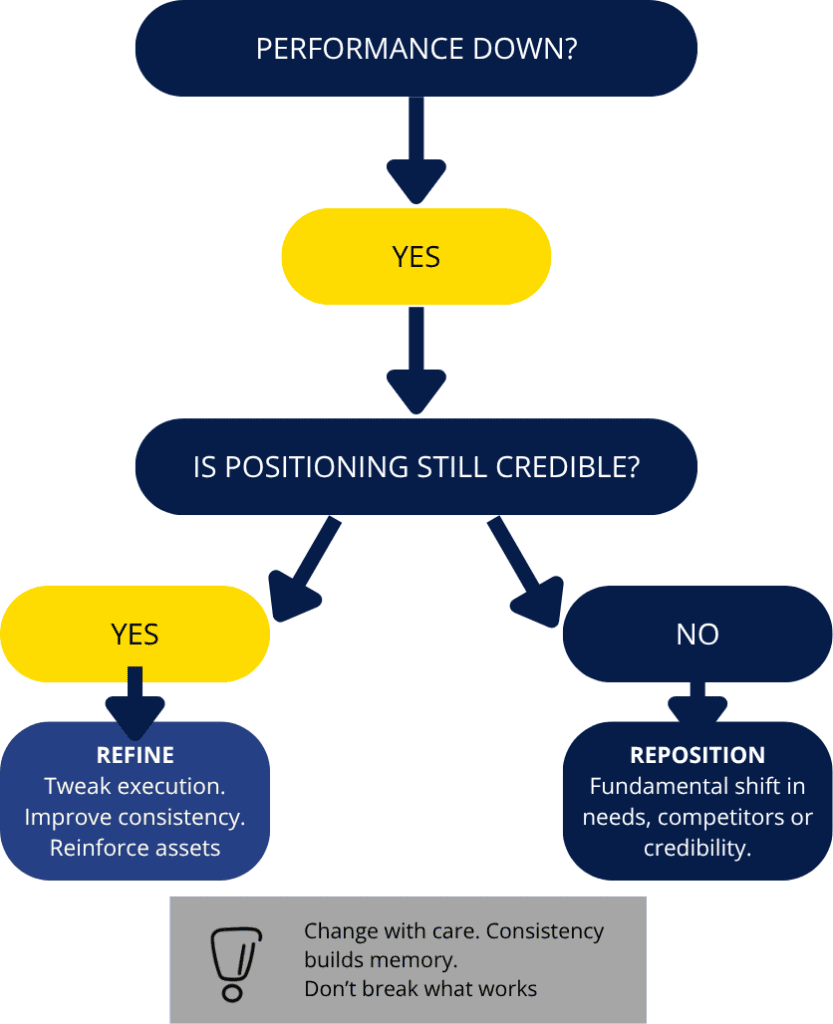
Refine or Reposition?
If brand positioning is something that takes years, even decades, to cement itself in the minds of category buyers, then you need to ask yourself some very serious questions if the new marketing hire wants to review it and make wholesale changes.
This should scare you.
Not every dip in performance requires a repositioning of the brand.
It could be that a new entrant has come into the market and is reaching more of your buyers with a message that means they are coming to mind more frequently.
It could be external factors.
In the majority of cases it is unlikely the performance is due to a problem with your positioning, it is more likely to relate to how the brand is being managed and whether the right messaging is reaching enough people who buy the category.
If, after careful consideration, you decide that the only way to fix the problem is to reposition rather than refine, then tread carefully. This should be reserved for fundamental shifts such as significant changes in customer needs, disruptive new competitors, technological change or a position that is simply no longer credible.
Conclusion: Brand Positioning Must Aid Memory Structure
Brand positioning provides a clear, long-term direction for how a brand should be understood, remembered and chosen. It defines the associations the organisation wants to build among category buyers, gives those buyers a credible reason to choose the brand and guides how the business presents itself across every customer touchpoint.
Effective brand positioning depends on clear strategic choices. It identifies the audience, establishes the competitive frame of reference, defines the few associations the brand wants to become known for and provides credible reasons to believe them. These choices should sit at the intersection of consumer relevance, competitive distinction and the company’s ability to deliver consistently.
Positioning expresses the organisation’s intention, while brand image reflects what buyers actually remember. Consistent marketing and distinctive brand assets help close the gap by repeatedly reinforcing the same associations until they become established memory structures.
Measurement therefore needs to extend beyond awareness and campaign response. Brands should track whether buyers increasingly associate them with the Category Entry Points that influence purchasing decisions. Strengthening these links builds Mental Availability and increases the likelihood that the brand will come to mind when someone is ready to buy.
Strong brand positioning is relevant, credible, memorable and sustained over time. It should be protected, measured and refined carefully rather than changed in response to short-term performance fluctuations. When positioning becomes firmly embedded in buyer memory, it can support greater penetration, stronger pricing power and sustainable brand growth.
Further Reading
Brand Strategy: How to Build Evidence-Led Marketing that Drives Growth
Brand Differentiation: How Distinctiveness Drives Mental Availability and Growth