
Brand strategy should inform better decision making. It should explain where growth could come from, which buying situations deserve investment, what gives the brand a credible role and what the organisation needs to do next. It should also make clear what will not be prioritised.
At SmilingCFO, we bring those decisions back to a practical question:
In which buying situations do we need more category buyers to think of our brand, and what will help them choose it?
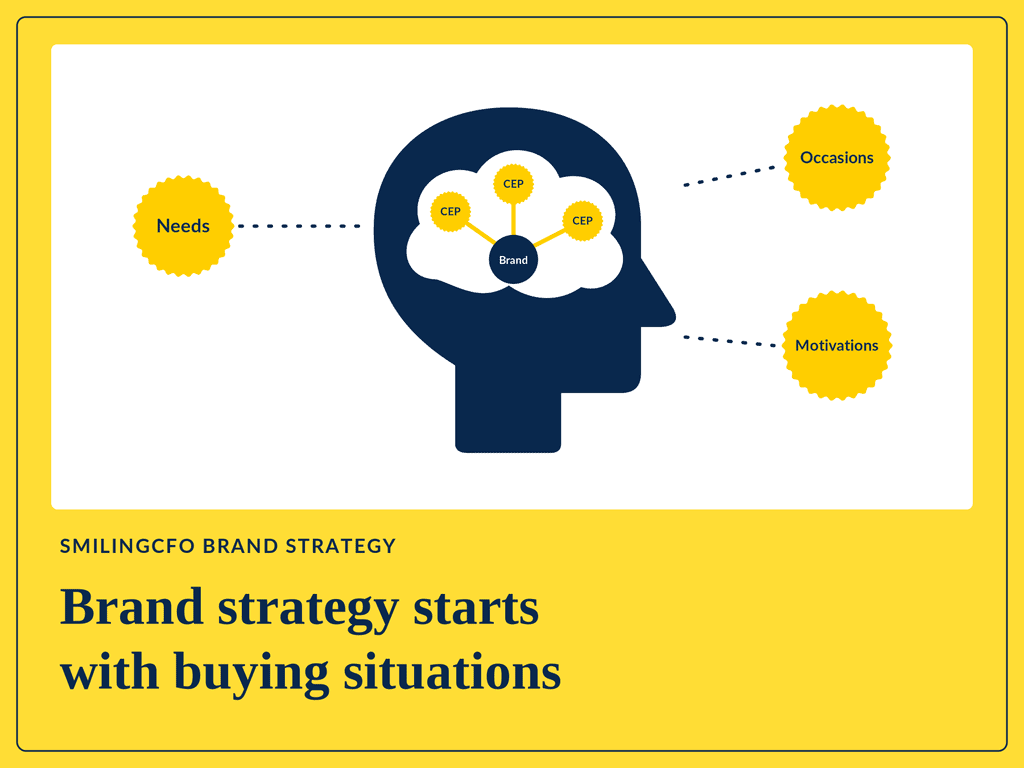
Our research experience spans a dozen countries, more than 35 categories and over 700 brands. That breadth provides context for interpreting an individual brand’s results. This article sets out how we approach that task, from understanding category buyers to agreeing the brief, investment and measures of success.
What is brand strategy?
Brand strategy is the set of choices that defines how a brand intends to grow: the opportunities it will pursue, the role it will play, the associations it will build and the resources required to deliver.
Positioning is part of that strategy. It expresses the intended role and meaning of the brand. Identity makes the brand recognisable. Campaigns bring selected priorities to life. The wider strategy gives those activities a common direction.
For example, “become the most trusted brand” is an ambition. To turn it into a strategy, I would want to know what buyers need reassurance about, in which situations that reassurance matters, why the brand can credibly provide it and what might still prevent purchase.
Brand Strategy should start with the category and how buyers think about that category
Before deciding where to grow, define the category you are competing in. How do buyers describe the category, which alternatives do they consider and how do their needs change across occasions. An internal product classification is a useful starting point, but it should be checked against buyer evidence.
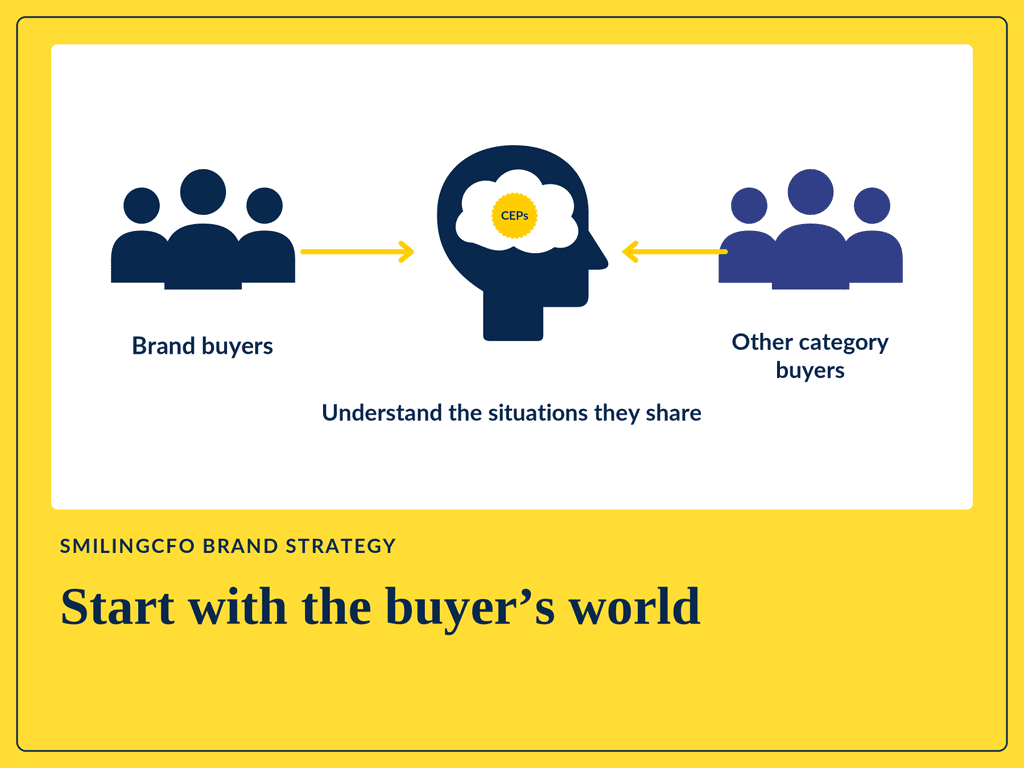
Agree the category definition, competitor set and purchase period before collecting or interpreting the data. Include light buyers and people who buy the category without currently choosing your brand.
The aim is to understand the market beyond the people who already know your brand best.
Understand when the brand needs to come to mind
Category Entry Points, or CEPs, are the cues buyers use to retrieve brands from memory in buying situations. They can include needs, motivations, occasions and context. Mental Availability concerns how easily a brand comes to mind; Physical Availability concerns how easy it is to buy.
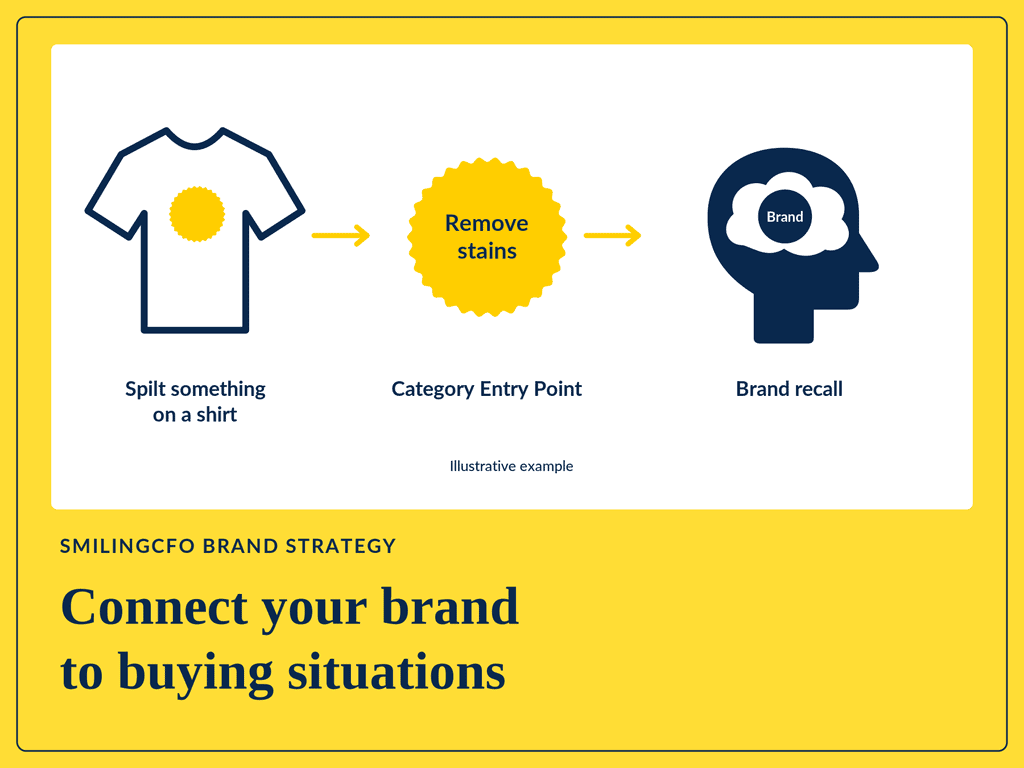
Consider an illustrative laundry situation: someone spills something on a shirt and needs to remove the stain. That need can prompt the retrieval of detergent brands associated with stain removal.
The strategic question is whether your brand has a useful connection with that situation, and whether the product can deliver.
A practical brand strategy framework: diagnose, develop hypotheses, set objectives
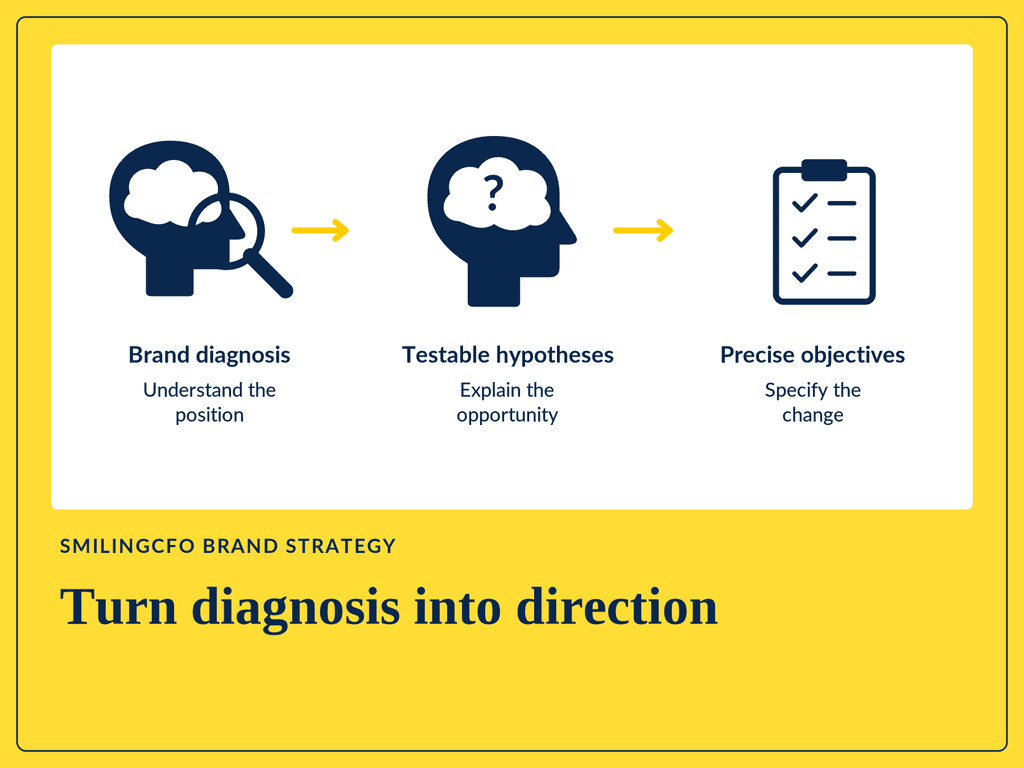
Our starting framework has three stages: brand diagnosis, testable hypotheses and precise objectives.
Each stage should produce something useful. Diagnosis identifies the problem or opportunity. A hypothesis explains a possible route forward. An objective specifies the change the business will seek to achieve.
1. Diagnose the brand’s position
A Mental Availability Assessment examines the associations category buyers make between brands and buying situations.
At SmilingCFO, we look at both the overall position and the patterns that lie beneath it. Which situations are widely relevant? Where is the brand already strongly associated? Where does it perform above or below expectations? How do the results differ between buyers and non-buyers?
For example, in one assessment, a brand’s heritage and authenticity provided an established source of credibility. Yet a substantial proportion of category buyers could not connect it to any of the measured CEPs. The recommendation therefore addressed both the number of people making an association and the breadth of associations they could make.
The strategic interpretation went further. Heritage could provide reassurance, but it did not necessarily tell people when to use the brand. The opportunity was to connect that credibility with recognisable shared occasions.
2. Develop hypotheses that can be examined
A brand may have strong associations among existing buyers and weak associations among non-buyers. One hypothesis could be that its communications have not reached enough additional category buyers. Another is that people need product experience before they appreciate its relevance.
Those explanations imply different actions.
I would examine media delivery, previous creative work, product experience and commercial availability alongside the research. A useful hypothesis makes the next decision clearer. It should explain why a proposed action could help and what evidence would increase or reduce confidence in it.
3. Set precise objectives
“Improve brand health” leaves too much open to interpretation.
A more useful objective specifies the association to establish or strengthen, the audience in which change is needed, the baseline and the intended timeframe.
For example:
Increase the proportion of category buyers who associate the brand with getting a family dinner ready quickly and with little effort.
Building a Mental Advantage, (i.e. +5pt deviation) with these CEPs would be a more precise objective.
An effective brand strategy needs to distinguish the work that is essential now from the opportunities that can be developed later.
The best brand strategies prioritise buying situations based on multiple criteria.
A popular CEP deserves attention, but popularity alone is not enough to determine investment.
I would assess an opportunity against five questions:
| Decision | What the evidence should help establish |
| Category value | How widely relevant is the situation, how often does it arise and what commercial value could it represent? |
| Brand credibility | Can the product deliver, and do existing associations provide a credible starting point? |
| Competition | Which brands are strongly associated, and which perform above expectations? |
| Additional coverage | Would this priority extend relevance to additional buyers, or largely duplicate other selected CEPs? |
| Practical delivery | Can the business support it through communications, distribution, product availability and investment? |
Our Mental Availability Assessments bring category relevance and brand associations together, then examine competitive patterns and the brand’s ability to participate. This helps turn a long list of possibilities into a more defensible shortlist.

Understand what Mental Advantage tells you
Larger brands generally attract more associations, while some CEPs attract more responses across the competitive set. Mental Advantage analysis compares a brand’s observed associations with an expected level that accounts for these patterns. It helps identify strengths that would be obscured by looking only at raw association scores.
At SmilingCFO, we also identify Potential Growth Spaces: CEPs where none of the measured brands exceeds the Mental Advantage threshold.
These deserve investigation. They do not establish that a situation is unclaimed, that demand is unmet or that growth will be easy. Competitors can have substantial associations without exceeding expectations.
The decision still depends on the value of the situation, the brand’s ability to deliver and the investment required.
Consider combinations, not just individual rankings
I would also examine how the shortlisted CEPs work together.
Two highly relevant situations may involve many of the same people. Another CEP could add meaningful coverage among category buyers who would otherwise be missed.
Decide what to defend, strengthen and expand
A brand strategy should provide direction for existing strengths as well as new opportunities.
Defend the valuable situations in which the brand already has a credible role.
Strengthen important associations that are weak relative to the competition.
Expand into additional situations where the brand can deliver something relevant.
One food-category assessment illustrated why these priorities need to be considered together.
The brand’s most mentally connected buyers strongly associated it with getting dinner ready. However, across all category buyers, the brand held no Mental Advantage within that territory. Existing familiarity and competitive strength were telling different stories.
The recommendation was to protect the core dinner role, address gaps in broader meal occasions and build relevance in family and social moments.
Turn brand strategy into a shared brief
The strategy becomes useful when teams can see what it means for their work.
I would bring strategy, creative and media together before the brief is finalised. Agree the priority buying situations, the evidence supporting the brand’s role and the memory change the campaign should seek to achieve.
Strategy: explain the choice
Strategy teams should explain why the selected opportunity deserves investment, what supports the brand’s credibility and what has been deprioritised.
The output should give the organisation a reason to commit, rather than simply a list of promising occasions.
Creative: define the memory, leave room for ideas
Creative teams need a clear objective and freedom over the execution.
For the dinner example, the brief could ask:
Make our brand easier to think of when dinner needs to happen quickly, easily and with little mental effort.
That leaves room for humour, emotion, surprise and distinctive storytelling. It also gives reviewers a useful test: is the situation recognisable, is the brand’s role clear and is the intended association memorable?
Media: connect broad reach with the memory task
The media brief should distinguish between category buyers who make no brand association, those whose existing associations need broadening and those who already know the brand but do not choose it.
In another Mental Availability Assessment, some non-buyers could make numerous brand associations but were less likely to connect the brand with an important taste attribute than a competitor. The recommendation was to strengthen that perception and investigate purchase barriers.
Make the work recognisably yours
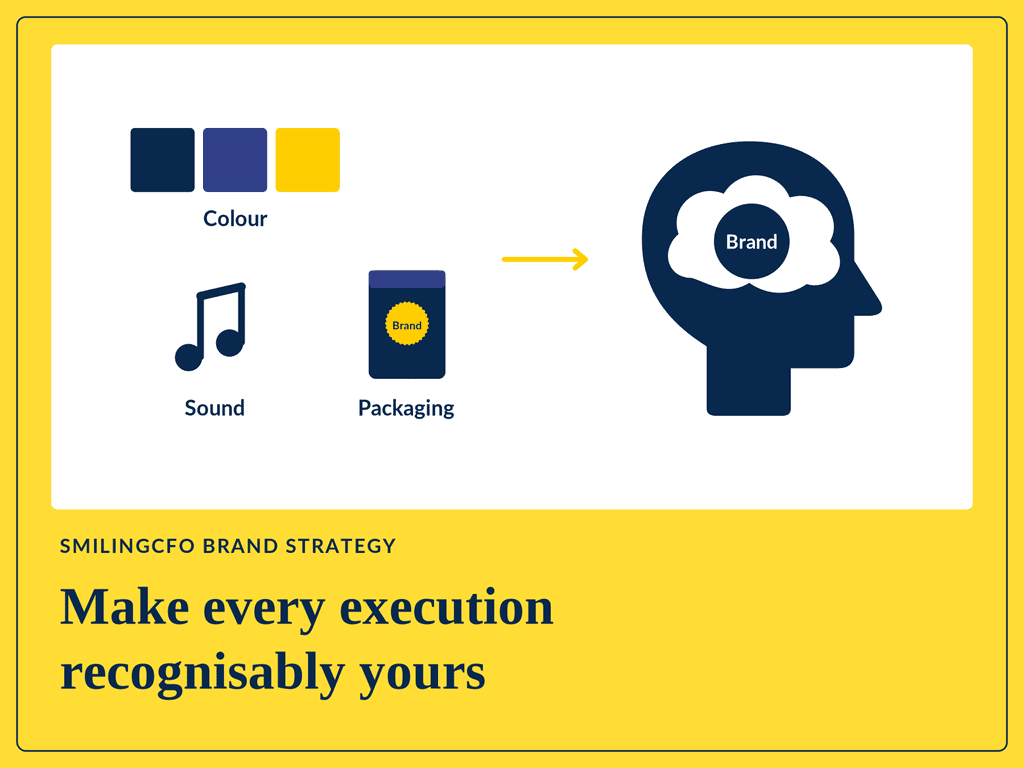
Brand strategy should also specify which distinctive assets the organisation will build and protect.
Colours, shapes, packaging, characters and sounds can help people identify the brand. Their value depends on whether they are recognised and linked to the correct brand, rather than simply whether the marketing team likes them. The Ehrenberg-Bass Institute assesses distinctive assets through fame and uniqueness.
I would test important assets without the brand name where appropriate, examining both correct attribution and confusion with competitors.
Use that evidence to decide which assets deserve consistent investment. Creative freedom and recognisable branding should support one another.
Connect Mental Availability with the ability to buy
A brand strategy should consider what happens after the brand comes to mind.
Can people find the product? Is the relevant format available? Is the price acceptable? Does the product meet expectations? Are there unnecessary obstacles to purchase?
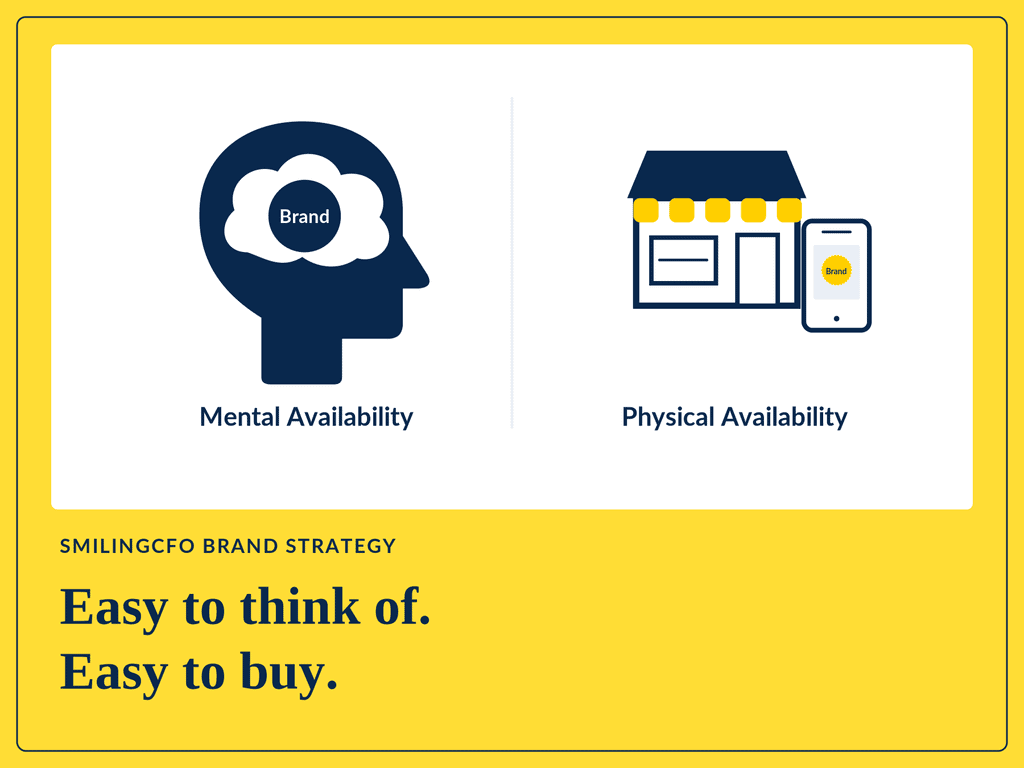
Where memory measures appear stronger than purchase behaviour, it could be that distribution is holding the brand back. Where the reverse is true then distribution power might be hiding a mental availability weakness.
Build an investment plan the organisation can deliver
The brand strategy should explain how resources support its priorities.
Agree investment principles with the CFO and commercial leaders before asking teams to develop detailed plans.
For each priority, specify the work required, its owner, the budget, dependencies and the point at which progress will be reviewed. Connect the communication calendar with product availability, customer activity and sales expectations.
Where investment needs to change, make the trade-off visible. What will be delayed? Which audience will receive less exposure? Which objective will take longer?
Measure whether the brand strategy is working
The evaluation plan should follow the strategic objectives.
Retain existing tracker measures where they remain useful, then add the mental availability evidence needed to assess the intended change. Establish the baseline before the campaign begins.
Match each Mental Availability metric to its purpose
| Metric | What it measures | Strategic use |
| Mental Penetration | The percentage of category buyers linking the brand to at least one measured CEP. | Assess whether the brand’s mental presence is extending to more people. |
| Network Size | The average number of measured CEPs linked to the brand, among people making at least one link. | Assess the breadth of existing memory networks. |
| Mental Market Share | The brand’s share of all measured brand–CEP links across the competitive set. | Monitor its overall relative position. |
| Share of Mind | The brand’s share of measured brand–CEP links within the group who link it to at least one CEP. | Examine its relative position among people with an existing brand association. |
These measures provide different perspectives. Review them alongside the specific CEPs and perception gaps the strategy intended to address.
Keep delivery, memory and commercial performance connected
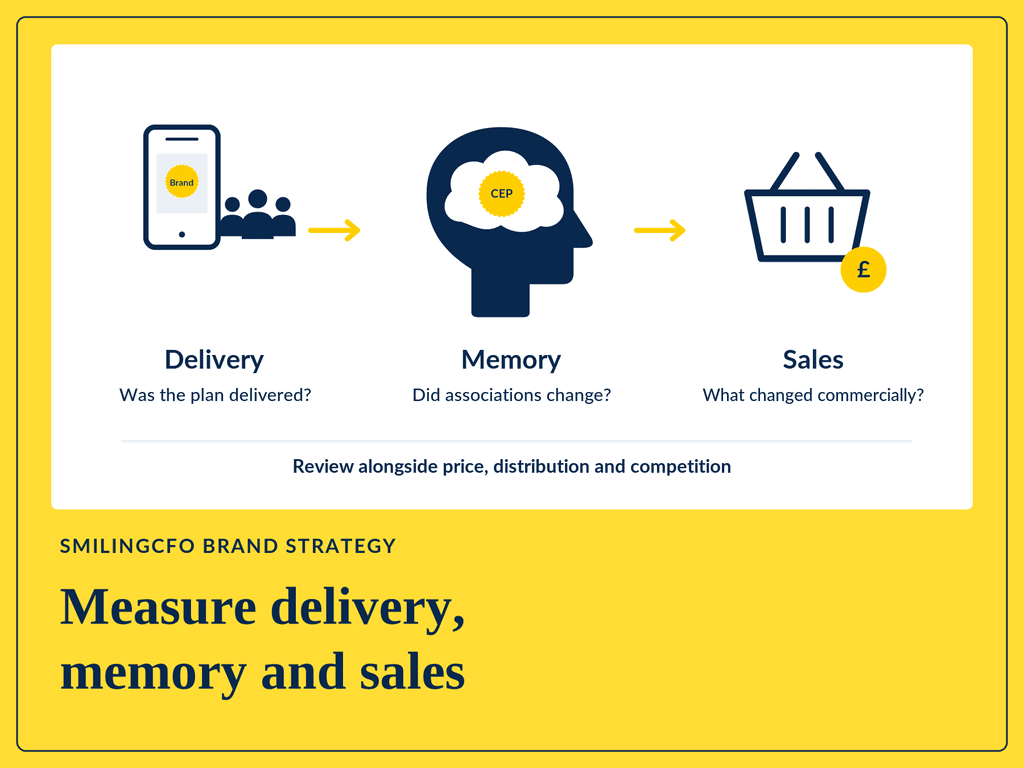
I would organise the review around three questions.
Was the plan delivered? Examine reach, exposure, creative deployment and relevant commercial availability.
Did the intended associations change? Look at the priority CEPs, Mental Availability metrics and differences between buyers and non-buyers.
What happened commercially? Review purchase penetration, sales, market share and profitability alongside price, distribution and competitive activity.
Measure delivery, memory and sales
Keep category definitions, questionnaire wording and research bases consistent enough to support comparison. Where changes are necessary, document them.
Interpret the metrics together. For example, recruiting people who make only one or two initial associations can increase Mental Penetration while reducing the average Network Size. That arithmetic does not automatically mean existing associations have weakened.
Finally, a before-and-after improvement does not establish how much the campaign caused. Use appropriate evaluation designs and treat explanations as hypotheses where causal evidence is unavailable.
What should be in a completed brand strategy?
Before approval, I would expect a short document that answers six questions:
- Where will we compete? The category, buyer universe and relevant alternatives.
- What is the diagnosis? The principal opportunity or constraint, supported by evidence.
- What will we prioritise? The situations and associations to defend, strengthen or expand.
- Why can the brand deliver? Its credible role, product support and distinctive assets.
- What will we do? The coordinated actions, resources, owners and timetable.
- How will we judge progress? The baseline, intended changes, commercial measures and review points.
How SmilingCFO supports brand strategy
SmilingCFO helps brand leaders and agency teams turn Mental Availability evidence into practical direction.
Our assessments identify relevant CEPs, examine competitive memory strengths and gaps, and help prioritise the associations and audiences that deserve attention. The intended output is brief-ready direction for strategy, communications and investment.
We use the evidence to support a clear discussion: what should the brand retain, where should it build a stronger presence and what else needs investigating before investment is committed?
That is the contribution we want research to make.
A strong brand strategy connects a credible opportunity with the decisions, resources and measures needed to pursue it.
To discuss what that could look like for your brand, contact SmilingCFO about a Mental Availability Assessment.
Further Reading
Mental Availability: A Strategic Guide for Brand Leaders
Brand Positioning: Ensuring Intent Becomes Reality.