Why Distinctive Brand Assets Matter for Mental Availability
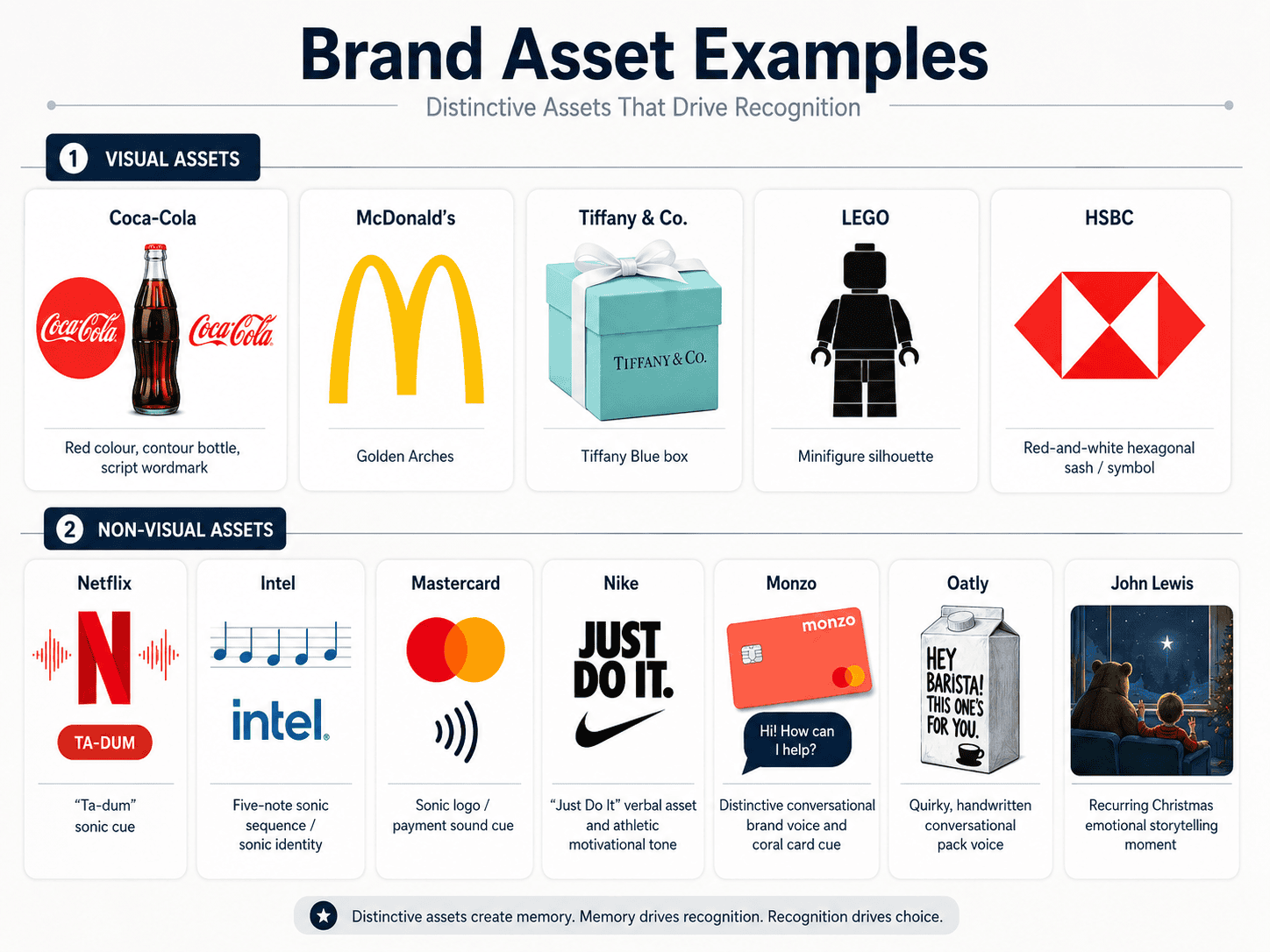
The brand asset examples in this article show how strong brands become easier to recognise before buyers have consciously processed the name, message or product claim.
In cluttered B2C categories, this matters because buyers are rarely giving every brand their full attention. They may be scanning a supermarket shelf, scrolling quickly through social media, passing an outdoor poster or making a routine purchase on autopilot. Distinctive Brand Assets help the brand stand out in these low-attention environments and make it easier to retrieve from memory.
The evidence from the Ehrenberg-Bass Institute, Byron Sharp and Jenni Romaniuk is clear at a high level: brands grow by becoming easier to think of and easier to buy. Distinctive Brand Assets (DBAs) support that process by creating additional memory routes back to the brand. When those assets are repeatedly presented alongside relevant Category Entry Points, they help strengthen the associations that underpin Mental Availability.
A colour, shape, sound or character does not usually give someone a reason to prefer a brand on its own. Its first job is recognition and attribution. It helps ensure that a product experience, advertisement or buying cue is connected with the correct brand rather than being remembered only as category advertising.
This article focuses on real brand asset examples and the practical lessons CMOs can draw from them. The important question is whether buyers recognise the DBAs, link them uniquely to the brand and encounter them consistently enough for the association to become established in memory.
What Makes a Brand Asset Truly Distinctive?
A Distinctive Brand Asset is a non-name element that prompts the brand from the memory of category buyers.
That definition is more demanding than simply being “on brand”. Many companies have a colour palette, tone of voice and set of design elements that look internally consistent but remain generic within the category.
Jenni Romaniuk’s practical distinction is based on two measures:
- Fame: how many category buyers link the asset with the brand.
- Uniqueness: how exclusively they link it with that brand rather than competitors.
An asset needs both. A widely recognised cue that also evokes three rivals is difficult to use alone. A unique asset that almost nobody recognises has potential, but still requires investment.
Two simple questions can help senior marketers challenge their current asset system:
Would a buyer link this asset to us without seeing the logo or brand name?
Could a rival use this asset tomorrow without creating confusion?
If the answer to the first question is no, the asset may not yet be famous enough. If the answer to the second is yes, it may be too generic to provide reliable brand identification.
This does not mean every asset needs to be legally exclusive or impossible to imitate. The objective is to build a combination of cues that buyers increasingly associate with one brand.
Visual Distinctive Assets: Codes Buyers Recognise Before Reading
Visual assets are often the fastest route to recognition because they can be processed before buyers read a headline or product description.
The strongest visual systems do not rely on one logo placed in the corner. They combine colour, shape, packaging, typography and repeated design structures.
Coca-Cola: Red, Script and the Contour Bottle
Coca-Cola has built one of the most extensive visual asset systems in the world.
Its red and white colour combination, Spencerian script, red disc and contour bottle reinforce one another. The bottle shape can still evoke Coca-Cola when shown without a label, while the red field and white wave provide recognition across packaging, vending machines, outdoor media and sponsorship.
The commercial value is not simply aesthetic consistency. These assets make Coca-Cola easier to locate on shelf and easier to identify in advertising with limited copy.
The system also allows creative flexibility. A campaign can change its story, setting or cultural expression while retaining enough of the recognition layer to remain unmistakably Coca-Cola.
This is the distinction made in the Brand Consistency article: the strongest brands preserve a small set of stable cues while allowing the execution to evolve.
McDonald’s: The Golden Arches
The Golden Arches are effective because they function at multiple distances and across multiple environments.
They identify restaurants from the roadside, appear on packaging and uniforms, and can be used as a cropped or partial visual device in advertising. Combined with red and yellow, “I’m Lovin’ It” and the five-note sonic signature, they form a broad recognition system rather than a standalone logo.
McDonald’s can therefore run highly economical creative. An outdoor execution may need only a fragment of the arches, a product image and a location cue.
That is commercially useful in fast-moving environments where the buyer has little time or motivation to process a detailed message.
Tiffany & Co.: Tiffany Blue
Tiffany Blue demonstrates how colour can become highly distinctive when used with discipline and reinforced by a consistent product experience.
The colour appears on boxes, bags, retail materials and communications. The packaging itself has become part of the emotional value of receiving the product.
Colour is generally difficult to own because competitors share category conventions. Research referenced in the Brand Consistency article found that characters, logos and logotypes often have greater potential for unique ownership than colour alone.
Tiffany succeeds because the colour is supported by packaging shape, retail experience, typography and long-term consistency. The lesson is that colour should rarely be treated as the entire asset strategy.
LEGO: The Mini-figure Silhouette
The LEGO mini-figure is more than a product component. Its proportions, head shape, hands and body structure form a recognisable brand asset.
The silhouette can be used across packaging, films, games, theme parks, retail and licensing. Different characters and themes provide creative variety while the basic figure remains stable.
The mini-figure also connects the master brand with multiple properties and audiences. A Star Wars or Harry Potter character still looks unmistakably LEGO.
This is an example of an asset that supports recognition while allowing the portfolio to expand. The brand can flex the expression without resetting the visual memory structure.
Non-Visual Distinctive Assets: Voice, Sound and Experience
Distinctive Brand Assets are not limited to what buyers can see.
Audio, language, tone of voice and recurring experiences can create powerful retrieval cues, particularly as brands operate through apps, video, voice interfaces and service environments.
Netflix: The “Ta-Dum”
Netflix’s short “ta-dum” sound marks the transition into the viewing experience.
It is effective because it appears at a repeated and emotionally relevant moment: immediately before the content begins. Over time, the sound has become connected with anticipation, entertainment and settling in to watch something.
The cue travels easily across devices and markets. It does not depend on language, screen size or a detailed visual execution.
Its strength comes from consistency and placement. A sonic asset becomes more valuable when it occurs at a stable moment in the customer experience.
Intel: The Five-Note Sequence
Intel’s sonic sequence became distinctive partly because the company itself was often invisible inside the products consumers purchased.
The sound helped turn a component brand into something buyers could recognise across computer advertising. “Intel Inside” and the five-note sequence gave a technical ingredient an identity and reinforced the idea that the processor mattered.
This demonstrates how sonic branding can help businesses that do not control the final retail environment. The asset allowed Intel to travel through the communications of partner manufacturers while retaining recognition.
Mastercard: A Sonic System
Mastercard has extended its identity into a broader sonic system used in advertising, transactions and digital experiences.
The strategic opportunity is significant. Payment brands often operate at moments where visual attention is limited but sound can confirm that an interaction has been completed.
A sonic cue can therefore do two jobs: identify the brand and reassure the customer that the transaction has worked.
This shows how assets can move beyond communications and become part of the product or service experience.
Nike: “Just Do It”
“Just Do It” is a verbal asset, but its power comes from more than being a memorable line.
It has been applied consistently across elite athletes, everyday sport, personal ambition and cultural moments. The wording remains stable while the story changes.
This gives Nike a flexible creative platform tied to a recognisable voice: direct, motivational and action-oriented.
A line becomes distinctive when buyers connect it strongly with one brand and when it can carry different executions over many years. Frequent replacement would destroy that cumulative value.
Monzo and Oatly: Distinctive Brand Voice
Monzo has used an informal, straightforward voice to make banking feel less institutional. The tone appears in app messages, customer communications, social media and service language.
Oatly has used a more irreverent, self-aware voice across packaging, advertising and public communications. The pack itself often reads like a conversation with the buyer.
In both cases, voice helps differentiate the experience, but it also supports recognition. Buyers can sometimes identify the brand from the style of writing before seeing the name.
Voice is harder to govern than a colour specification because it depends on judgement. It therefore requires clear examples, principles and approval processes rather than vague instructions to “sound human”.
John Lewis: A Recurring Emotional Occasion
The John Lewis Christmas campaign is not one fixed logo, character or piece of music. Its distinctiveness comes from a recurring moment and narrative expectation.
Buyers anticipate an emotional story, a particular production quality and a soundtrack released in the context of Christmas.
The individual execution changes each year, but the ritual itself has become a recognisable brand property.
This demonstrates that recurring occasions, narratives and emotional structures can also function as assets when they are consistently branded and protected.
The Brand Consistency article makes the same point through Specsavers: a recurring situation or narrative device can become as recognisable as a logo when it is repeatedly connected with the brand.
How CMOs Should Select, Protect and Scale Distinctive Brand Assets
The objective is not to accumulate dozens of potential assets. Most brands will be better served by selecting three or four priority cues that can work together.
A balanced system might include:
- a defining colour combination;
- a product or packaging shape;
- a sonic cue;
- a character, tagline or distinctive voice.
The exact combination will vary by category and touchpoint. A packaged-goods brand may place greater emphasis on pack geometry and colour. A digital service may benefit more from app sounds, interface elements and tone of voice.
Validate What Buyers Already Recognise
Begin with an audit of existing and historic assets.
Include logos, colours, packaging shapes, characters, slogans, sounds, typefaces, product forms and recurring creative devices. Brand archives can reveal useful cues that have been neglected but still retain memory value.
Then test these quantitatively for Fame and Uniqueness.
Do not select assets solely because the brand team likes them or because they work well in a design system. The research should show which cues buyers actually use to identify the brand.
Build a Two- to Three-Year Playbook
The brand asset system needs to move from research into execution.
The playbook should specify how priority assets will appear across:
- advertising;
- packaging;
- retail and shopper activity;
- ecommerce thumbnails;
- social media;
- CRM;
- sponsorship;
- sales materials;
- uniforms and vehicles;
- apps and product experience.
It should distinguish between the fixed recognition layer and the flexible execution layer.
The fixed layer includes the assets that must remain stable. The flexible layer includes story, casting, setting, channel format, cultural reference and the Category Entry Point being dramatised.
This allows creative teams to innovate without continually rebuilding recognition from zero.
Hard-Wire Assets Into Briefs and Governance
Distinctive brand assets should be included in creative briefs, retail briefs, product-development processes and agency onboarding.
Moments of change create the greatest risk:
- redesigns;
- pack refreshes;
- sponsorships;
- retailer collaborations;
- market adaptations;
- mergers;
- new agency appointments.
Any proposal to remove or significantly alter a priority asset should be supported by evidence. The decision should consider current Fame and Uniqueness, the role the asset plays in recognition and the likely cost of rebuilding lost memory.
Measure Performance Over Years
Asset performance should be reviewed through recurring Fame and Uniqueness research.
Deployment should also be audited.
Distinctive assets are an input into Mental Availability. When they are consistently co-presented with relevant Category Entry Points, the brand should become easier to identify, easier to recall and more likely to be considered. Running a SmilingCFO Mental Availability Assessment each year will show you the progress being made.
Conclusion
The strongest brand asset examples demonstrate that recognition is built through cumulative exposure rather than periodic reinvention.
Coca-Cola’s contour bottle, McDonald’s Golden Arches, Tiffany Blue, the LEGO minifigure, Netflix’s “ta-dum” and Nike’s “Just Do It” work because buyers have encountered them consistently across multiple years, channels and experiences.
Their value lies in making the brand easier to identify and retrieve in moments where attention is limited and competition is high.
The practical recommendation for CMOs is clear:
- Identify the three to five assets with the greatest Fame, Uniqueness and practical potential.
- Protect them as long-term commercial assets.
- Build a two- to three-year playbook for consistent use.
- Allow creative variation around a fixed recognition layer.
- Measure asset performance and Mental Availability over time.
- Resist rebrands that remove valuable memory structures without compelling evidence.
Done well, Distinctive Brand Assets become more than design elements. They form a repeatable recognition system that improves attribution, strengthens Mental Availability and increases the brand’s chance of being chosen across more buying situations.
Further Reading / Listening
Mark Ritson and Byron Sharp discuss distinctiveness on Uncensored CMO
Mental Availability: A Strategic Guide for Brand Leaders
Distinctive Brand Assets: A Practical Guide for CMOs and Insight Leaders