What is Brand Differentiation? (and How It Actually Creates Competitive Advantage)
Brand differentiation is the process of establishing a relative advantage in the minds of category buyers. Brand positioning defines what an organisation wants its brand to stand for; differentiation reflects the extent to which buyers associate that brand with certain qualities, benefits or experiences more strongly than they associate its competitors with them.
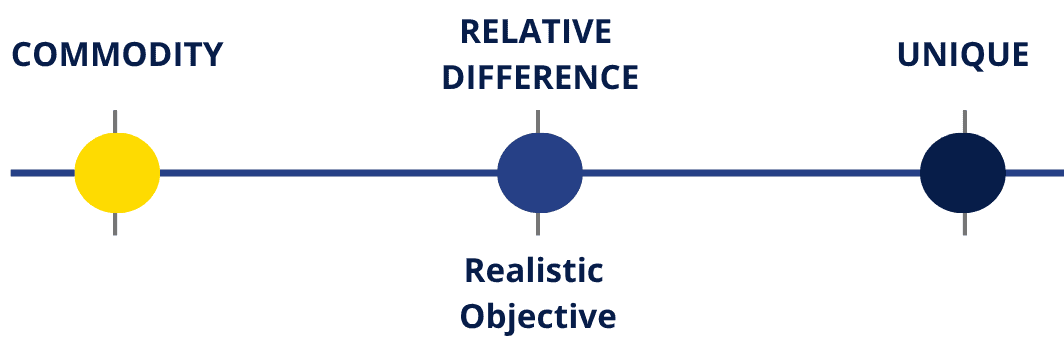
The word relative is important. Brand differentiation does not require a unique product feature, an uncontested market position or an attribute that no competitor could credibly claim. In most mature categories, genuine uniqueness is rare and often temporary. Product features can be copied, service improvements can become category norms and competitors can make similar claims.
Mark Ritson’s MiniMBA approach therefore directs marketers towards relative brand differentiation: being more strongly associated with a small number of relevant qualities than competing brands. The objective is to identify a few attributes that matter to category buyers, deliver them credibly and reinforce them more consistently than the competition. It is positioning based on being “more or less of something” rather than searching for a supposedly unique selling proposition.
This creates a more realistic task for CMOs. A brand does not need exclusive ownership of an idea such as safety, convenience, performance or value. It needs sufficient relative strength for buyers to connect that idea with the brand more readily than they connect it with the alternatives.
Volvo does not possess exclusive ownership of automotive safety. Every credible manufacturer must make safe cars. However, decades of product choices and communications have made safety more strongly associated with Volvo than with many competing brands. The difference is relative rather than absolute.
Byron Sharp offered an equally useful warning at Cannes:
“If your brand is differentiated, you’d better know why. If it isn’t, don’t worry, because most brands aren’t.”
The implication is not that brand differentiation has no value. It is that marketers should avoid inventing differences that buyers do not recognise or care about. Most brands compete with relatively similar products, serve overlapping buyers and share many category associations. Brand differentiation should therefore be treated as a potential competitive advantage to identify and build, not as a compulsory claim that every strategy document must contain.
For most brands, distinctiveness and Mental Availability will remain at least as important. Buyers need to recognise the brand and retrieve it in relevant buying situations before any relative difference can influence choice. At Cannes in 2026, Sharp and Ritson agreed that building Mental Availability and consistently using Distinctive Brand Assets are central marketing tasks.
The practical distinction is:
Brand Differentiation gives buyers a reason to purchase. Distinctiveness helps them recognise and remember which brand it is.
Effective brand strategy needs both, but not necessarily in equal measure. A genuinely differentiated brand should understand and protect the source of that advantage. A brand with little measurable differentiation should concentrate on becoming easier to identify, recall and buy rather than manufacturing an unconvincing point of difference.
Where Brand Differentiation Lives: Turning Strategy into Market Reality
Brand differentiation exists in what buyers experience, not in the vocabulary used during a positioning workshop. It appears in product performance, service delivery, pricing, distribution, customer experience and the associations repeatedly reinforced through communications.
This is where differentiation differs from the wider Brand Positioning discussion. Positioning articulates the intended meaning of the brand. Differentiation is the relative strength that emerges when the organisation delivers and reinforces part of that meaning more convincingly than competitors.
Product Differentiation
Product differentiation may come from performance, technology, design, ingredients, durability or ease of use.
Tesla built relative brand differentiation by making electric power, software and technology more central to its automotive proposition than traditional manufacturers initially did. Electric vehicles are no longer unique to Tesla, but the brand continues to benefit from having established strong associations with electric mobility and technological progress.
This illustrates the distinction between uniqueness and relative brand differentiation. Tesla does not need to be the only business producing an electric car. Its advantage comes from being more readily associated with electric vehicle innovation than many alternatives.
Patagonia creates relative strength around product durability and environmental responsibility. Outdoor clothing competitors can also produce durable products or offer repairs, but Patagonia reinforces these qualities through product design, repair services, resale and communications. The combination makes those associations especially credible for the brand.
Service Differentiation
“Exceptional customer service” is not a useful differentiator by itself. It is a generic claim made by organisations in almost every category.
Service becomes differentiating when it is translated into a recognisable and repeatable customer experience. A bank might provide instant notifications and simple in-app controls. A retailer might make returns unusually easy. A business-to-business provider might give customers direct access to specialists rather than routing every query through a general service desk.
Monzo’s early relative difference did not come from claiming to care more about customers. It came from making banking feel more immediate and understandable through its app, real-time notifications, spending information and approachable tone.
Competitors can copy individual features. The strategic task is to keep delivering and reinforcing the broader experience strongly enough for buyers to continue associating it with the brand.
Price and Value Differentiation
Price-based differentiation also needs to be considered relatively.
A brand does not need to offer the lowest price on every individual product. It may instead become known for reliable overall value, transparent pricing or a consistently favourable balance between price and quality.
Aldi’s brand differentiation comes from the package buyers experience: a limited range, extensive own-label offer, operational simplicity, competitive basket prices and repeated quality comparisons. Other supermarkets can reduce prices, but Aldi has made value more central to how its business operates and how buyers remember it.
Distinctive Brand Assets
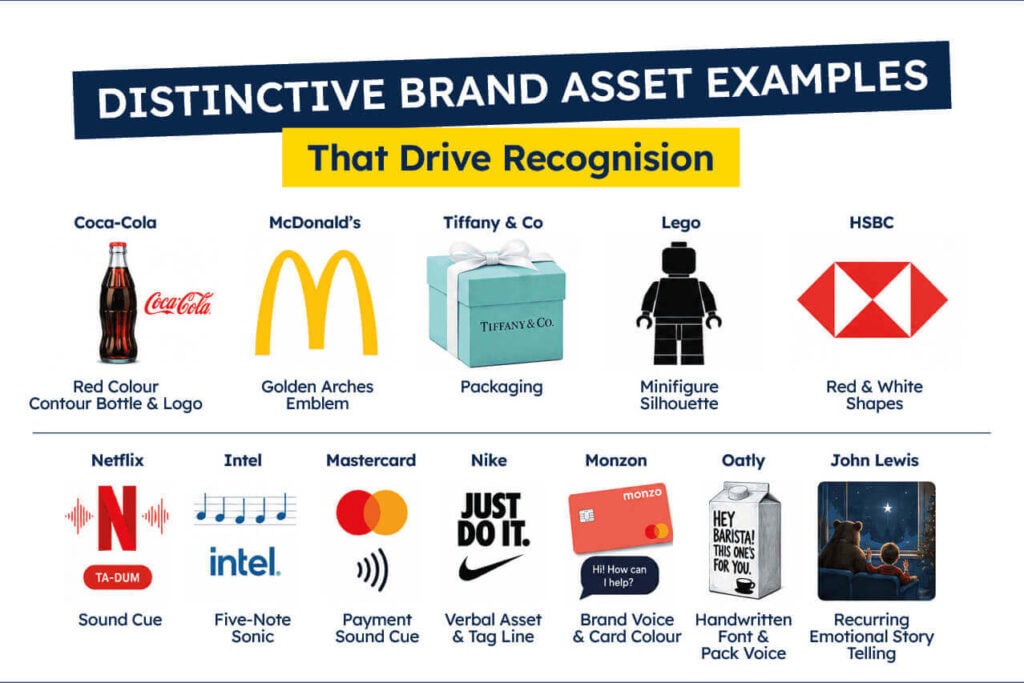
Distinctive Brand Assets perform a different role. Colours, logos, shapes, characters, sounds and packaging help buyers recognise the brand and connect its activity with the correct name.
A distinctive asset does not necessarily give someone a reason to prefer the brand. Monzo’s coral card helps people identify Monzo; it does not, by itself, explain why the bank offers a better current account. Aldi’s colours identify Aldi, while its pricing, product range and operating model provide the relative value proposition.
Brand Differentiation and distinctiveness should therefore work together:
- Differentiation establishes the associations the brand wants to be relatively stronger on.
- Distinctiveness ensures that buyers correctly attribute those associations and experiences to the brand.
- Mental Availability connects the brand with the buying situations in which it needs to be recalled.
Together, these elements create a coherent proposition that buyers can experience and remember.
Designing a Brand Differentiation Strategy Grounded in Evidence
A brand differentiation strategy should begin by measuring reality. The organisation needs to understand whether buyers already perceive meaningful differences, where those differences exist and whether they influence choice.
Understand Category Buyers and Buying Situations
Begin with category research rather than narrowly profiling the existing customer base. Identify the needs, occasions, problems and triggers that bring buyers into the category.
Category Entry Point research can establish:
- Which buying situations are most common or commercially valuable.
- Which associations buyers use to distinguish between available options.
- Where competitors possess Mental Advantages.
- Where the brand has credible capabilities but weak buyer associations.
- How category needs and expectations are changing.
Segmentation can add useful context, but marketers should be cautious about constructing artificial differences between the buyers of competing brands. In many categories, brands share large numbers of customers. The strategic opportunity is often to become more strongly associated with relevant buying situations across the category rather than to define a narrow target audience.
Measure Existing Relative Brand Differentiation
Ask category buyers which qualities, benefits and experiences they associate with each brand. The analysis should compare brands rather than looking at the client brand in isolation.
A score of 45% for “easy to use” may appear encouraging until research shows that three larger competitors score between 55% and 65%. Conversely, a seemingly modest score may represent a genuine relative advantage when every competitor performs materially worse.
Useful questions include:
- Which associations are disproportionately linked with the brand?
- Are these differences statistically and commercially meaningful?
- Do they matter to buyers?
- Are they supported by the actual product or experience?
- Are they connected with important Category Entry Points?
- Do buyers outside the existing customer base recognise them?
This is where Mental Availability analysis adds value. It shows whether a relative difference is helping the brand come to mind in buying situations, rather than simply appearing as an abstract image attribute.
Identify Potential Sources of Relative Strength
Review possible differentiators across the whole business:
- Product performance or technology.
- Service design.
- Convenience and accessibility.
- Range architecture.
- Pricing or subscription structure.
- Specialist knowledge.
- Heritage and credibility.
- Customer experience.
- Distribution.
- Distinctive sensory or visual assets.
Reject generic descriptions unless the organisation can make them specific and observable.
“Trusted” is generic.
“Every product is independently tested and carries a ten-year guarantee” is evidence.
“Customer-focused” is generic.
“Customers retain one named contact from onboarding through delivery” is an operating model.
A useful differentiator should describe something buyers can experience, verify or remember.
Apply the Three Cs
Potential differentiators should pass three tests:
Consumer: Does the association matter to category buyers?
Competition: Can the brand become relatively stronger on it than the alternatives?
Company: Can the organisation deliver it consistently and credibly?
The competitive test does not ask whether no other brand can make the claim. It asks whether the company can establish greater relative strength through superior delivery, evidence and sustained communication.
Prioritise one central positioning concept supported by a small number of attributes. Ritson argues that adding more concepts dilutes the probability of standing for anything. Relative brand differentiation develops by selecting fewer associations and reinforcing them more consistently than competitors.
Executing Differentiation at Scale: Assets, Experience and Pricing
Relative brand differentiation is built through cumulative execution. Brands become known for something because they deliver and communicate it repeatedly, not because they mention it in one campaign.
Codify the Intended Advantage
Translate the strategy into clear operating guidance covering:
- The central positioning concept.
- The attributes the brand wants to become relatively stronger on.
- The evidence supporting each claim.
- The Category Entry Points the position should reinforce.
- The product and service behaviours required.
- The pricing logic.
- The Distinctive Brand Assets that identify the brand.
- The messages and experiences that must remain consistent.
This prevents different functions from interpreting brand differentiation independently.
A brand seeking relative strength around simplicity should not offer a confusing product range, complex pricing and an impenetrable website. A premium service position will lack credibility if customers receive a standardised, low-contact experience.
Say Less, More Often
Relative brand differentiation depends on concentration. Ritson’s guidance is to select a small number of important associations and reinforce them with greater consistency, media investment and longevity than competitors. The brand does not need exclusive ownership of the attributes; it needs stronger ownership in buyer memory.
This means resisting the pressure to introduce a new message with every campaign. A sequence of unrelated propositions may keep internal stakeholders interested, but it prevents buyers from learning what the brand should represent.
The relevant question is not whether the organisation has said the message before. It is whether category buyers have learned it yet.
Use Distinctive Assets to Carry the Difference
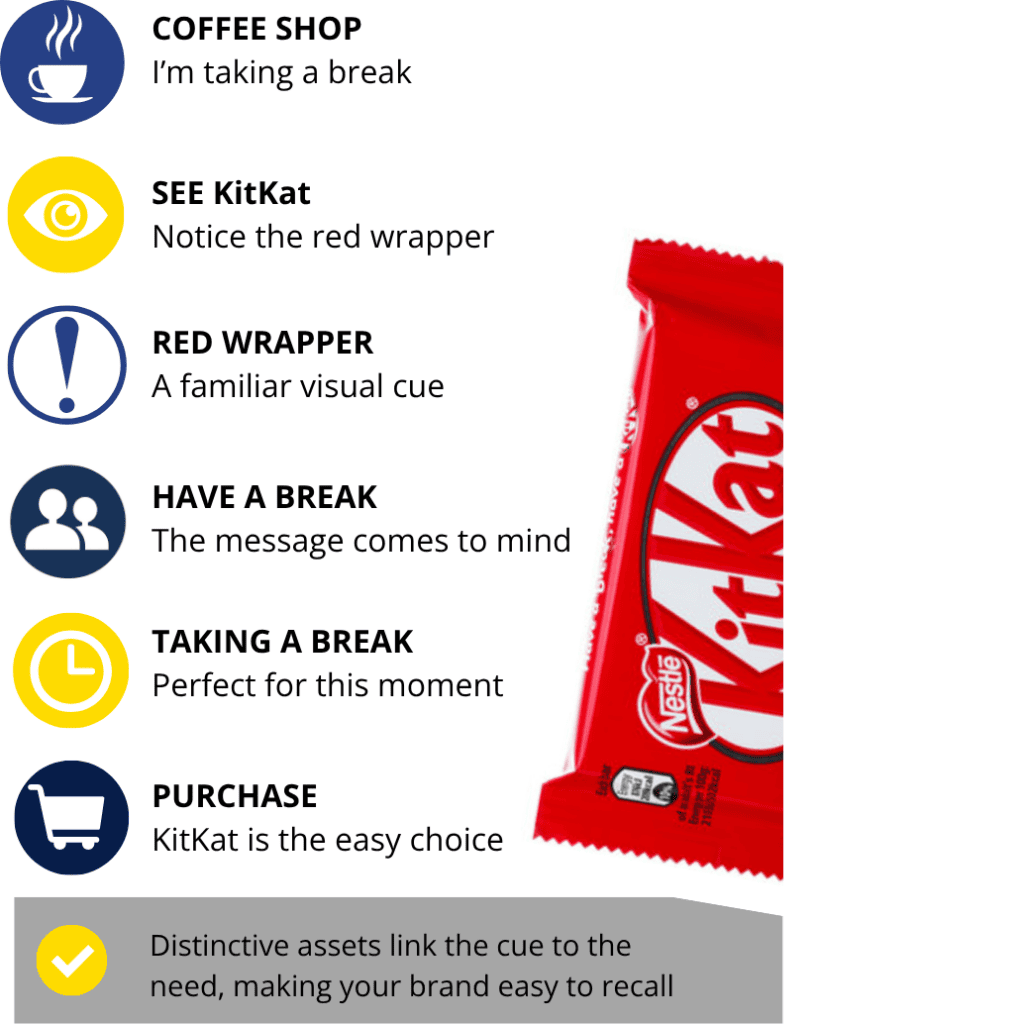
Every expression of the position should be recognisably branded. Distinctive colours, shapes, characters, sounds and verbal devices help connect repeated product and communication experiences with the same brand.
This is Ritson’s “Double D” approach: differentiation and distinctiveness. One helps the brand stand apart; the other helps it stand out and be correctly identified.
Align Product, Experience and Price
The relative advantage needs to extend across the marketing mix.
A quality position requires product performance and service evidence.
A convenience position requires accessible distribution and a low-friction buying process.
A value position requires a pricing structure buyers can understand and trust.
An innovation position requires a continuing record of meaningful improvement.
Marketing communications can strengthen a credible difference, but they cannot indefinitely compensate for an experience that contradicts it.
Measuring Whether Your Brand is Truly Differentiated (Not Just Different on Paper)
The purpose of measurement is to establish whether buyers perceive a relevant relative difference and whether it contributes to Mental Availability and commercial performance.
Measure Relative Associations
Track intended associations against competitors, not only against the brand’s previous score.
The central questions are:
- Are buyers more likely to link the brand with the intended attributes than they are to link competitors with them?
- Is the relative gap growing, stable or declining?
- Does the association matter in category choice?
- Is it present among non-buyers as well as existing customers?
Avoid interpreting every statistically higher score as a strategic advantage. The difference also needs to be meaningful, credible and relevant to the situations that drive buying.
Measure Distinctive Asset Strength
Test whether buyers recognise assets and correctly attribute them to the brand.
An asset should ideally be:
- Famous: widely recognised among category buyers.
- Unique: attributed primarily to the correct brand.
- Consistently used: reinforced across touchpoints over time.
This identifies whether the brand is building recognition even where strong differentiation is limited.
Measure Mental Availability
Track whether brand differentiation contributes to retrieval in buying situations.
Relevant metrics include:
- Mental Penetration.
- Network Size.
- Mental Market Share.
- Spontaneous recall within priority Category Entry Points.
- Relative association advantages and disadvantages.
- Development among buyers and non-buyers.
A brand may have a strong association with one attribute but remain mentally available across too few buying situations. In this case, differentiation has become narrow and may not provide a sufficient platform for growth.
Connect the Difference with Commercial Outcomes
Assess whether stronger relative associations coincide with:
- Increasing penetration.
- Improved price realisation.
- Trial and repeat purchase.
- Wider distribution.
- Reduced dependence on promotions.
- Revenue and profit growth.
- Market-share improvement.
Brand differentiation should not be judged by whether buyers can repeat the positioning statement. It should help the brand become easier to choose, support stronger pricing or provide another measurable commercial advantage.
A CMO Checklist for Relative Brand Differentiation
Before investing further in a brand differentiation strategy, ask:
- What does the evidence show that our brand is relatively stronger on?
- Do category buyers care about that difference?
- Is it connected with important Category Entry Points?
- Can buyers experience the difference through the product, service, price or distribution?
- Could a competitor currently make the same claim more credibly?
- Are we reinforcing a small number of associations more consistently than competitors?
- Do our Distinctive Brand Assets make the activity recognisably ours?
- Is the relative advantage strengthening Mental Availability?
- Does it support penetration, preference, pricing power or another commercial outcome?
- Would growth still be possible if the brand proved to have little measurable differentiation?
The final question is particularly important. Brand differentiation can create competitive advantage, but it is not a prerequisite for the survival or growth of every brand. Where strong relative differences exist, marketers should understand, reinforce and protect them. Where they do not, brands should not invent them.
Instead, the priority should be to build Distinctive Brand Assets, reach category buyers, strengthen links with relevant Category Entry Points and make the brand easier to buy.
Strong brand strategy does not force a choice between differentiation and distinctiveness. It uses evidence to determine the role each should play. Relative differentiation gives the brand the opportunity to become better known for a few relevant qualities, while distinctiveness and Mental Availability ensure buyers notice, recognise and recall it.
The result is a more credible route to growth: identify any real relative advantage, express it with clarity, brand it distinctively and reinforce it for long enough to become established in buyer memory.
Recommended Reading:
Brand Positioning: Ensuring Intent Becomes Reality.
Copy Kitkat on your quest for ‘double D marketing’
Brand Strategy: How to Build Evidence-Led Marketing that Drives Growth