
Brand strategy should help marketers become respected not only for creative brilliance, but also for their understanding of marketing science, category dynamics, and the factors that influence whether brands are considered in buying situations. At SmilingCFO, we want to help create that environment.

Brand strategy should help marketing teams build practical, evidence-based plans that drive brand growth. The desired outcome is simple: Effective strategies your CFO will want to invest in.
What Makes an effective Brand Strategy?
To secure investment from your Board, CFO, or external stakeholders, you must demonstrate how your strategy will deliver growth. The best growth strategies should:
- aim to recruit more Category Buyers to your Brand.
- be built on the principles of Mental & Physical Availability.
- be commercially actionable, e.g. the sales teams believe and are committed to delivering the strategy.
- be financially adaptable to the extent that the CFO is given the flexibility to adjust and phase investment to meet business milestones, without impacting the integrity of the brand strategy.
Organisations such as P&G, Unilever and Kraft Heinz are calling out the importance of reaching more buyers, understanding the context in which these buyers interact with the category, and building what they call “brand superiority” to drive conversion.
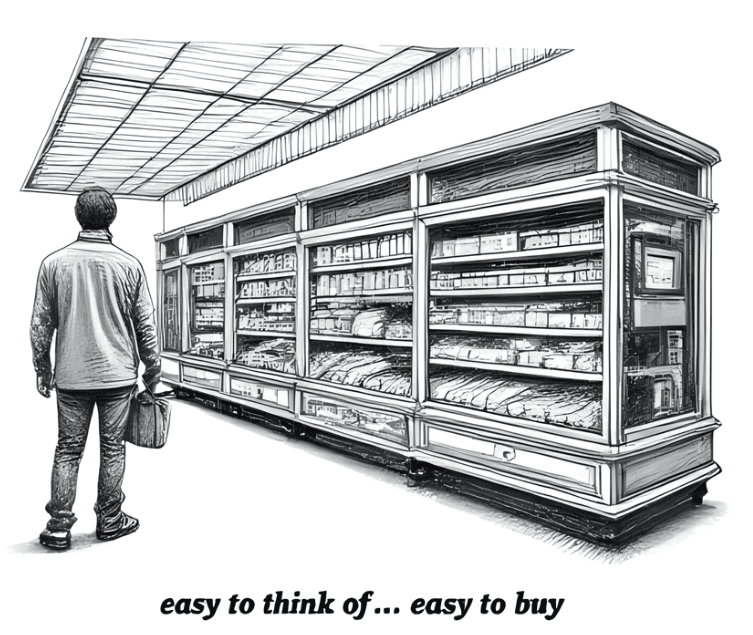
Brands grow when they come to mind in more buying situations than competitors, and are then easy to find and purchase, whether physically or digitally.
Why Good Brand Strategy Starts With Market Orientation
As Mark Ritson tells us, a good brand strategy starts with market orientation.
Part of this process should be to understand the ‘Category Entry Points’ — i.e. the needs, motivations and occasions buyers use to recall brands in different buying situations.
By running a Mental Availability Assessment, you can understand the probability of your brand coming to mind, how your brand is perceived and where you have an advantage relative to your competitors.
This allows you to develop hypotheses based on the emerging patterns.
The key point is that market orientation will sharpen your objectives by focusing on:
· where the growth will come from
· what needs to be fixed
· where you need to play defence in order to stop competitor incursion
Three Steps Toward a Better Brand Strategy
A practical, evidence-led brand strategy can be developed in three steps:
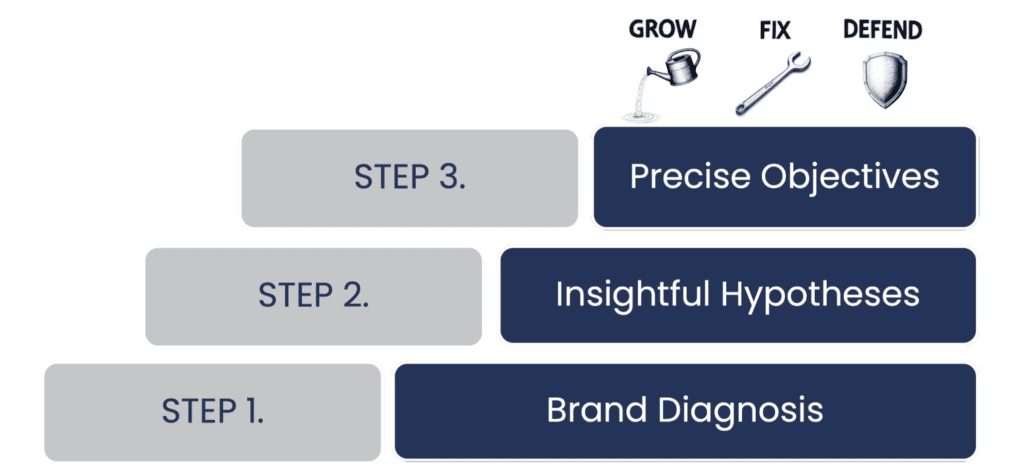
Step 1: Brand Diagnosis
The first step is to understand the current position of the brand.
This means looking beyond general awareness or preference scores and understanding how likely the brand is to be recalled in the buying situations that matter.
Step 2: Insightful Hypotheses
Once the diagnosis is complete, the next step is to develop hypotheses based on the emerging patterns.
These hypotheses should explain where the brand has an advantage, where it is vulnerable, and where there may be opportunities to recruit more buyers.
Step 3: Precise Objectives
The final step is to turn the evidence into precise objectives.
This should include where the brand needs to grow, what needs to be fixed, and where the brand needs to defend against competitor incursion.
The Role of Mental Availability in Brand Strategy
At its heart, Mental Availability is simple.
It measures how likely it is that someone recalls your brand in a specific buying situation.
Ehrenberg-Bass refer to the triggers that spark this recall as ‘Category Entry Points’ or CEPs. These are the real-life situations that make someone reach for a coffee, pick up a snack, or call an insurance provider.
The idea of “Mental Availability + Physical Availability = Brand Growth” was introduced by The Ehrenberg-Bass Institute and is an approach adopted by some of the world’s best brand builders, including Diageo, Coke and McDonald’s.
Mental Availability is built through consistency, repetition, and reinforcement.

Distinctive brand assets; logos, colour palettes, characters, and pack formats, must be used year in and year out, to refresh and strengthen memory.
Creative ideas must reach mass audiences, not just narrow targets, so that CEP associations are reinforced broadly across the buying population.
As Byron Sharp emphasises, reach is not a nice-to-have; it is the lifeblood of memory building.
Category Entry Points: The Buying Situations That Shape Brand Recall
A key part of brand strategy is understanding the retrieval cues, or Category Entry Points, buyers use to access the category your brand participates in.
For example, in the context of a laundry detergent buying situation, “spilt something on my shirt” may trigger the Category Entry Point of “removing stains.”
If more than one brand comes to mind and both are physically available, then ‘other attribute’ tie-breakers, e.g. kind to the environment, come into play.

The key points to consider are:
Understand the retrieval cues, or Category Entry Points, buyers use to access the category your brand participates in.
Understand if the brand can credibly build associations with the most valuable CEPs.
A key principle of building Mental Availability is to reach as wide a group of Category Buyers as possible, ‘co-presenting’ the brand’s distinctive assets in the context of the target CEPs.
Having addressed the first three steps, develop specific messages or promotions for particular target segments.
The Benefits of a Mental Availability Assessment
Some Category Entry Points are more valuable than others and a Mental Availability Assessment identifies the ones that are used most frequently by category buyers and buyers of your brand.
It is possible to spot CEPs where no brand holds an advantage. These white spaces present opportunities for growth.
An assessment highlights the most effective combination of CEPs to target in order to recruit new buyers.
By understanding how your brand image is perceived by buyers of the category you can review whether your intended messaging is cutting through and/or reaching enough people.
In simple terms, a Mental Availability Assessment helps brand owners understand where to focus and how to win.
Physical Availability: Making the Brand Easy to Buy
Once recalled, a brand is only bought if there are no barriers to purchase, digitally or physically.
Brand leaders shouldn’t overlook the need to work with their sales colleagues and commercial partners to optimise the buying experience.
Behind every brand’s success is a compelling customer rationale. Based on the chart below, brand 5 has the beginnings of a rationale for more space on the shelf.
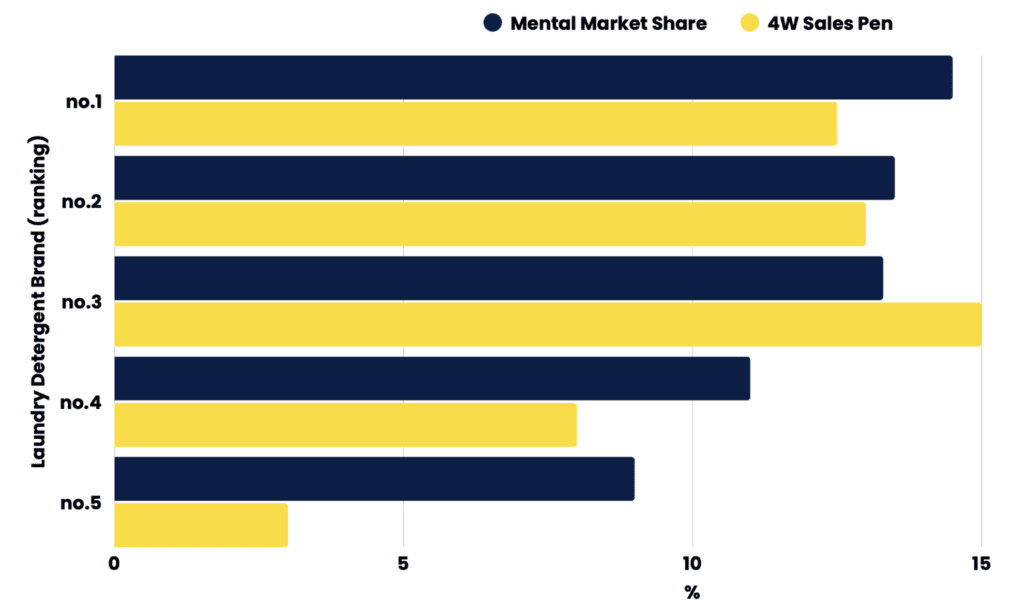
Normally, Mental Market Share (MMS) and Sales Market Share have a close correlation. In this example, the sales penetration for brand 5 is lower than expected, probably due to space being allocated to the ‘big 3’. The relatively strong MMS score for brand 5 hints at its potential and a sales upside for the retailer. Assuming there is a margin benefit if buyers move to brand 5, then this is a good story with which to arm the sales team.
Understanding the Role of Autopilot in Brand Strategy
If you are one of the big brands, then you will want category buyers to stay on ‘autopilot’.
As Phil Barden explains in his book Decoded, when the purchase is routine or habitual, then the automatic and effortless processes of System 1 lead the purchasing behaviour.
If you are a challenger brand, then you will want to find ways to disrupt normal purchase behaviour.
Translating Brand Strategy Into a Commercial Plan
Building the whole plan ‘bottom-up’ rarely leads to the best plan.
In general terms, the more collaborative and inclusive the commercial and brand planning process is, the better the output. But in three key areas, we advocate a ‘top-down’ approach.
Brand Budgets
Ensure you have investment principles in place.
Provide your leaders with a framework within which to operate.
Task them to propose and align on how the overall budget is allocated by brand.
Include the sales leaders in the promotional elements of the budgeting process.
Be ready to step in to facilitate final commercial agreement.
Activation Calendar
This has to support the overall brand strategy and communication plan if both Mental and Physical Availability are to be achieved.
If you run a portfolio, ensure you have a priority grid to drive consistent objectives across all Brands and Channels.
Sales Targets
It is unlikely that it will be possible to focus on every Territory, Channel and Customer.
Set targets for the sales teams based on the level of support that has been allocated in the budgeting process.
The sales individual will be grateful that they don’t spend hours building a business case for investment that never had a chance of being approved.
Starting everything bottom-up rarely works; it is time-consuming and often frustrates those doing the building because they are not the decision maker.
If you are truly empowering the team and are willing to accept their output as final, then running a bottom-up process might be appropriate, but it is likely to be a slow and potentially tense approach.
Better Brand Tracking: Measuring the Metrics That Matter
The tools and methods for tracking brand health have evolved significantly over time, reflecting changes in our understanding of how people think.
Many brand owners have been tracking metrics like awareness, consideration, and preference for decades.
These metrics provide continuity and historical context, but may not fully reflect the advancements in our understanding of how the brain works, what influences behaviour, and how brands are recalled in buying situations.
The opportunity lies in integrating newer concepts like Mental Availability into existing tracking.
A brand seeking to expand market share should prioritise metrics like Mental Market Share because we know there is a clear correlation between Mental Market Share and actual Market Share.
By tracking Mental Market Share and making the results visible to the business, everyone can share in the success, or if improvements are required, better understand the reasons for the mitigating actions.
Marketers have a strategically critical role in any organisation and must continue to demonstrate that what is measured drives both brand and business performance.
Ensure all stakeholders understand what is being measured and why.
The Mental Availability Metrics Every Brand Strategy Should Track
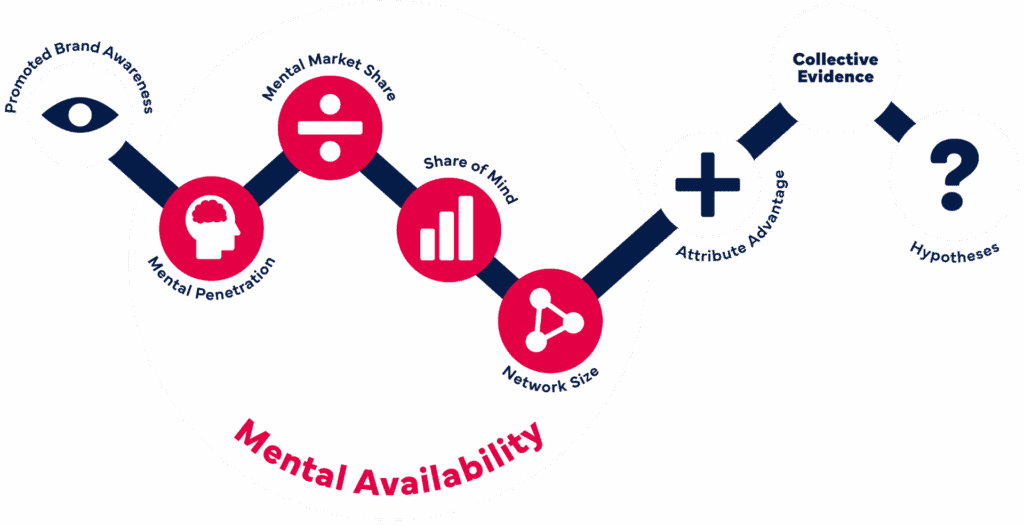
We start with Prompted Brand Awareness before we get to Mental Availability because we want to know if the brand is associated with the correct category.
Then we ask, “what is the share of all the links that are made between the category entry points and the brands?” In other words, the Mental Market Share.
You can think of this a little bit like your Sales Market Share, where you’re keen to understand the brand’s share of all the sales in the market.
Mental Penetration tells you how many Category Buyers can link the brand to at least one Category Entry Point.
There is a significantly higher chance of purchase by those who can make at least one link.
Network Size identifies the average number of CEPs that are linked to a brand by a Category Buyer. The higher the average, the more chance the brand is recalled in multiple buying situations.
Share of mind helps owners of large brands understand how vulnerable they are to competitor incursion. In other words, who is starting to encroach on a brand’s territory, and what level of cut-through are they achieving.
Common Brand Tracking Pitfalls to Avoid
Overcomplicating the Tracking System
Too many metrics or frameworks can overwhelm stakeholders and dilute focus.
In her book Better Brand Health, Jenni Romaniuk suggests circa 60% of a tracker should be dedicated to Category Entry Points, 30% to ‘Other Attributes’ and 10% to Attitude Statements.

This much more meaningful brand tracker is in contrast to many used by brands, which tend to focus much more heavily on attitude, differentiation and digital/social media metrics.
We would always recommend adding a Pricing metric to your brand tracking.
Lack of Actionable Insights
We have all sat through Brand Health Reports that fail to drive action, meaning tracking becomes a box-ticking exercise rather than a tool for growth.
Use dashboards and storytelling techniques to communicate the “why” behind the data.
Make sure you have non-buyer and light-buyer data, as recruitment of these groups is critical.
Be Careful Not to Overly Focus on Short-Term Gains Over Long-Term Equity
Prioritising metrics that track immediate sales uplifts while ignoring those that measure brand strength over time is a mistake.
Balance short-term metrics, such as conversion rates, with long-term metrics, such as mental availability.
A Brand Strategy Checklist Before You Present to the CFO or Board
Before you press send on your brand strategy, or present it to your CFO or the Board, here is a helpful checklist.
- Think about how the brands strategy might be conveyed by the CFO to Investors.
- Is it a credible story for this group?
- Are the objectives easy to understand externally?
- Is the strategy balanced to deliver against the short-term milestones of the business and the long-term needs of the brand?
- Have you reduced waste and optimised spend by minimising your ‘non-working’ investment?
- Are the metrics transparent, consistent and understood by all?
- Hopefully, you are able to put a tick against each of these. If so, you are good to go.
Conclusion: Brand Strategy Should Show Where to Focus and How to Win
An effective Brand Strategy is not built on opinion, preference, or a desire to say something different for the sake of it.
It is built on evidence.
It starts with understanding the category, the buying situations that matter, and the likelihood of your brand being thought of when buyers enter those situations.
It identifies where growth will come from, what needs to be fixed, and where the brand needs to defend its position.
It connects Mental Availability with Physical Availability, so the brand is not only easy to think of, but also easy to buy.
And it gives the whole organisation a brand strategy it can believe in, invest in, and deliver.
For marketers, the opportunity is to move brand strategy out of the world of abstract positioning and into practical commercial action.
That means building strategies that are clear enough for the Board to understand, credible enough for the CFO to invest in, and actionable enough for sales and commercial teams to support.
The brands that grow are not simply the brands people like, prefer, or recognise. They are the brands that come to mind in more buying situations than competitors, and are then easy to find and purchase.
That is why evidence-led Brand Strategy matters.
It shows brand owners where to focus, how to win, and how to build marketing worth investing in.