The key facts for CMOs
Category Entry Points (CEPs) are the building blocks of Mental Availability; the mental cues and buying triggers that help buyers recall your brand when making decisions. These triggers can be personal, such as feeling tired and wanting a pick-me-up, or situational, such as stopping at a petrol station for a quick snack.
They link the buying situation to the brands that buyers have stored in their memory.
SmilingCFO data consistently shows that Category buyers who can make at least one link to a brand are significantly more likely to buy the brand than those who cannot.
Therefore understanding the CEPs for your category is a crucial step toward building Mental Availability.
Defining Category Entry Points in the Context of Mental Availability
Mental Availability is concerned with a brand’s propensity to be thought of in buying situations now and in the future, ensuring that a brand is readily accessible in the minds of potential buyers at the moment they are making a purchase decision.
In the way that ‘Brand Awareness’ measures whether people know the brand, Mental availability measures whether they think of the brand when entering the category.
This concept of building Mental Availability is a fundamental growth principle introduced to us by Byron Sharp in the seminal marketing book, ‘how brands grow: what marketers don’t know’ and adopted by some of the world’s best brand builders, Diageo, Coca-Cola and McDonalds. Strong brands are not just recognised, they are easy to think of, in the right moments, by the widest possible group of category buyers.
“In most buying situations people want to move quickly and easily from generating a category need to satisfying this need”
Jenni Romaniuk: Better Brand Health 2023
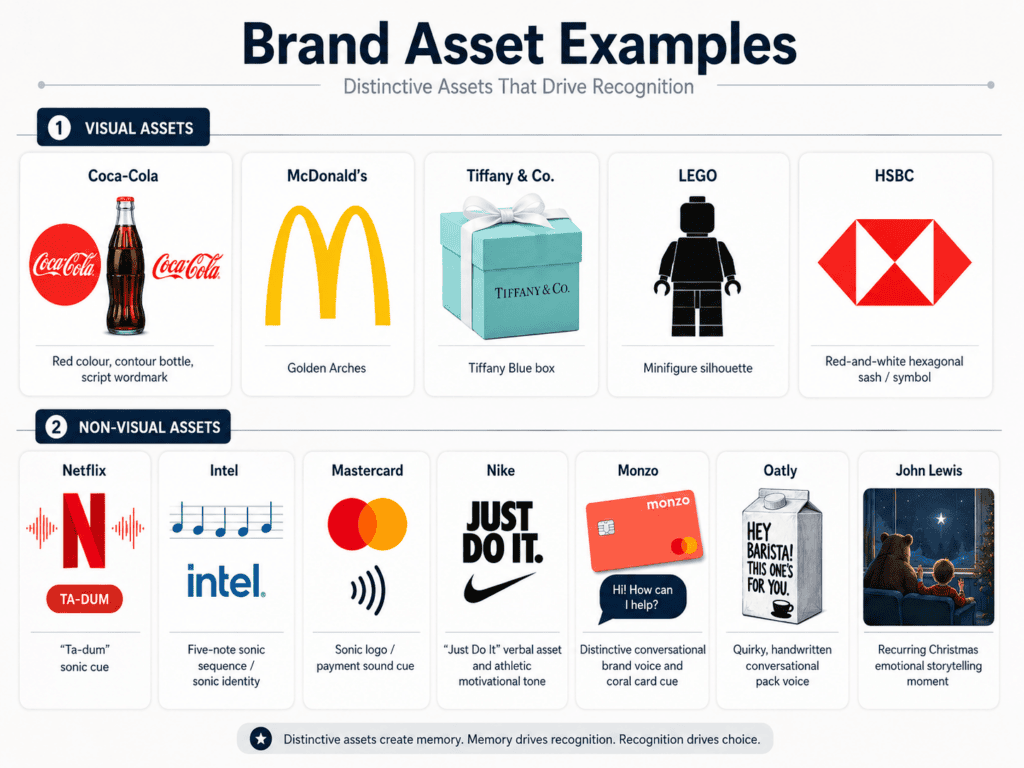
For a brand to be easily recalled, it needs to have strong associations with multiple Category Entry Points. These associations are built by establishing a set of distinctive brand assets (e.g. colours, shapes, sounds, slogans) that consistently appear alongside the most important buying situations. Over time, that builds Mental Availability.
A Category Entry Point might be practical, such as “quick dinner” or “remove a stain fast.” It might be emotional, such as “treat myself after a hard week.” It might be social, such as “something for guests.”
Whatever the specific example it is important to understand that category entry points would exist even if your brand did not.
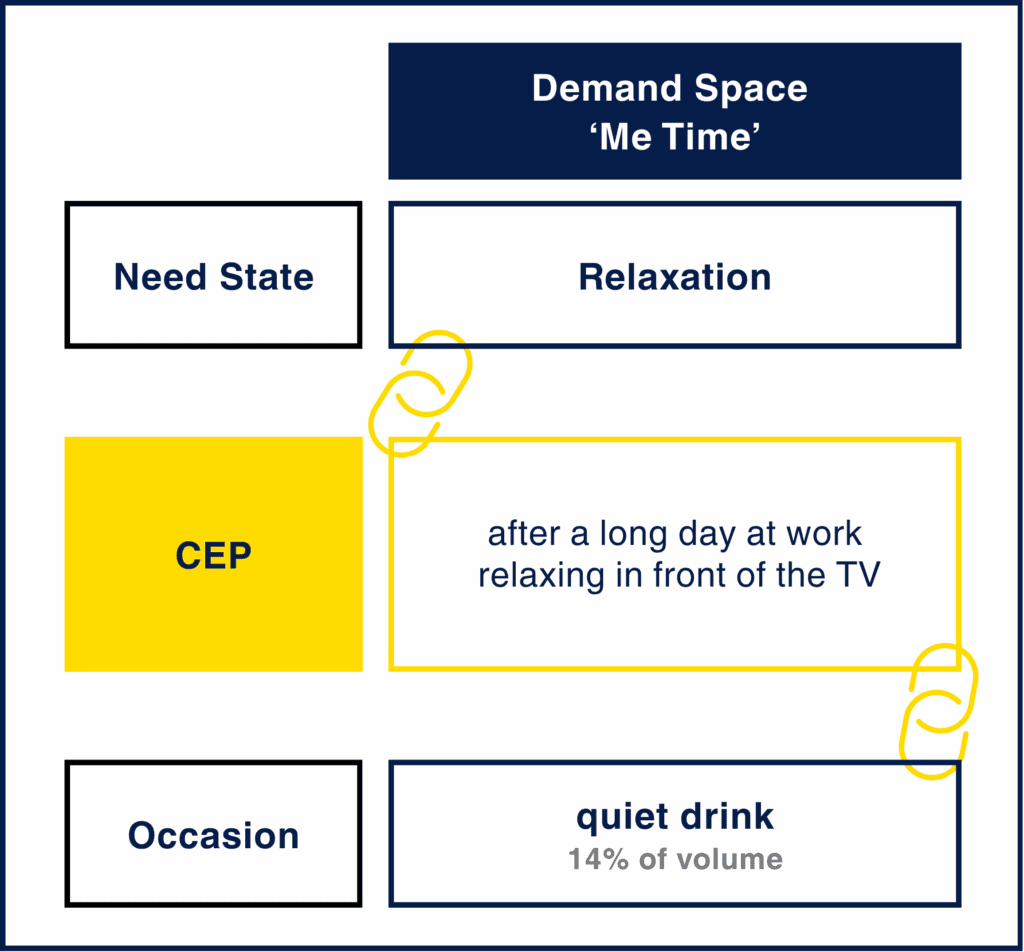
Category Entry Points can be Needs, Occasions and/or Motivations.
The most common CEP related question clients ask is “are CEPs occasions, or are they motivations, or need states?” and the answer is that they are all of these things, but with one powerful distinction.
Rather than being abstract e.g. ‘seeking relaxation’, they are specific e.g. ‘after a long day at work, relaxing watching TV’.
Conscious that many brand leaders will use Demand Spaces, (or similar) to identify growth opportunities, particularly if they have multiple territory responsibility.
I wrote an article dedicated to showing How Demand Spaces and Mental Availability Work Together
In short, Demand Spaces highlight the most attractive spaces from the perspective of both the individual brands and the overall portfolio so the company can make the logical choice about where to compete. Whereas Mental Availability highlights the most attractive category entry points, for individual brands, to increase the chance of being thought of in multiple buying situations AND the likelihood of being purchased.
In addition to being associated with multiple CEPs, it’s important for brands to focus on the other attributes buyers expect from the category. These are often divided into two types: Must-Do attributes and Tie-Breaker attributes.
- Must-Do Attributes: These are the fundamental features or benefits that every brand in the category is expected to deliver. Sometimes referred to as the “job to be done,” these attributes address the core need that brings buyers into the category. For example, in the laundry detergent category, a Must-Do attribute might be “removing stains effectively.” Failing to meet these basic expectations can eliminate your brand from consideration entirely.
- Tie-Breaker Attributes: These are the perceived benefits that provide buyers with a reason to choose your brand over another. For instance, a detergent brand might highlight its “eco-friendly ingredients” or “gentle formula for sensitive skin”.
Why Category Entry Points Matter for Brand Growth
We have run Mental Availability Assessments in a dozen countries, across 30+ categories and the growth patterns hold true for the 500+ brands in our database. The leading brands have the widest network of CEP associations, often with superiority with several of the highest value category entry points. This results in higher mental market share, which translates into higher sales market share.
Any growth map should include two important steps;
- Build Mental Penetration to increase the chance of a brand being purchased. (Mental Penetration measures how many category buyers have the brand present in memory, i.e. link at least one category entry point to the brand). KitKat is a wonderful example of a brand that has built strong Mental Penetration, by being associated with ‘break time’. This helps the brand to bridge multiple category entry points, for example, “the afternoon slump,” “after-school snack,” or “coffee companion”?
- Build associations with multiple Category Entry Points, ideally the most important CEPs with few competitors.
In my recent mental availability article I highlighted how brands associated with 6+ CEPs have more buyers than those brands with fewer associations.
How to Identify the Category Entry Points for Your Category
If you’re responsible for brand strategy, one of the most valuable analyses you can conduct as part of your market orientation is understanding which CEPs buyers/consumers use to access the category and recall specific brands from memory.
We have found the most effective process is to include qualitative and quantitative research, in line with Professor Jenny Romaniuk’s recommendations, (Better Brand Health).
- Qualitative Research: Start with the Buying Situation
The qual. is based on the 7 W’s framework (e.g. Why, When, Where, While, With/for whom, With/for what, HoW feeling) that you will find in the book, ‘Better Brand Health’ is a smart and structured way to identify the appropriate memory retrieval cues for each category. Take time to unearth the emotional Category Entry Points, not just the rational ones. - Brand Agnostic Quantitative Research Part 1: Before Category Buyers are influenced by brand associations, measure the extent to which each CEP is used to access the category. This will highlight the CEPs with the highest category relevance.
- Brands Included Quantitative Research Part 2: Measure the level of association between a representative set of brands and the 20 or so CEPs that were identified as most important in the previous round of quantitative research. This will highlight the CEPs with the highest brand relevance.
By following these steps, it is possible to create a Category Entry Point list that reflects not only the practical needs of buyers but also their deeper motivations and personal needs.
Integrating these insights into your brand strategy allows you to frame your brand in a way that aligns with buyers’ goals, making it more relevant in decision-making moments.
How to Prioritise Category Entry Points
It is helpful to map the results of the 2-part quantitative research into a 4-box grid like the one below to understand which CEPs are most important.
Category Entry Points in the top-right quadrant are highly relevant to buyers, and brands have already built strong mental associations, thereby reinforcing the CEPs as relevant to the category. The likelihood of these CEPs being triggers to recall brands in buying situations is therefore high.
The bottom-right quadrant represents highly relevant occasions to category buyers, but there are not a wide number of brands strongly associated with them. These CEPs provide potential opportunities for brands to build stronger mental links.
The top-left quadrant highlights occasions where brands have built strong associations, but the occasions themselves are less central to the category at this moment in time.
The bottom-left quadrant contains occasions that are currently low in both relevance and brand association, making them lower strategic priority.
In a mature category with significant brand investment like premium beer in the UK, there is likely to be a high number of CEPs in the top right quadrant. However, in a market where the premium beer category is new but growing we are likely to see fewer CEPs in this quadrant. Therefore, the CEPs worth targeting may sit elsewhere in the 4-box grid.
Building Mental Advantage and Finding White Space
A mental advantage is when the number of links between a particular brand and a category entry point is higher than statistically expected. A brand increases its chances of growing by building mental advantage with multiple CEPs.
Having identified the most important CEPs and how many buyers can link a brand to each one, we need to assess the opportunities by reviewing the competitor landscape.
- Are any of the ‘white spaces’, (i.e. the CEPs where no brand has a mental advantage), realistically attainable, relevant to the brand’s positioning and valuable enough to pursue?
In the example below we can see that CEP 3 presents a potential white space opportunity because no other brand included in the research has a mental advantage.
- 2. Are there Category Entry Points ‘worth fighting for’, i.e. they are used by many category buyers, but there are strong competitors in this space? Even though there are two brands with a mental advantage for CEP 1, it may still be appropriate and important for brand 3 to compete in this space, particularly if the CEP has high category relevance and/or a ‘must do’ CEP.
- 3. Are there Category Entry Points where the mental advantage is sufficiently strong that some investment could be reallocated to strengthen associations with other target CEPs? Brand 3 may be able to reallocate investment from CEP 5 to CEP 1. Professor Romaniuk highlights that the law of diminishing returns is likely to be applicable where a brand has a positive deviation greater than 10pts.
SmilingCFO tip for Brand Leaders:
We advise clients to not only measure CEP associations but to map them against competitors, so you find CEPs where many category buyers use the retrieval cue, fewer competitors are present and your brand has a credible claim. That is where the growth is likely to be sourced.
Activating Category Entry Points Across Brand Touchpoints
Campaigns build Mental Availability when they connect the brand to valuable category entry points.
This is not about restricting creativity, the intent is to liberate it. For example, Corona has successfully built associations with sunshine and outdoor imagery that makes it easier for buyers of the category to recall the brand in key buying situations. The treatment is often stylish but can sometimes be more abstract, e.g. ‘Free Range Humans’.
Media, Retail and Digital Activation Around CEP Moments
The challenge for marketers is to ensure that a brand’s relevance is retained across a fragmented landscape.
Category Entry Points provide the unifying thread. By anchoring customer experience strategies in CEPs, brands can deliver relevance at every step of the journey.
For example, a coffee brand might want to be associated with “morning wake-up”, “on-the-go convenience,” and “afternoon pick-me-up.” Each of these contexts is a CEP.
By identifying the right CEPs for their category, the coffee brand can anchor its customer experience strategy around them. This could mean:
- In-store signage highlighting “grab-and-go energy.”
- A website filter or category labelled “morning essentials.”
- A customer service script that acknowledges “helping you get through a busy day.”
- A social ad targeting commuters with the same message.
CEPs provide the consistency that helps buyers move fluidly between digital and physical channels.
How to Embed CEPs in Planning and Reporting
In my 30-year FMCG marketing and sales career, I must have been an integral part of the brand planning process for 20 cycles and led the whole process at least half a dozen times. What I have learned is that there is not a perfect process, but there are a set of best practices that deliver more effective marketing strategies and better commercial execution.
The framework below adapts Jenni Romaniuk’s advice to “design for the category, analyse for the buyer, report for the brand…”.
We have introduced a fourth dimension “translate for the business”. As a former CMO I would see firsthand the issues that the business would have to get complex matters to be easily understood with a clear set of options for the board to consider. Not being able to translate this for the board would result in great ideas not seeing the light of day.
The key point to convey is that this framework can inform a compelling brand strategy and track progress in a way that is meaningful to key stakeholders. Embarking on a brand strategy without identifying the most important Category Entry Points is similar to navigating a maze blindfolded, you might eventually stumble through, but it will be inefficient and frustrating for you AND your CFO.
This framework can be followed by completing a Mental Availability assessment.
This cost-effective approach will tell you how likely your brand is to be thought of in buying situations. It will tell you the most important memory retrieval cues for the category in which your brand operates. You will understand buyer behaviour and the brand’s growth opportunities in a way that enables sales colleagues to build customer rationales that widen the brand’s physical availability.
The data you use must ultimately inform the KPIs that are incorporated into business targets.
To that end, make sure all your key stakeholders understand the data, where it is sourced and why it is used. Then, ensure the metrics selected matter to the business and are not confused by marketing jargon.
Common Pitfalls and How to Avoid Them
Define the category in a way that your competitors would be happy to use the report. In other words, ensure that you identify a wide range of CEPs and track associations across a set of brands that represent the whole market.
Define too narrowly, and you may be skewing the results in your favour, which limits your chances of spotting new growth opportunities. Define too widely, and unless you are one of the market leaders, your brand could fail to register as many links as it should.
It is true that marketers need to bring focus to their communication and activations if they are to align the commercial teams behind great execution. However, this needs to be done mindful of the fact that ultimately brands need to build associations with multiple buying situations to increase the chance of purchase.
Resist the temptation to turn the CEPs into abstract clusters. It is appropriate to populate the CEPs under themes, but don’t affect the meaning of the CEP in the pursuit of aggregation or simplification. Stay true to the insight that informed the wording of the CEP question that went into research.
Conclusion
Growth is linked to the number of CEP associations a buyer of the category can make to your brand.
New opportunities become clear when you compare how different brands are retrieved in different buying situations.
Building mental advantage with high value CEPs and finding white spaces will sustain brand growth.
Author: Martin Coyle, Partner SmilingCFO.
Martin is a former Chief Marketing Officer and Chief Commercial Officer at global Bevco, Molson Coors.
He is an expert in building Mental and Physical Availability, Portfolio Strategy development and aligning organisations behind brand execution.
Further Reading:
Mental Availability: A Strategic Guide for Brand Leaders
Distinctive Brand Assets: A Practical Guide for CMOs and Insight Leaders