Key Takeaways
- The battle for brand growth is decided in the context of Buying Situations, Not Awareness Scores
- A Brand’s Mental Availability is shaped by more than its own marketing
- Investment decisions should be guided by ‘Measured Mental Availability’
You do not build everything that sits in the mind of your buyer.
That statement can feel uncomfortable for brand owners. We invest in communications, distinctive assets, innovation, media weight, retail activation and pricing strategy. We brief agencies carefully. We track awareness and consideration. We optimise performance media weekly.
Yet the memory structures that determine whether we are bought are only partially under our direct control.
Mental availability, the probability that a brand comes to mind in buying situations, is shaped not only by what you say and do, but also by what competitors, retailers, word of mouth, culture and even pricing architecture do around you.
If you do not measure Mental Availability, you are navigating blind.
This article covers three things:
- How memory is built.
- How it is shaped by both your actions and the actions of others.
- A structured process to understand and manage your brand’s mental availability.
1. How Memory Is Built
From a cognitive science perspective, memory is a network.
Brands are nodes. Buying situations are nodes. Attributes, emotions, people, prices, occasions, and usage contexts are nodes. Links form between them through exposure and experience.
Every exposure whether that be advertising, packaging, shelf presence, recommendation, price promotion, sponsorship, social media, or usage strengthens or weakens associative links.
Over time:
- Strong, frequent, consistent exposure builds strong neural connections.
- Weak, inconsistent exposure builds fragile links.
- Competing signals create shared or ambiguous associations.
When a buyer encounters a buying trigger, for example, “quick dinner,” “healthy snack,” “treat for guests,” “great value weekly shop”, the brain activates connected nodes. Brands with the strongest and most accessible links are more likely to be recalled.
To understand how mentally available a brand is, it is necessary to understand the following;
- How many buying situations a brand is linked to (network breadth).
- How strongly it is linked (whether it has a mental advantage, or disadvantage).
- How often those situations occur in the category (category relevance).
This is why Category Entry Points (CEPs) matter. They represent the real-world buying triggers that drive behaviour. The SmilingCFO Mental Availability database consistently shows that brands not linked to a single CEP have less than a 5% chance of being purchased.
https://smilingcfo.co.uk/mental-penetration-and-predictable-brand-growth/
2. You Don’t Fully Control Memory
Marketers might assume mental availability is built through owned communications. That is only partially true.
Your brand’s actions build memory through:
- Paid media
- Packaging
- Product performance
- Distribution visibility
- Distinctive brand assets
- Sponsorships and partnerships
- In-store activation
But there are three major external forces that shape memory just as powerfully.
2.1 Competitors Reinforcing the Same CEP
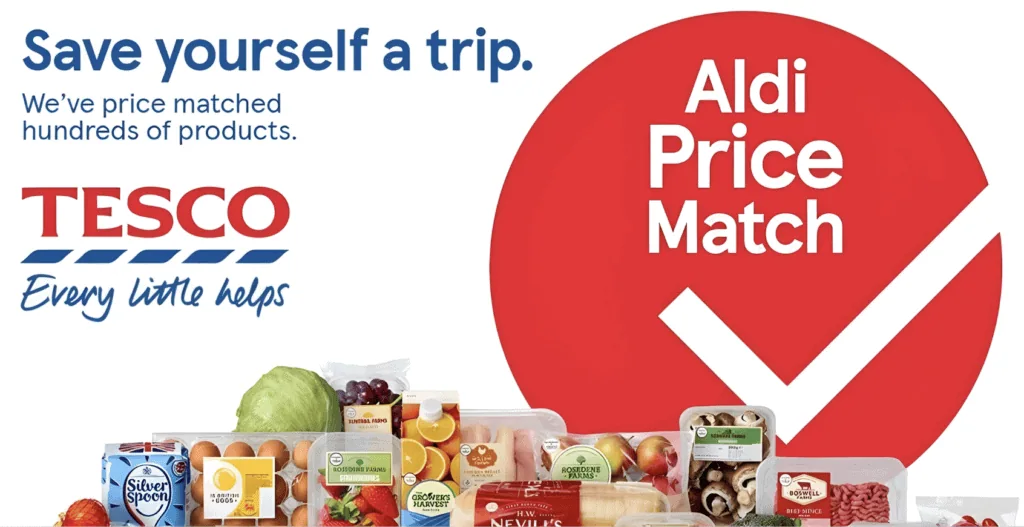
Consider the “great value” buying situation.
Aldi has invested heavily in owning “great value.”
Tesco reinforces it through Aldi Price Match initiatives.
Something subtle but important happens in memory.
If Tesco repeatedly communicates price parity with Aldi, it strengthens the mental link between:
- Tesco → Great Value
- Aldi → Great Value
- Great Value → Supermarket category
Tesco may be defending price perception, but it is simultaneously reinforcing the salience of the “value” CEP across the category.
In other words: brands sometimes co-build memory structures.
This has implications:
- CEPs can be category-owned, not brand-owned.
- Competitive advertising can indirectly strengthen your associations.
- Defensive communications can unintentionally reinforce a rival.
2.2 Retailer Framing and Pricing Architecture
Retailers shape mental availability through:
- Shelf placement
- End caps
- Promotional signage
- Price labelling
- Online filters and tags
- “Best value” or “editor’s pick” cues
A retailer deciding to badge your product as “family favourite” creates a memory link whether you initiated it or not.
Online, algorithmic recommendations do the same.
You are not the only architect of your brand’s mental network.
2.3 Word of Mouth and Cultural Signals
Social media, reviews, influencers, and informal conversation build associations that may not align with your positioning.
If consumers repeatedly describe your product as:
- “Good for kids” or
- “The cheap option” or
- “The fancy one” or
- “The safe choice”
Those phrases become encoded as mental shortcuts. Even if you never briefed them.
3. The Strategic Implication
You will never control 100% of what sits in memory.
But you can measure it. Once you understand:
- Where you have mental advantage
- Where you suffer mental disadvantage
- Which CEPs are high value
- Where white space exists
- Whether you have a credible right to play
You can act deliberately instead of reactively.
4. A Structured Process to Understand Mental Availability
Step 1: Mental Availability Benchmarking
Objective: Establish your brand’s current mental position.
Measure:
- Mental Market Share (share of associations vs competitors)
- Mental Penetration (how many buyers link you to any CEP)
- Network Size (number of CEPs you are linked to)
Output:
- Where you have Mental Advantage (over-index vs market share)
- Where you have Mental Disadvantage (under-index)
This provides the baseline.
Step 2: Identify High-Value CEPs
Not all buying situations are equal.
Depending on the data available it is possible to assess CEPs based on:
- Frequency of occurrence
- Revenue contribution
- Growth potential
Then:
- Identify the top-performing CEPs.
- Remove low-value CEPs from strategic focus.
Step 3: Assess Competitiveness
For each high-value CEP assess the strength of competitor associations.
Some CEPs are worth fighting for. Others are structurally crowded.
Step 4: Spot White Spaces
There will be CEPs that present growth opportunities because no brand holds a mental advantage.
Pursue the high-value CEPs that have the closest strategic fit with your perceived brand image, distinctive assets, price positioning and organisational capability.
Step 5: Target List of CEPs
To get to this point, “worth fighting for”, “white space” and other “high-value” CEPs have been identified. To retain focus and reflect available investment budgets this shortlist will be harvested to 6-8 CEPs.
This final list of target CEPs informs:
- Messaging strategy
- Media weighting
- Creative briefs
- Retail activation
- Portfolio innovation
- Pricing architecture
This is the point at which a robust Mental Availability strategy can become operational.
5. Application and Activation
Once defined, mental availability strategy drives three execution levers:
Messaging
Repetition builds memory. Consistency compounds strength.
Creative should deliberately encode the target CEP(s).
Targeting
Media should align with context triggers.
Occasion-based targeting strengthens situational retrieval.
Portfolio Management
- Different SKUs can reinforce different CEPs.
- Innovation should expand network breadth strategically.
- For those managing more than one brand, understanding each brand’s mental availability and CEP associations enables distinctive spaces for the portfolio.
6. What This Means for Brand Performance.
Growth does not come from awareness alone.
It comes from being mentally available in the buying situations that drive revenue.
Memory structures determine:
- Whether we are shortlisted.
- Whether we are substituted.
- Whether we are price-compared.
- Whether we are even considered.
And those memory structures are not shaped solely by our marketing activities and budget.
They are influenced by:
- Competitors reinforcing the same buying triggers.
- Retailers reframing value or premium.
- Consumers sharing narratives that may not align with our positioning.
- Category norms that shape expectations before we even enter the frame.
So the strategic risk is clear:
If we are not measuring our mental availability, we do not know:
- Where we hold advantage.
- Where we are structurally weak.
- Which buying situations are worth defending.
- Which opportunities are credible.
- Where competitors are building equity at our expense.
The process outlined in this article offers a decision framework:
- Benchmark the brand’s mental position.
- Identify the highest-value buying situations.
- Assess competitive intensity.
- Locate genuine white space.
- Evaluate the brand’s ability to win.
- Focus investment on a defined portfolio of priority CEPs.
The outputs of this framework enable effective deployment of capital, creative, media, pricing, and distribution in a way that systematically strengthens brand performance over time…
And of course, makes your CFO smile!
See how well placed your brand and organisation is to win the Mental Availability battle by taking the Mental Availability Review… https://mentalavailability.smilingcfo.co.uk/
Further Reading:
‘Better Brand Health’ https://www.jenniromaniuk.com/books
Find out more about how to build memory links where demand occurs…
https://smilingcfo.co.uk/mental-availability-and-brand-health-tracking/