Key takeaways
- AI search rewards clear, situation-based language that matches how people ask questions.
- CEP-led content improves discoverability because it mirrors real buying cues.
- Strengthening these associations makes a brand more retrievable both in consumer memory and in AI-generated outputs.
The way people search is changing, raising further the importance of Category Entry Points (CEPs).
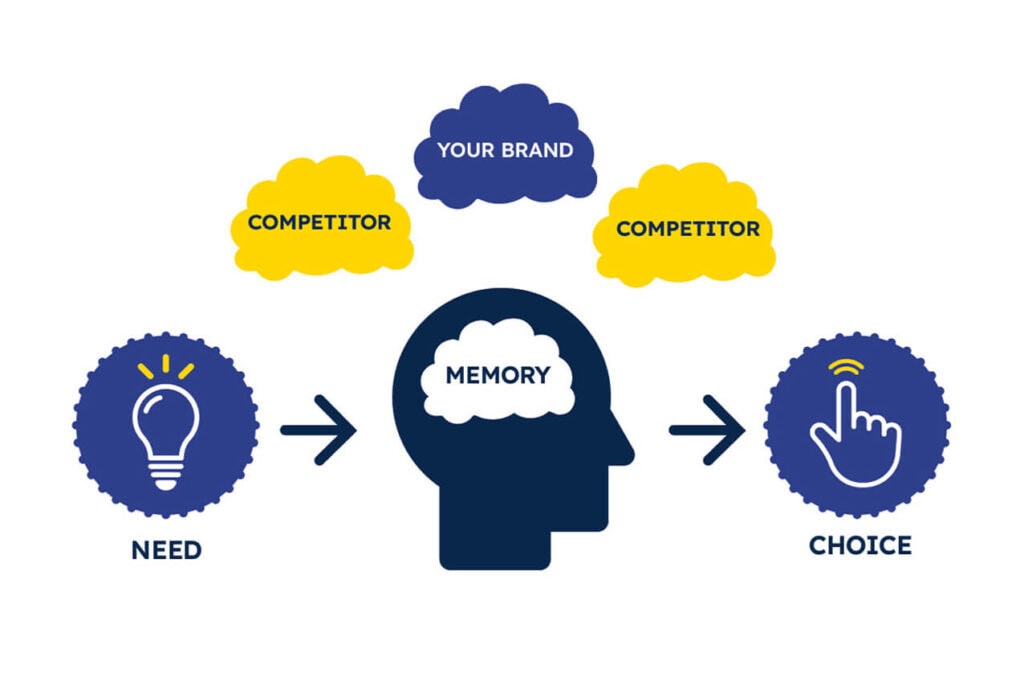
CEPs are the cues, occasions, and needs that trigger buying decisions, and they are becoming just as critical for visibility in Search as they are for consumer recall.
Search is moving beyond ranked lists of links into the world of AI-generated answers. Often referred to as Generative Engine Optimisation (GEO), this shift is about ensuring your brand appears in the responses created by ChatGPT, Gemini, and other AI search tools.
As Andrew Holland, a thought leader in Search and a MarketingWeek columnist, explains: “In GEO, content isn’t just discovered through keywords, it’s retrieved in context. That means marketers need to think differently about what their brand is connected to.” [1]
And that “retrieved in context” idea is exactly where CEPs and Mental Availability come together. To be surfaced at the right moment, whether by consumers or AI engines, a brand must be mentally linked to the CEPs that shape purchase decisions.
What Is Mental Availability and why does it matter more than ever?
The concept of Mental Availability comes from the work of the Ehrenberg-Bass Institute [2] and is defined as the propensity for a brand to be thought of in buying situations. It is about recall at the right moment, not just general awareness. Brands build mental availability by connecting themselves to a wide set of CEPs.
Generative Engine Optimisation (GEO) mirrors the way consumers already make choices. Generative AI systems are designed to understand intent and context. Instead of returning a list of links, they pull together information from multiple sources, and generate a synthesised, often singular, answer.
This matters for marketers because these systems aren’t searching for isolated keywords; they are searching for contextual relevance. And that’s exactly what CEPs represent. The same cues that help consumers recall a brand are also the ones AI engines use when constructing their answers. Strengthening these associations makes a brand more retrievable both in consumer memory and in AI-generated outputs.
GEO Highlights the Value of CEPs
SEO rewards keyword density and backlinks. GEO, by contrast, rewards association strength.
If someone asks, “What’s the best breakfast for kids before school?” or “Which insurer is best for families travelling abroad?”, the brands most likely to appear are those already strongly linked to those buying situations. That makes mapping and prioritising CEPs essential, ensuring that your brand is strongly connected to the cues that consumers (and AI systems) use to make sense of a category.
At SmilingCFO, we help brands identify and prioritise Category Entry Points by running Mental Availability Assessments for clients. Our research across a wide range of categories consistently shows that not all CEPs are equal and there will be some that are used significantly more by buyers when they access the category. In most instances these are the ones that should be prioritised by brand owners, however it is wise to also consider other factors;
i) How competitive are these valuable CEPs?
ii) Is the brand image congruent with these target associations?
iii) Is the CEP currently an area of strength for the brand?
A SmilingCFO case study is provided below.
https://smilingcfo.co.uk/1-category-entry-points/
These insights give marketers clarity on where to focus, ensuring that investments in creative and media not only build human recall but also support visibility in a GEO-driven search environment.
Turning CEP Insights Into Action
Writing in Marketing Week, Andrew Holland introduced us to the concept of “AI Availability; the likelihood of a large language model (AI) recommending a brand in a buying situation.“
This definition closely mirrors what marketers already know as Mental Availability. Both ideas focus on whether a brand is recalled at the critical moment of choice, whether by a human consumer or an AI system.
By combining diagnostic tools with category-level analysis, SmilingCFO helps brands make practical decisions about which CEPs to pursue and how to strengthen the associations that matter most. This means brands can invest with confidence, knowing that their creative and media are aligned to contexts used by consumers and AI search engines.
So, whilst GEO may be new, the principles of brand-building that underpin it are not.
To support marketers, SmilingCFO now offers a free Mental Availability Review: a practical starting point for assessing how well a brand is prepared to benefit from a CEP-orientated strategy.
https://mentalavailability.smilingcfo.co.uk
References
[1] See Andrew’s insights on LinkedIn: Andrew Holland SEO
[2] Byron Sharp, How Brands Grow (2010), Ehrenberg-Bass Institute for Marketing Science. See: Ehrenberg-Bass Institute