Why Mental Availability Should Be on Your Board Agenda
Mental Availability is one of the few marketing metrics that can be hardwired to business metrics. When Mental Market Share grows, Sales Market Share is likely to follow.
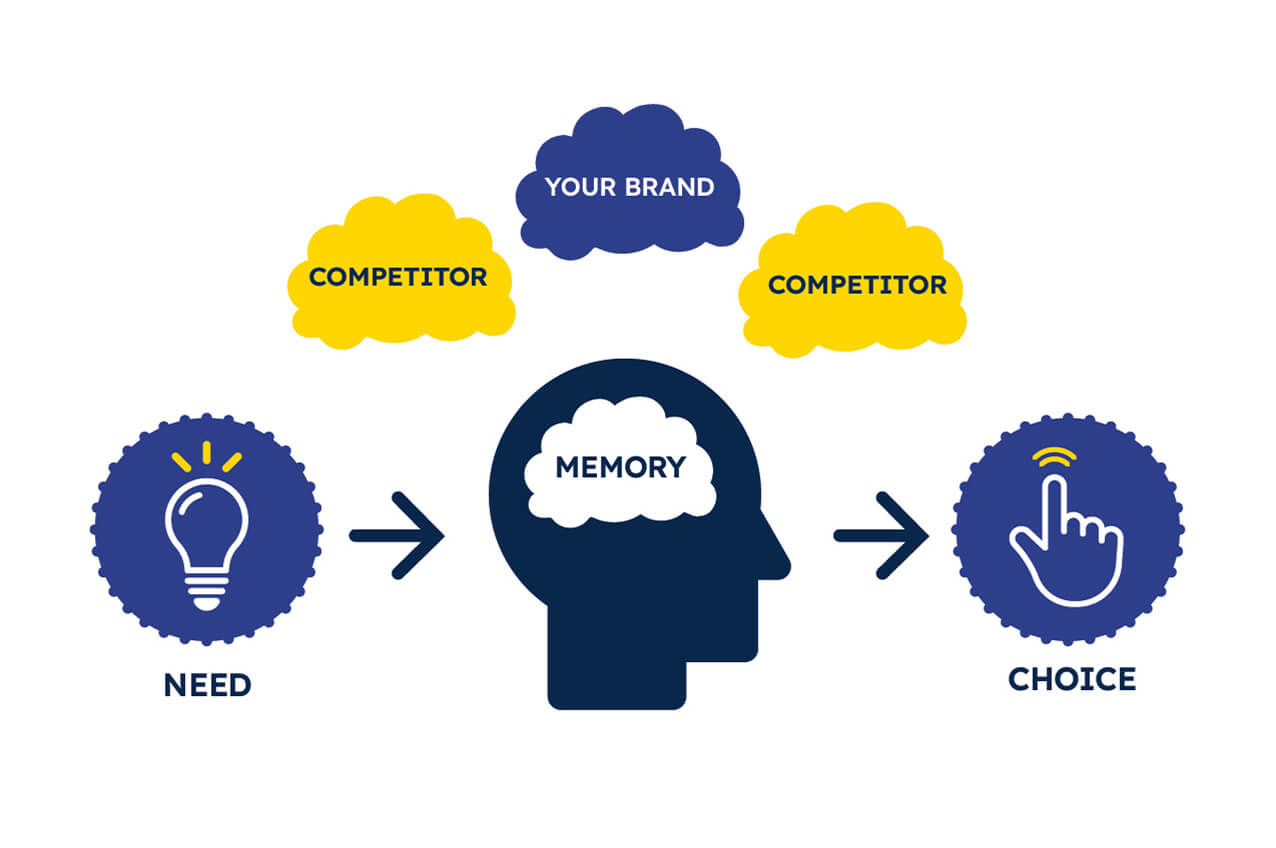
This is because brands grow by coming to mind in multiple buying situations.
This approach owes much to the work of the Ehrenberg-Bass Institute for Marketing Science. Their research has helped shift the focus of brand growth from loyalty and persuasion to the importance of being easy to think of and easy to buy.
As a CMO it is important you know the buying situations when your brand is recalled compared to your competitors. Understanding the value of these buying situations and those where your brand is less likely to be recalled is a critical step in developing a growth plan. The resulting action should be to keep reminding buyers of your category that the brand exists by building associations with multiple high value buying situations.
This strategic guide outlines;
The importance of Category Entry Points (the mental triggers that retrieve brands from memory in buying situations) and Distinctive Brand Assets
How to measure Mental Availability and incorporate it into your existing brand health tracker
How to use the data to secure the right level of marketing investment
How to make your marketing campaigns more effective
What is Mental Availability?
Mental Availability is concerned with a brand’s propensity to be thought of in buying situations now and in the future, ensuring that a brand is readily accessible in the minds of potential buyers at the moment they are making a purchase decision.
In the way that ‘Brand Awareness’ measures whether people know the brand, Mental availability measures whether they think of the brand when entering the category.
This concept of building Mental Availability is a fundamental growth principle introduced to us by Byron Sharp in the seminal marketing book, ‘how brands grow: what marketers don’t know’ and adopted by some of the world’s best brand builders, Diageo, Coca-Cola and McDonalds.
Strong brands are not just recognised, they are easy to think of, in the right moments, by the widest possible group of people who buy the category.
“In most buying situations people want to move quickly and easily from generating a category need to satisfying this need”
Jenni Romaniuk: Better Brand Health 2023
This means Mental Availability is rooted in how memory works. Buyers do not hold brands in their minds as isolated concepts. Brands are connected to occasions, needs, emotions, users, price expectations, and product attributes..
When the relevant situation arises, the mind activates those linked associations. Brands with broader, stronger, and fresher connections are easier to retrieve.
SmilingCFO Tip for Brand Leaders:
Our own research replicates the growth patterns presented by Sharp and the Ehrenberg Bass Institute and as such we advocate that, every brand strategy includes the following Mental Availability objective;
Strengthen the links buyers of the category can make between your brand and multiple buying situations.
Why Mental Availability Matters for Brand and Business Growth
SmilingCFO data consistently shows that Category buyers who can make at least one link to a brand are significantly more likely to have bought the brand than those who cannot.
The probability of purchase continues to increase in line with the number of links a category buyer can make to a brand. For example, in recent research of a sports category in the US, more than 60% of category buyers who could make 6 links or more to the leading brand claimed to have purchased the brand.
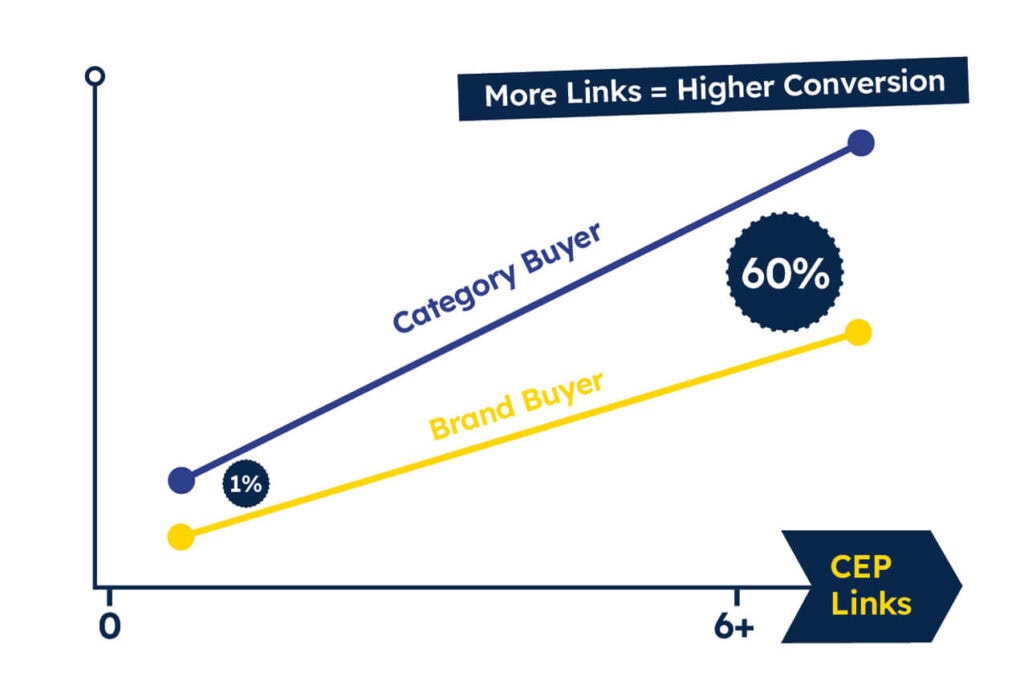
In contrast, for those unable to make any links, less than 1% claimed to have bought the brand. This pattern is repeated across multiple categories in our database and confirms that brands that are mentally available across multiple buying situations are better placed to recruit more buyers. This correlation between the number of CEP links made to the brand and the number of category buyers claiming to have bought the brand is the basis of a compelling growth map. It has the ability to galvanise the business behind a clear objective that can be measured and tracked in a way that all employees and external stakeholders can understand.
Mental Availability: Key Concepts that Underpin Growth
Overview of How Brands Grow
Mental Availability is core to the evidence-based principles associated with the Ehrenberg-Bass Institute. These principles emphasise penetration growth, broad category-buyer reach, and the importance of being easy to think of and easy to buy.
Rather than pursuing differentiation, or persuasion strategies, this view of brand growth places the focus on accessibility in memory and availability in market. Brands grow by recruiting more buyers, especially light and non-buyers, and by increasing the likelihood that those buyers will think of them when they enter the category.
It is important to acknowledge that Mental Availability and Physical/Purchase Availability work together. A brand may be easy to think of, but if it is difficult to find, or access, growth will be constrained. Equally, a brand may be widely distributed, but if buyers do not think of it in buying situations, then conversion opportunities are missed.
For a brand to be easily recalled, it needs to have strong associations with multiple Category Entry Points. These associations are built by establishing a set of distinctive brand assets (e.g. colours, shapes, sounds, slogans) that consistently appear alongside the most important buying situations. Over time, that builds Mental Availability.
Category Entry Points (CEPs): The building blocks of Mental Availability
As briefly referenced earlier, Category Entry Points, or CEPs, are the cues buyers use to retrieve brands from memory.
A CEP might be practical, such as “quick dinner” or “remove a stain fast.” It might be emotional, such as “treat myself after a hard week.” It might be social, such as “something for guests.”
Whatever the specific example it is important to understand that category entry points would exist even if your brand did not, in other words, they are brand-agnostic. This important distinction influences the research methodology when identifying CEPs for a category.
Another key consideration is that not all CEPs are equally important. Some occur more frequently, some influence more revenue, and some offer more realistic growth potential for your brand.
The best place to start is by identifying the buying situations most used by category buyers.
From there, brands can assess how frequently each CEP occurs, how competitive it is, and whether the brand has a credible right to build associations with it.
The result should be a focused list of priority CEPs that can guide messaging, creative briefs, media weighting, retail activation, and innovation.
SmilingCFO Tip for Brand Leaders:
If your team cannot align on the most important buying situations and the most relevant category entry points, then you are not ready to brief your agencies. Remember, our data consistently shows that brands associated with 6+ CEPs have more buyers than brands with fewer associations.
Distinctive Brand Assets: Making Brand Recall Easier
A strong set of Distinctive Brand Assets (DBAs) makes it easier for buyers to retrieve a brand from memory.
If I am a soft drink / soda category buyer I might want ‘a refreshing drink with my lunch’ (a probable CEP). My brain will search for solutions and will try and match a shortlist of options with imagery in the store.
The power of DBAs is brought to life below.
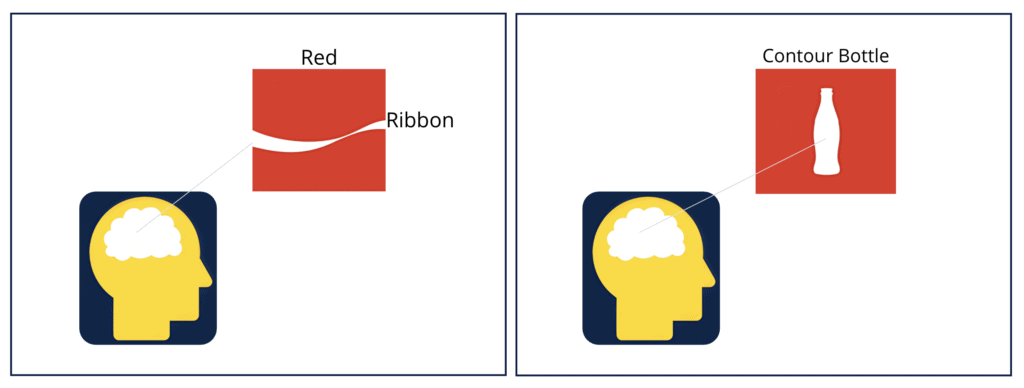
I suspect most people could correctly recall the brand based solely on the image on the left.
For many that might also bring memories of the sound of a coca-cola being poured, which can often be heard playing from vending machines.
So in a matter of moments we have colour, shape and sound combining to not only make it easier to think of Coke but also to find it on shelf and buy it.
Distinctive Brand Assets are built over time, are most effective when tapping into all five human senses and should be applied consistently, ideally in the context of buying situations to strengthen brand associations with key CEPs.
SmilingCFO Tip for Brand Leaders:
Test your distinctive assets without the logo. If category buyers can’t recall the brand, or worse still misattribute the brand then the assets may be too weak to build memory effectively. Move beyond the size of the logo debate and ensure your partners have a brief to build a set of distinctive assets that cover all the senses.
Brand Image: Perception Influences which CEPs to Target
“One of the Ehrenberg-Bass Institute’s major contributions was to flip marketer attention from what the brand evokes (brand image) to what evokes the brand (mental availability). But after brands are noticed or brought to mind there is often some evaluation, some choice between options, and here brand image can play a role.” – Byron Sharp LinkedIn 2025
By running a mental availability assessment you can see how your brand is perceived in the minds of buyers and non-buyers and check if it is in line with, or at odds with the intended Brand Positioning.
The example below shows an extract of the results for Sparkling ICE in the US.
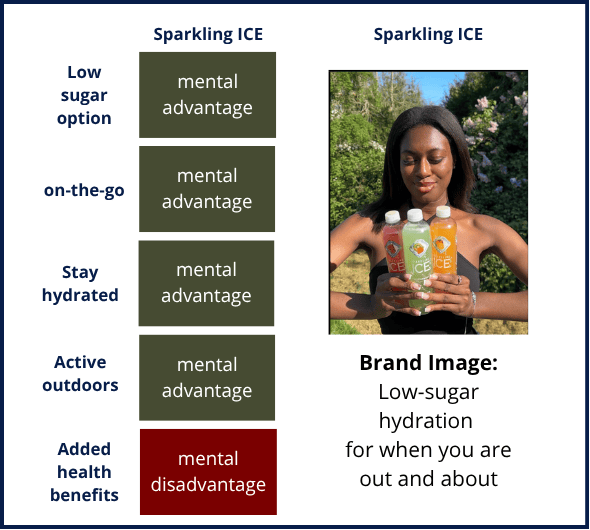
The green boxes highlight the CEPs where the brand holds mental advantage, (i.e. where the level of association is significantly higher than is statistically expected).
By connecting the areas of strength we can see that buyers of the category see the brand as “low-sugar hydration for when you are out and about”. The brand owner will know whether this is how they want customers to think of the brand.
To have four areas of mental advantage is good, so I suspect the brand image is close to the brand positioning. If it is, then great, defend the position. If it isn’t then they will need to review the reasons why. It could be that messaging is being misinterpreted, or distinctive assets are creating confusion or competitors are dominating the CEPs Sparkling ICE are targeting.
How Mental Availability is Measured
Mark Ritson talks passionately about the importance of Market Orientation. A crucial “180-degree turn” to view a brand from a buyers perspective rather than the marketer’s.
With equal passion we would recommend every brand runs a Mental Availability Assessment as part of the market orientation process or annual brand planning process.
This will reveal the most relevant and valuable CEPs for the category and provide a brand’s mental availability scores benchmarked against the competition.
The results will help define the brand’s objectives, highlighting where to defend and where to allocate investment to unlock new growth opportunities.
The brand owner will be armed with an understanding of where their brand holds a mental advantage, enabling an analysis of the brand image category buyers hold compared to the intended brand image, (i.e. the brand’s positioning).
In most instances we are able to identify ‘white spaces’. These are CEPs where no brand holds a mental advantage. This insight could lead to new innovation, packaging development, a new experience or service.
Measurement Frameworks and Research Design
Following qualitative research and a combination of brand agnostic and branded quantitative research we model the data, benchmarking mental availability scores with the competitive set, and ultimately recommending the 6 or more CEPs the brand should target to increase the chance of conversion.
Along the way the high value CEPs, i.e. those used most frequently by category buyers to recall brands from memory, are identified and we highlight which are heavily contested and which present a realistic opportunity for the brand to pursue.
The final output is a set of objectives and metrics that can align an organisation and motivate agencies.
SmilingCFO Tip for Brand Leaders:
Focusing just on buyers of the brand is not enough. We always compare buyer and non/light buyer data because future growth is dependent on building mental availability with those who don’t currently choose the brand.
Core Mental Availability KPIs
Mental Market Share is the primary mental availability metric and tracks the share of all the links that are made between the category entry points and the brands.
When a brand’s Mental Market Share is lower than its Sales Market Share, it may be leaning too heavily on distribution or pricing.
When Mental Market Share exceeds Sales Market Share, it may signal unrealised potential because poor Physical Availability is holding back performance.
There are three diagnostic metrics of MMS to review;
Mental Penetration. This key measure tells you how many Category Buyers can link the brand to at least one Category Entry Point. Remember, there is a significantly higher chance of purchase by those who can make at least one link.
For all small and midsize brands, Mental Penetration is a key metric. As your Mental Penetration score gets higher then increasing focus on Network Size will be important.
Network Size identifies the average number of CEPs that are linked to a brand by a Category Buyer. The higher the average, the more chance the brand is recalled in multiple buying situations.
Share of mind, helps owners of large brands understand how vulnerable they are to competitor incursion. In other words, who is starting to encroach on a brand’s ‘territory’, and what level of ‘cut through’ are they achieving.
Integrating Mental Availability into Brand Tracking
Many brand owners have been tracking metrics like awareness, consideration, and preference for decades. These metrics provide continuity and historical context, but may not fully reflect the advancements in our understanding of how the brain works, what influences behaviour and how brands are recalled in buying situations. The opportunity lies in integrating newer concepts like mental availability into existing tracking so you don’t lose the ability to compare past performance. The key is to ensure the measurement system reflects not just what people think of the brand in general, but whether they think of it in the moments that matter commercially.
If Category Entry Points don’t feature in your tracker, it might be time to consider rebalancing your metrics. This doesn’t mean you need to overhaul your existing tracker and lose your valuable history. You can introduce Mental Availability metrics alongside your existing brand health measurements in a way that complements existing reporting.
We know from Binet & Field’s ‘The Long & The Short of It…’ that brands should balance short-term activation with long-term marketing strategies. This makes Mental Availability tracking especially valuable for brands seeking cumulative growth rather than short bursts of performance.
Mental Availability is built gradually through repeated exposure, consistent cues, and sustained presence in relevant contexts. As a result, it should be tracked over time rather than judged as a one-off campaign outcome.
Improving Mental Availability in Practice
A strong Mental Availability strategy will seek to achieve the following;
- Optimise Prompted Awareness
- Build Mental Penetration
- Widen Network Size.
Prompted Awareness: This is the foundational work that has to be done before diving deeper into Mental Availability. It sounds obvious, but buyers of the category have to be able to associate your brand with the correct category. This means prioritising reach over frequency and ensuring the branding (distinctive brand assets) are clear and consistent.
Mental Penetration: Remember, the objective here is to maximise the number of category buyers who can link a brand to at least one CEP, because the chances of someone buying the brand if they can’t make a link is extremely low.
To establish a healthy Mental Penetration score you need to take the principles of building Prompted Awareness, i.e. Reach over Frequency and combine it with clear messaging around a CEP that has the potential to become a Mental Advantage for the brand.
Network Size: To increase the chance of being recalled in more buying situations a brand needs to be linked to more Category Entry Points.
Often it is the case that smaller brands have smaller Network Sizes because their messaging is too narrow.
Identify 6 Category Entry Points that you want the brand to be associated with over the next 2 to 3 years and liberate your creative team/agency to come up with appropriate ideas and messaging.
Mental Availability Strategies
Plotting a representative set of brands Mental Availability scores informs the core brand objective.
In the example below we see that those brands in yellow need to focus on building Mental Penetration by increasing the pool of buyers who can link the brand to at least one CEP.
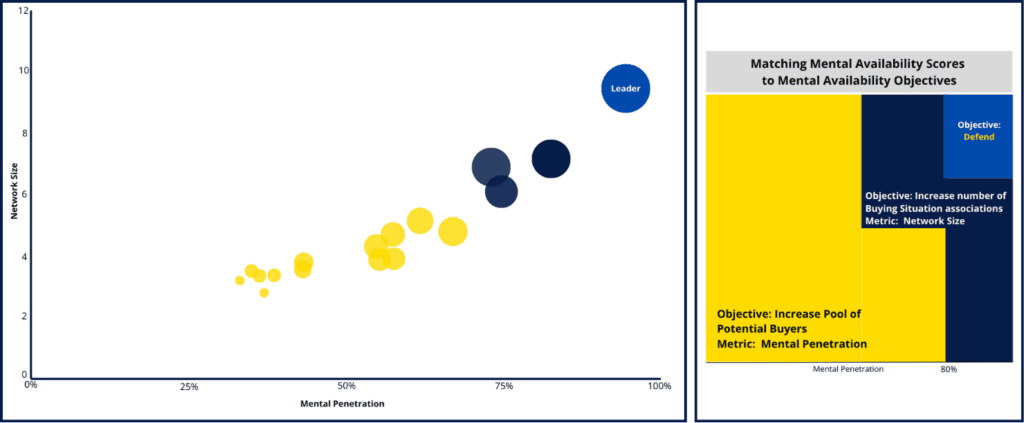
For the brands in dark blue, they are at the point where they need to allocate investment to widen the network of brand associations.
The pale blue brand is the clear market leader and needs to defend its areas of mental advantage.
Once the brand’s current position is understood, the next step is prioritisation.
To reach a robust conclusion both buyer and non-buyer associations should be analysed. Understanding the CEP links made most often by buyers with the most knowledge of the brand can help highlight the retrieval cues that should continue to be repeated and refreshed. Identifying the CEP linkages of non-buyers provides clues as to how they are accessing the brand, and draws attention to potential barriers to purchase.
Creating Effective Marketing Campaigns
Campaigns build Mental Availability when they deliberately connect the brand to valuable category entry points.
This is not about restricting creativity, the intent is to liberate it.
For creative teams, this means using CEPs to guide ideation. Teams should be given open-ended briefs with a clear objective.
For media teams, it means ensuring the brand reaches broad category-buyer audiences while considering when and where context can reinforce retrieval.
For strategy teams, it means identifying where the brand has credible opportunities to grow its mental presence. For example, ensuring the perceived image of the brand in the minds of buyers and non-buyers is not inhibiting the brand coming to mind in those target buying situations.
“…communications should spotlight messages that will be useful to the consumer the next time they are in a buying situation. Messages that relate to how, why, when, or with whom buying or consumption will occur. By better understanding the mental pathways that consumers take when they become a category buyer and linking our brand to those messages (Category Entry Points), we build and reinforce useful associations which increase the Mental Availability of our brand.” Dr Ella Ward & Byron Sharp IPA 10.9.24
These associations are built most effectively by co-presenting your brand in the right context and reaching as many buyers of the category as you can afford. There is a role for targeting, but ensure that these tactics are not at the expense of the overall Mental Availability objective.
Ensuring Consistency Across Touchpoints
Memory is built by exposure and experiences across advertising, packaging, shelf presence, recommendations, sponsorship, usage, promotions.
Memory is a network of nodes. Brands are nodes. Buying situations are nodes. Attributes, emotions, people, prices, occasions, and usage contexts are nodes.
Links form between them through exposure and experience. Every exposure whether that be advertising, packaging, shelf presence, recommendation, price promotion, sponsorship, social media, or usage strengthens or weakens associative links.
The challenge for marketers is to ensure that a brand’s relevance is retained across a fragmented landscape.
Category Entry Points (CEPs) provide the unifying thread. By anchoring customer experience strategies in CEPs, brands can deliver relevance at every step of the journey.
For example, a coffee brand might want to be associated with “morning wake-up”, “on-the-go convenience,” and “afternoon pick-me-up.” Each of these contexts is a CEP.
By identifying the right CEPs for their category, the coffee brand can anchor its customer experience strategy around them. This could mean:
- In-store signage highlighting “grab-and-go energy.”
- A website filter or category labelled “morning essentials.”
- A customer service script that acknowledges “helping you get through a busy day.”
- A social ad targeting commuters with the same message.
The form changes, but the CEP remains constant.
Using Mental Availability data to secure the right level of investment
Clearly there will be times when the business is under pressure to deliver a particular quarter target and needs to adjust investment or push for a burst of additional revenue. Top marketers understand this and are relaxed in the knowledge that they have already aligned their organisation behind long-term objectives, metrics and investment, by showing that there is a clear correlation between Mental Availability growth and Sales Penetration.
In the illustration below ‘MMS’ (Mental Market Share) is the primary Mental Availability Metric used and ‘Purchased’ is a proxy for Sales Penetration or Sales Market Share.
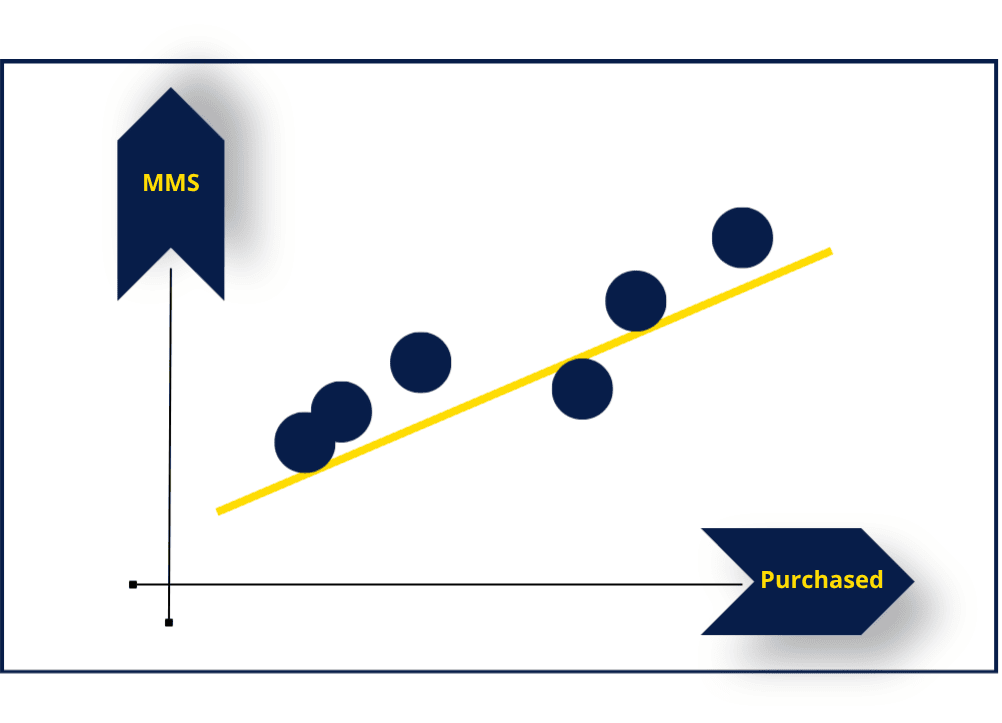
Mental Availability should be viewed as a business-growth metric. It gives finance and leadership a clearer explanation of how marketing spend drives outcomes. As a result, investment decisions can be made and progress tracked without ambiguity.
SmilingCFO Tip for Brand Leaders:
In my experience, the most rewarding part of being a CMO is the positive impact you can have on the whole organisation. Influencing the broader business direction and optimising commercial execution to deliver the profit target and pay bonuses to colleagues is what is most fulfilling. I have not found it possible to achieve this without the support of my CFO.
CFOs respond to clarity on what drives brand growth and how it will be measured. Mental availability provides a bridge between brand building and investment discipline.
Real-World Examples and Applications
To make the power of mental availability tangible this section showcases a series of real examples lifted from our database.
Mental Advantage: When to dig deeper
In the first case, a leading chocolate brand had 97% prompted awareness and ranked #1 Mental Market Share overall. On the surface, the brand looked healthy. But when the data was split by demographic group, an emerging weakness was exposed. Among Gen Z, a key competitor had more Mental Advantages, meaning it was more strongly associated with multiple Category Entry Points (CEPs), making it more likely to be chosen by this group.
Key takeaway: High awareness doesn’t mean you’re top of mind when it matters. Brands must audit which buyer situations they own, especially within future growth segments.
Network Strength: Stack the odds in your favour.
In a coffee category study, none of the top three brands, despite their size, had a single area of Mental Advantage, yet a large global brand, relatively new to this market, had successfully built a Mental Advantage in five areas. This exposed the market leaders’ vulnerability.
It also highlighted the need to track mental availability over time. Doing so would have picked up any declining associations and where the competitor was stealing share of mind.
Key takeaway: Brands grow by building wider, fresher networks. Meaning the more CEPs owned by a brand, the more likely the brand will win.
Mental Reach: Understand your non-buyers
In another case, a leading rice brand showed that whilst it had built strong mental links among current buyers, it had not penetrated the minds of enough non-buyers. By comparing the brand’s share of memory among buyers versus non-buyers across the top ten CEPs, even accounting for category size differences, the number of expected non-buyer links fell short. This created a barrier to future growth.
Key takeaway: Future buyers start as non-buyers. If they’re not able to make multiple links to your brand on relevant occasions, your chances of being purchased are significantly restricted.
Conclusion
Recap of Mental Availability’s Importance
We have run Mental Availability Assessments in a dozen countries, across 30+ categories and the growth patterns hold true for the 600+ brands in our database.
The leading brands have the highest Mental Market Share, the widest network of CEP associations and are more likely to have the multiple areas of Mental Advantage.
Time and time again the research results point to the fact that the battle for brand growth is decided in the context of buying situations, not awareness scores. That is why we will always advocate that Mental Availability guides brand strategy, measurement, media, creative and investment.
Here is a useful checklist for every brand leader as they embed Mental Availability principles across their team and agency partners.
- Understand the retrieval cues, (Category Entry Points), buyers use to access the category your brand participates in.
- Understand if the brand can credibly build associations with the most valuable CEPs.
- Spot CEPs where no brand holds a mental advantage. These ‘white spaces’ are potential opportunities for growth.
- Reach as wide a group of Category Buyers as possible, ‘co-presenting’ the brand’s distinctive assets in the context of the target CEPs.
- Integrate Mental Availability metrics into your brand health tracker and ensure data is captured for light and non-buyers as well as buyers.
- Benchmark your brand scores with competitors to understand the most important brand objective.
- If Mental Penetration is low, then build a plan to increase the number of category buyers who can link the brand to at least one CEP. Remember, when someone can make at least one CEP link there is a greater chance of purchase.
- If Network Size is the identified objective then look to your current buyers who can make 6+ links for insight.
A Final SmilingCFO Tip for Brand Leaders
You cannot control everything that sits in a buyers’ mind, but you can understand it, influence it, and invest more intelligently once you measure it.
Whilst some of the world’s leading brands have adopted the principles of How Brands Grow and are becoming experts at understanding Mental Availability, there are many brands who have not, which presents you with an exciting growth opportunity.
Start your journey by running a Mental Availability Assessment for your category.
Author: Martin Coyle, Partner SmilingCFO.
Martin is a former Chief Marketing Officer and Chief Commercial Officer at global Bevco, Molson Coors.
He is an expert in building Mental and Physical Availability, Portfolio Strategy development and aligning organisations behind brand execution.
Further Reading:
Category Entry Points: The Mental Pathways to Brand Choice